Story and characters realized and written by Cammzy J. Armster
Reference sheets (as seen below) all drawn / illustrated by Cammzy J. Armster
Originally written from February 2025–October 2025–September 2026
A product of Cammzy Armster Studios since 2025
Content warning: may contain risqué and heavy topics—Proceed with caution
©2026 Cammzy Armster Studios. All rights reserved.
—
The Camniverse, an independent, interconnected fictional universe created by Cammzy Armster, originated from his early days on the Dream Fiction Wiki in July 2021 on Fandom, where he began writing Kamland, a fictional country composed of the constituents Camriya, Vurganda, and Kemsiya. It also included numerous pages covering fictional Kamland versions of American television channels, fictional people who contributed to Kamland’s central languages and television output (Komraj Merguj, Jaqqiw Dwankuj, Joak Hugalo), record labels, drinks, and other media. All of this was later scrapped and heavily criticized by Cammzy Armster due to two factors: his self-described "cringe" attempt at worldbuilding and, notably, multiple plot holes and grammatical errors. It was brought back from the grave when Cammzy ventured into original character (OC) art and conlang-related worldbuilding in 2023. The Toyhouse account he created in January 2026 (initially to house the already-established Camniverse) is no longer active, as he wrote this Camniverse document to keep track of his character artwork, bios, and the fictional universe he rewrote for his constructed language called “Kalennian” (starting in August 2026).
Cammzy J. Armster (pronounced CAM-zee Jay ARM-stir, born October 2008) is a Georgia-born independent cartoonist, animator, YouTuber, and electronic musician based in Albany, whose incomprehensible, yet interesting work has been published online since June 2017 as he went through multiple stages of experimenting with mobile animation software, creating a YouTube channel called “blackjackson11” in 2020 where he showcased a variety of content (YouTube Poops, stick figure and logo-related animations, content featuring text-to-speech voices, and recently commentary videos), programming a (fake) one-off PowerPoint operating system coded with Visual Basic called “CamOS” in 2022, and creating music that mixed hip-hop and intelligent dance beats with chaotic, glitchy power electronics elements under the former names of “CAWDJEL” (pronounced “cod-jell”) and “HeavyHertz” starting in 2021 and 2023, respectively, and ending in July 2025 to begin producing music as “Cammzy” on SoundCloud. He has also ventured into character art, as he first started publishing art in December 2023 on DeviantArt and Bluesky in September 2024 to later create the character “Tangy”, who became a staple of his Bluesky account’s initial posts since its launch. As of late 2026, he is currently active on various social media platforms, including (but not limited to) “camrenzza2008” (Reddit), “Cammzy Armster” (all lowercase; on Bluesky), “c4mmzy” (on Discord), “cammzy” (SoundCloud), and “blackjackson11-on-DA” (DeviantArt). He is the most active in the art, conlanging, and graphic design/logo communities. Cammzy has been influenced by a number of artists, musical talent, and online creators in his childhood, including (but not limited to) John Kricfalusi, HISHE, speedoru, hotdiggedydemon, Hyun’s Dojo, Jim Tozzi, David Lynch, Ryan Trecartin, Matt Groening, J.J. Villard, Cary & Michael Huang, Aphex Twin, Skrillex, Chime, Death Grips, Bill Wurtz, Vernon Chatman, Merzbow, Chic Young, Jim Davis, SOPHIE, 100 Gecs, Jane Remover, and many others.
The characters you are about to see in this document all exist in the Camniverse (“Cammzy” + “universe”), which merged both my OCs (all which I’ve drawn since my venture into the art world in 2023) and the story I created for my artificial constructed language, Kalennian (started in 2024 and is creatively related to the broader Camniverse) into a creatively unified world since 2026. This document focuses on both, with great depth in every aspect.
Characters
Cammzy
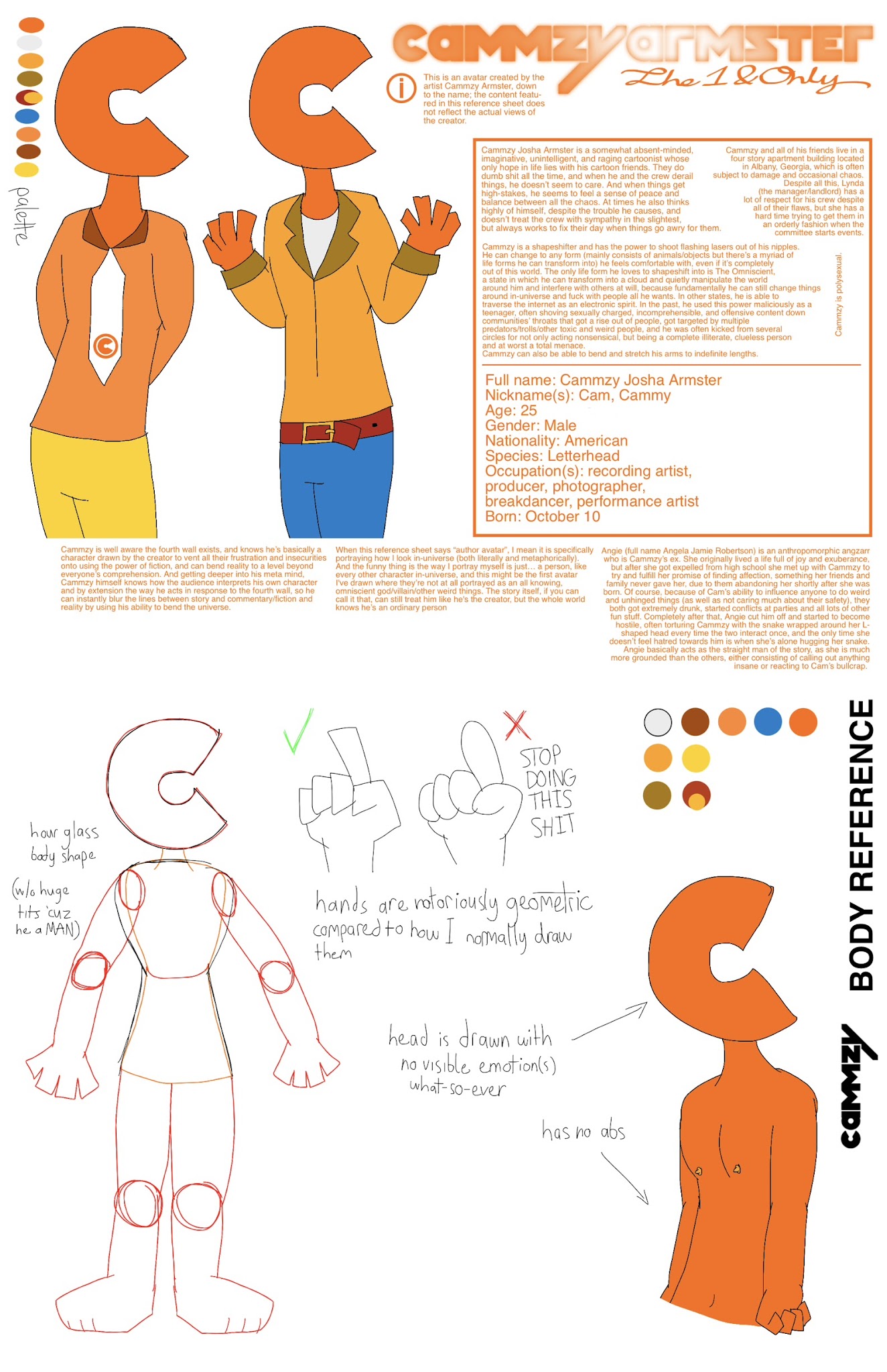
Meta-bio
This character serves as the in-universe, official avatar/persona of the real Cammzy Armster (born 2008), whose traits do not match with the creator. They took their hobbies/interests and fundamentally exaggerated them to fit their avatar, aka how they draw/see themselves. It has been used since 2023.
Bio
Cammzy Josha Armster is a somewhat absent-minded, imaginative, unintelligent, and raging cartoonist whose only hope in life lies with his cartoon friends. They do dumb shit all the time, and when he and the crew derail things, he doesn’t seem to care. And when things get high-stakes, he seems to feel a sense of peace and balance between all the chaos. At times he also thinks highly of himself, despite the trouble he causes, and doesn’t treat the crew with sympathy in the slightest, but always works to fix their day when things go awry for them.
Main info
Full name: Cammzy Josha Armster
Nickname(s): Cam, Cammy
Age: 25
Gender: Male
Nationality: American
Species: Letterhead
Other Occupation(s): recording artist, producer, photographer, animator, breakdancer, performance artist
Born: October 10
Trivia
When the reference sheet above says “author avatar”, I mean it is specifically portraying how I look in-universe (both literally and metaphorically). And the funny thing is the way I portray myself is just… a person, like every other character in-universe, and this might be the first avatar I've drawn where they’re not at all portrayed as an all knowing, omniscient god/villain/other weird things. The story itself, if you can call it that, can still treat him like he's the creator, but the whole world knows he’s an ordinary person
Cammzy is a shapeshifter. He can change to any form (mainly consists of animals/objects but there’s a myriad of life forms he can transform into) he feels comfortable with, even if it’s completely out of this world. The only life form he loves to shapeshift into is The Overseeing Orange Cloud, a state in which he can quietly manipulate the world around him and interfere with others at will, because fundamentally he can still change things around in-universe and mess with people all he wants. In other states, he is able to traverse the internet as an electronic spirit. In the past, he used this power maliciously as a teenager, often shoving sexually charged, incomprehensible, and offensive content down communities’ throats that got a rise out of people, got targeted by multiple predators/trolls/other toxic and weird people, and he was often kicked from several circles for not only acting nonsensical, but being a complete illiterate, clueless person and at worst a total menace. Cammzy can also be able to bend and stretch his arms to indefinite lengths, and can also have the power to shoot flashing lasers out of his nipples.
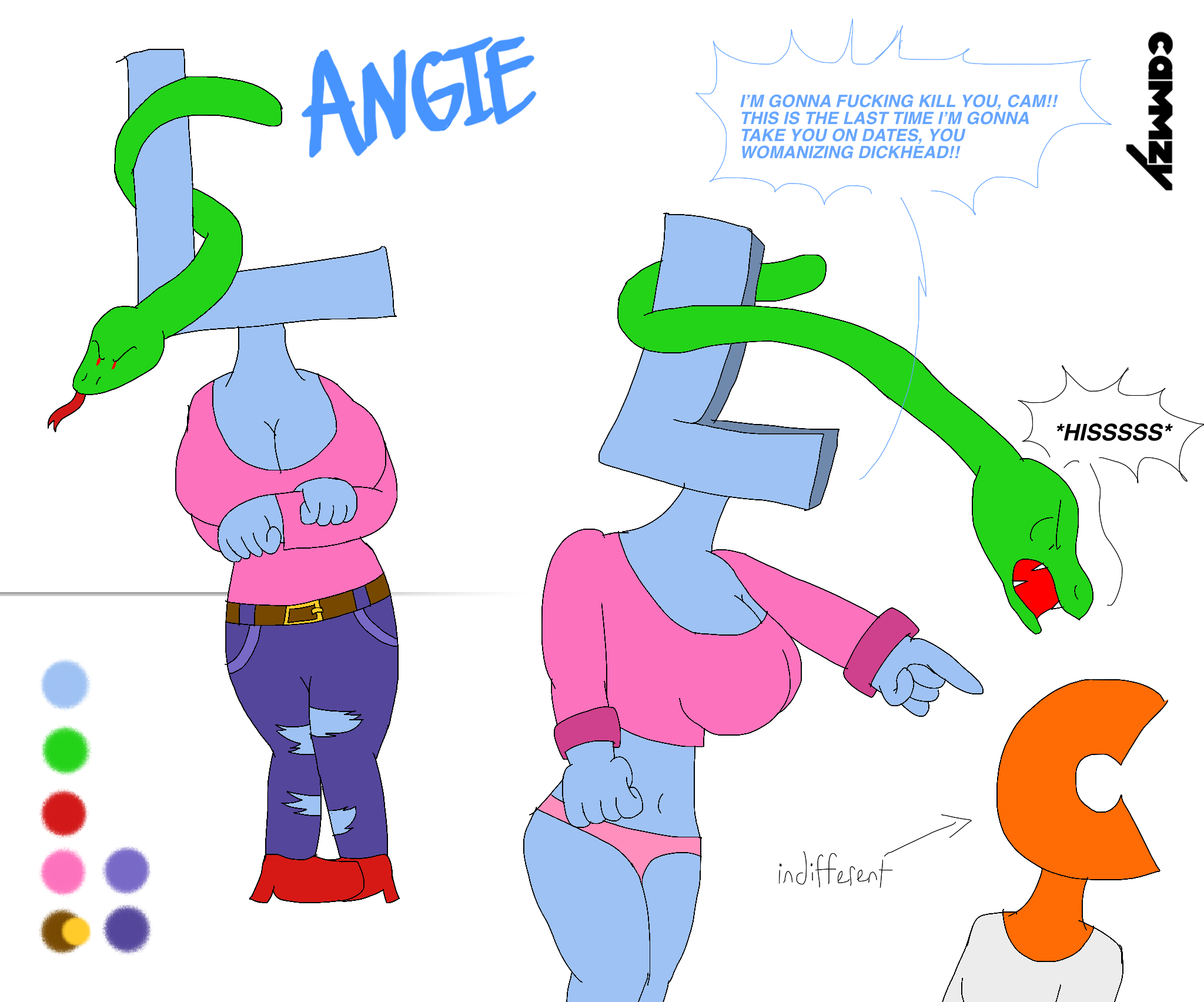
Angie (full name Angela Jamie Robertson) is an anthropomorphic angzarr who is Cammzy’s ex. She originally lived a life full of joy and exuberance, but after she got expelled from high school she met up with Cammzy to try and fulfill her promise of finding affection, something her friends and family never gave her, due to them abandoning her shortly after she was born. Of course, because of Cam’s ability to influence anyone to do weird and unhinged things (as well as not caring much about their safety), they both got extremely drunk, started conflicts at parties and all lots of other fun stuff. Completely after that, Angie cut him off and started to become hostile, often torturing Cammzy with the snake wrapped around her L-shaped head every time the two interact once, and the only time she doesn’t feel hatred towards him is when she’s alone hugging her snake. Angie basically acts as the straight man of the story, as she is much more grounded than the others, either consisting of calling out anything insane or reacting to Cam’s bullcrap. Angie’s design/concept is based off of the angzarr symbol, which is an obscure typographical symbol with an unconfirmed meaning.
Cammzy and all of his friends live in a four story apartment building located in Albany, Georgia, which is often subject to damage and occasional chaos. Despite all this, Lynda (the manager/landlord) has a lot of respect for his crew despite all of their flaws, but she has a hard time trying to get them in an orderly fashion when the committee starts events.
Cammzy is well aware the fourth wall exists, and knows he’s basically a character drawn by the creator to vent all their frustration and insecurities onto using the power of fiction, and can bend reality to a level beyond everyone’s comprehension. And getting deeper into his meta mind, Cammzy himself knows how the audience interprets his own character and by extension the way he acts in response to the fourth wall, so he can instantly blur the lines between story and commentary/fiction and reality by using his ability to bend the universe.
Cammzy is polysexual.
Cammzy’s friends include:
- Hanna
- Lucy B.
- Japoney
- Nebula
- Endemol
- Nelvana
- Tangy
- Hank
- Damien
- Soleil
- Rufus
- Lynda
- Kadlish
- Damien
- Mike
- Cándida
- Roxxie
- Nebula
Nebula
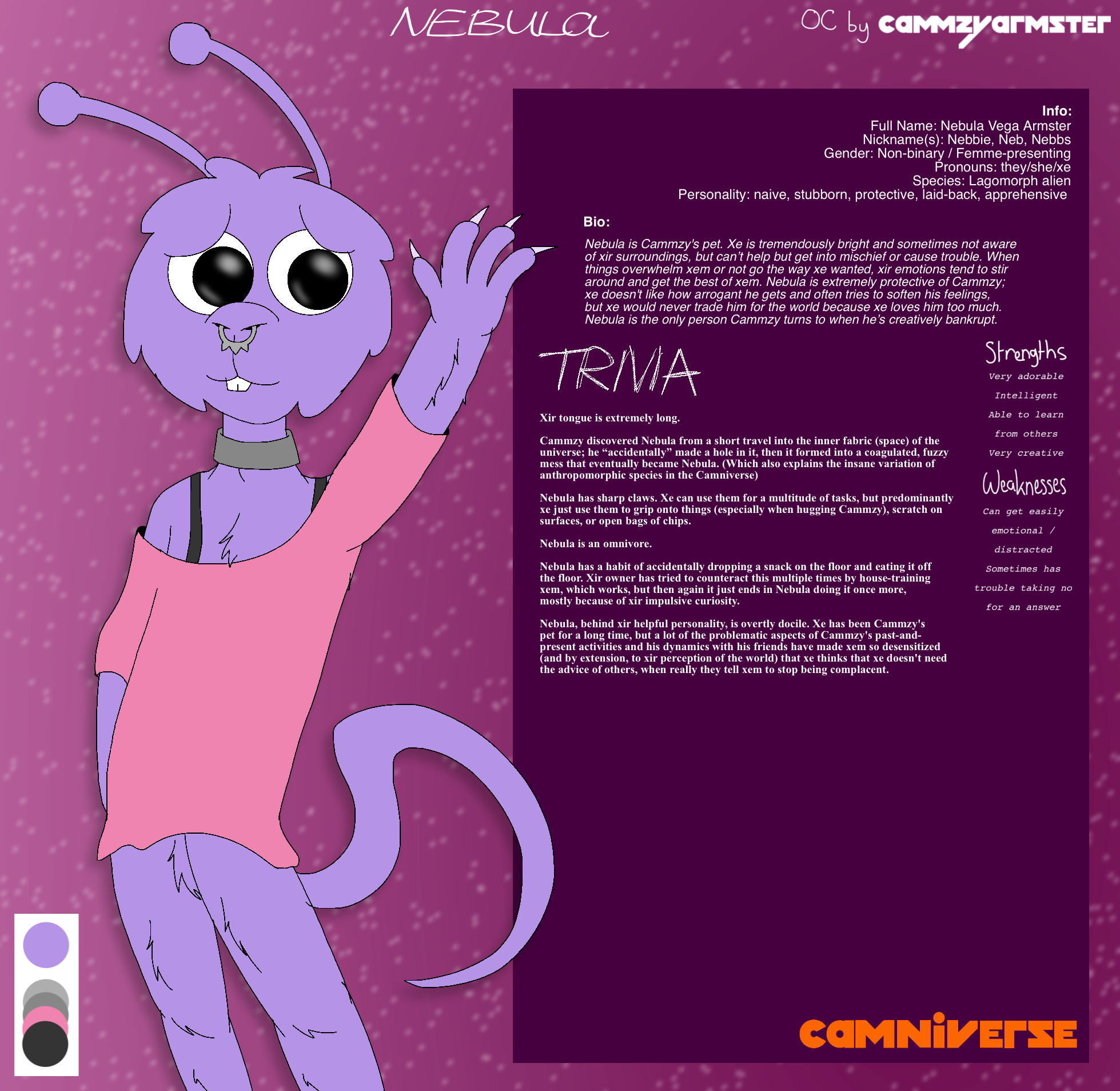
Info:
Full Name: Nebula Vega Armster
Nickname(s): Nebbie, Neb, Nebbs
Gender: Non-binary / Femme-presenting
Pronouns: they/she/xe
Species: Lagomorph alien
Personality: naive, stubborn, protective, laid-back, apprehensive
Note: This bio exclusively refers to Nebula with the neopronouns xe, xem, and xir, for consistency. Click here to learn more about neopronouns and their uses.
Nebula is Cammzy's (anthropomorphic) pet. Xe is tremendously bright and sometimes not aware of xir surroundings, but can’t help but get into mischief or cause trouble. When things overwhelm xem or not go the way xe wanted, xir emotions tend to stir around and get the best of xem. Nebula is extremely protective of Cammzy; xe doesn't like how arrogant he gets and often tries to soften his feelings, but xe would never trade him for the world because xe loves him too much. Nebula is the only person Cammzy turns to when he’s creatively bankrupt.
Strengths:
Very adorable
Intelligent
Able to learn from others
Very creative
Weaknesses:
Can get easily emotional / distracted
Sometimes has trouble taking no for an answer
Trivia:
Xir tongue is extremely long.
Cammzy discovered Nebula from a short travel into the inner fabric (space) of the universe; he “accidentally” made a hole in it, then it formed into a coagulated, fuzzy mess that eventually became Nebula. (Which also explains the insane variation of anthropomorphic species in the Camniverse)
Nebula has sharp claws. Xe can use them for a multitude of tasks, but predominantly xe just use them to grip onto things (especially when hugging Cammzy), scratch on surfaces, or open bags of chips.
Nebula is an omnivore.
Nebula has a habit of accidentally dropping a snack on the floor and eating it off the floor. Xir owner has tried to counteract this multiple times by house-training xem, which works, but then again it just ends in Nebula doing it once more, mostly because of xir impulsive curiosity.
Nebula, behind xir helpful personality, is overtly docile. Xe has been Cammzy's pet for a long time, but a lot of the problematic aspects of Cammzy's past-and-present activities and his dynamics with his friends have made xem so desensitized (and by extension, to xir perception of the world) that xe thinks that xe doesn't need the advice of others, when really they tell xem to stop being complacent.
Lucy
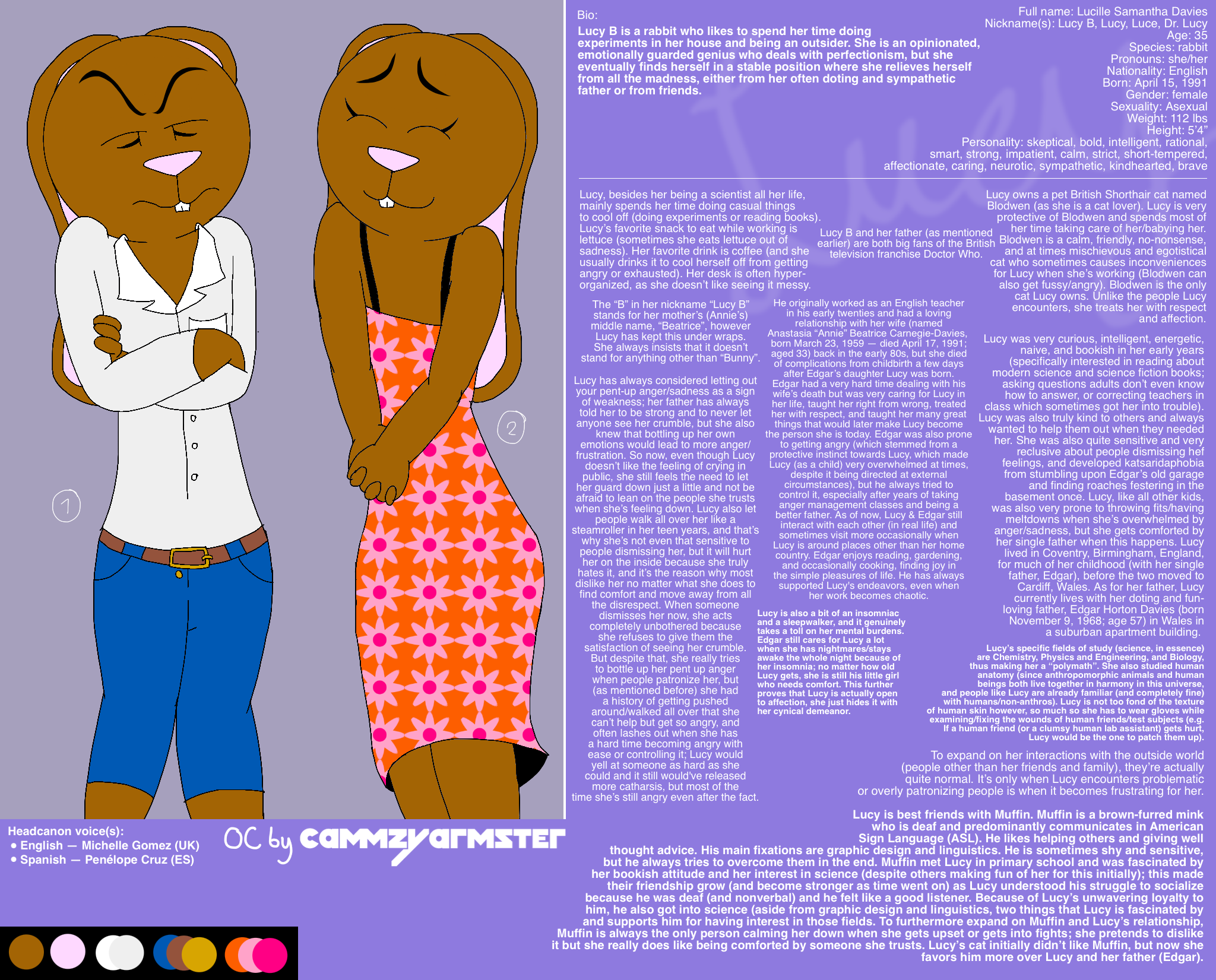
Full name: Lucille Samantha Beatrice Davies
Nickname(s): Lucy B, Lucy, Luce, Dr. Lucy
Age: 35
Species: rabbit
Pronouns: she/her
Nationality: English
Born: April 15, 1991
Gender: female
Sexuality: Asexual
Weight: 112 lbs
Height: 5’4”
Personality: skeptical, bold, intelligent, rational, smart, strong, impatient, calm, strict, short-tempered, affectionate, caring, neurotic, sympathetic, kindhearted, brave
Appearance: Lucy is portrayed as a very tall rabbit with predominantly brown fur whose ears drop down behind her head (lop-eared), and has thick eyebrows. She wears a gray collar-up lab coat and pants. Sometimes, in non-professional settings, she wears a flower-patterned purple dress or a white T-shirt. She also has a flat chest and a slender build.
Bio:
Lucy B is a rabbit who likes to spend her time doing experiments in her house and being an outsider. She is an opinionated, emotionally guarded genius who deals with perfectionism, but she eventually finds herself in a stable position where she relieves herself from all the madness, either from her often doting and sympathetic father or from friends.
Trivia
- Lucy, besides her being a scientist all her life, mainly spends her time doing casual things to cool off (doing experiments or reading books). Lucy’s favorite snack to eat while working is lettuce (sometimes she eats lettuce out of sadness). Her favorite drink is coffee (and she usually drinks it to cool herself off from getting angry or exhausted). Her desk is often hyper-organized, as she doesn’t like seeing it messy.
- Lucy owns a pet British Shorthair cat named Blodwen (as she is a cat lover). Lucy is very protective of Blodwen and spends most of her time taking care of her/babying her. Blodwen is a calm, friendly, no-nonsense, and at times mischievous and egotistical cat who sometimes causes inconveniences for Lucy when she’s working (Blodwen can also get fussy/angry). Blodwen is the only cat Lucy owns. Unlike the people Lucy encounters, she treats her with respect and affection.
- Lucy was very curious, intelligent, energetic, naive, and bookish in her early years (specifically interested in reading about modern science and science fiction books; asking questions adults don’t even know how to answer, or correcting teachers in class which sometimes got her into trouble). Lucy was also truly kind to others and always wanted to help them out when they needed her. She was also quite sensitive and very reclusive about people dismissing her feelings, and developed katsaridaphobia from stumbling upon Edgar’s old garage and finding roaches festering in the basement once. Lucy, like all other kids, was also very prone to throwing fits/having meltdowns when she’s overwhelmed by anger/sadness, but she gets comforted by her single father when this happens. Lucy lived in Coventry, Birmingham, England, for much of her childhood (with her single father, Edgar), before the two moved to Cardiff, Wales. As for her father, Lucy currently lives with her doting and fun-loving father, Edgar Horton Davies (born November 9, 1968; age 57) in Cardiff, Wales (as mentioned earlier) in a suburban apartment building. He originally worked as an English teacher in his early twenties and had a loving relationship with her wife (named Anastasia “Annie” Beatrice Carnegie-Davies, born March 23, 1959 — died April 17, 1991; aged 33) back in the early 80s, but she died of complications from childbirth a few days after Edgar’s daughter Lucy was born. Edgar had a very hard time dealing with his wife’s death but was very caring for Lucy in her life, taught her right from wrong, treated her with respect, and taught her many great things that would later make Lucy become the person she is today. Edgar was also prone to getting angry (which stemmed from a protective instinct towards Lucy, which made Lucy (as a child) very overwhelmed at times, despite it being directed at external circumstances), but he always tried to control it, especially after years of taking anger management classes and being a better father. As of now, Lucy & Edgar still interact with each other (in real life) and sometimes visit more occasionally when Lucy is around places other than her home country. Edgar enjoys reading, gardening, and occasionally cooking, finding joy in the simple pleasures of life. He has always supported Lucy's endeavors, even when her work becomes chaotic.
- The “B” in her nickname “Lucy B” stands for her maiden name “Beatrice”, which is also her mother’s (Annie’s) middle name, “Beatrice”, however Lucy has kept this under wraps. She always insists that it doesn’t stand for anything other than “Bunny”.
- Lucy B and her father (as mentioned earlier) are both big fans of the British television franchise Doctor Who.
- Lucy constantly expresses disdain for others boasting about their own accomplishments/skills without any regard for their peers; she also doesn’t tolerate compliments from others, either incredibly genuine or backhanded, despite her appreciating those who give her admiration deep down.
- Lucy has always considered letting out your pent-up anger/sadness as a sign of weakness; her father has always told her to be strong and to never let anyone see her crumble, but also that bottling up her own emotions would lead to more anger/frustration. So now, even though Lucy doesn’t like the feeling of crying in public, she still feels the need to let her guard down just a little and not be afraid to lean on the people she trusts when she’s feeling down. Lucy also let people walk all over her like a steamroller in her teen years, and that’s why she’s not even that sensitive to people dismissing her, but it will hurt her on the inside because she truly hates it, and it’s the reason why most dislike her no matter what she does to find comfort and move away from all the disrespect. When someone dismisses her now, she acts completely unbothered because she refuses to give them the satisfaction of seeing her crumble. But despite that, she really tries to bottle up her pent up anger when people patronize her, but (as mentioned before) she had a history of getting pushed around/walked all over that she can’t help but get so angry, and often lashes out when she has a hard time becoming angry with ease or controlling it; Lucy would yell at someone as hard as she could and it still would've released more catharsis, but most of the time she’s still angry even after the fact.
- Lucy is also a bit of an insomniac and a sleepwalker, and it genuinely takes a toll on her mental burdens. Edgar still cares for Lucy a lot when she has nightmares/stays awake the whole night because of her insomnia; no matter how old Lucy gets, she is still his little girl who needs comfort. This further proves that Lucy is actually open to affection, she just hides it with her cynical demeanor.
- Lucy’s specific fields of study (science, in essence) are Chemistry, Physics and Engineering, and Biology, thus making her a “polymath”. She also studied human anatomy (since anthropomorphic animals and human beings both live together in harmony in this universe, and people like Lucy are already familiar (and completely fine) with humans/non-anthros). Lucy is not too fond of the texture of human skin however, so much so she has to wear gloves while examining/fixing the wounds of human friends/test subjects (e.g. If a human friend (or a clumsy human lab assistant) gets hurt, Lucy would be the one to patch them up).
- Lucy is best friends with Muffin. Muffin is a brown-furred mink who is deaf and predominantly communicates in American Sign Language (ASL). He likes helping others and giving well thought advice. His main fixations are graphic design and linguistics. He is sometimes shy and sensitive, but he always tries to overcome them in the end. Muffin met Lucy in primary school and was fascinated by her bookish attitude and her interest in science (despite others making fun of her for this initially); this made their friendship grow (and become stronger as time went on) as Lucy understood his struggle to socialize because he was deaf (and nonverbal) and he felt like a good listener. Because of Lucy’s unwavering loyalty to him, he also got into science (aside from graphic design and linguistics, two things that Lucy is fascinated by and supports him for having interest in those fields. To furthermore expand on Muffin and Lucy’s relationship, Muffin is always the only person calming her down when she gets upset or gets into fights; she pretends to dislike it but she really does like being comforted by someone she trusts. Lucy’s cat initially didn’t like Muffin, but now she favors him more over Lucy and her father (Edgar).
- To expand on her interactions with the outside world (people other than her friends and family), they’re actually quite normal. It’s only when Lucy encounters problematic or overly patronizing people is when it becomes frustrating for her.
Additional info about Edgar
Full name: Edgar Horton Davies
(Preferred) Nickname(s): Eddie, Edd
Age: 57
Gender: male
Species: rabbit
Nationality: English
Pronouns: he/him
Born: November 9, 1968
Height: 5’1”
Weight: 93 lbs
Spouse: Annie Carnegie-Davies (m. 1979–1991)
Father of: Lucia “Lucy B” Samantha Davies
Sexuality: Heterosexual
Personality: doting, caring, fun-loving, supportive, compassionate, thoughtful, funny, kindhearted
Appearance: Edgar is a brown-furred rabbit whose ears drop down to his shoulders (lop-eared). He usually wears a long-sleeved dark red sweater and light blue jeans.
Bio:
Edgar is the fun-loving, doting, and passionate father of Lucy B. He began his career as an English teacher. His loving wife, Annie, tragically died of complications a few days after Lucy's birth. Edgar enjoys reading, gardening, and occasionally cooking. He also still enjoys reading books relating to etymology/science and comic books, like Lucy did in the past.
Trivia:
- As mentioned, prior, Edgar spent a majority of his adult life with Annie (his now-deceased wife) as early as 1979. Edgar originally worked as an English teacher in his early twenties and had a loving relationship with her, but she died of complications from childbirth a few days after Edgar’s daughter Lucy was born. Edgar was also prone to getting angry, which stemmed from a protective instinct towards Lucy, which made Lucy (as a child) very overwhelmed at times, despite it being directed at external circumstances, but he always tried to control it, especially after years of taking anger management classes and being a better father.
- Since Lucy’s birthday is so closely tied to the anniversary of Annie's passing, him and Lucy (sometimes along with her friend Muffin) will sometimes go to the local graveyard to go look at her mother’s gravestone (which has roses on it). Edgar also has his own separate way of grieving, as sometimes he will spend time looking at some of the pictures of him and his wife.
- Edgar has hemophobia and gets woozy at the sight of blood. He almost fainted when he saw Lucy cut her knee when she was 9 once.
Lucy’s cat prefers Edgar because he brings better treats (like tuna). He also jokingly talks to Blodwen like a human student.
Aside from spending time with Lucy (as a laid-back father), he spends time reading books, gardening, and occasionally cooking, but also enjoys reading comics. He pretended to dislike/act disapprovingly of Dennis the Menace & Gnasher (a comic series from Lucy’s home country, the UK) but Lucy (as a child) would catch him actually laughing at them and enjoying them.
Muffin
Bio:
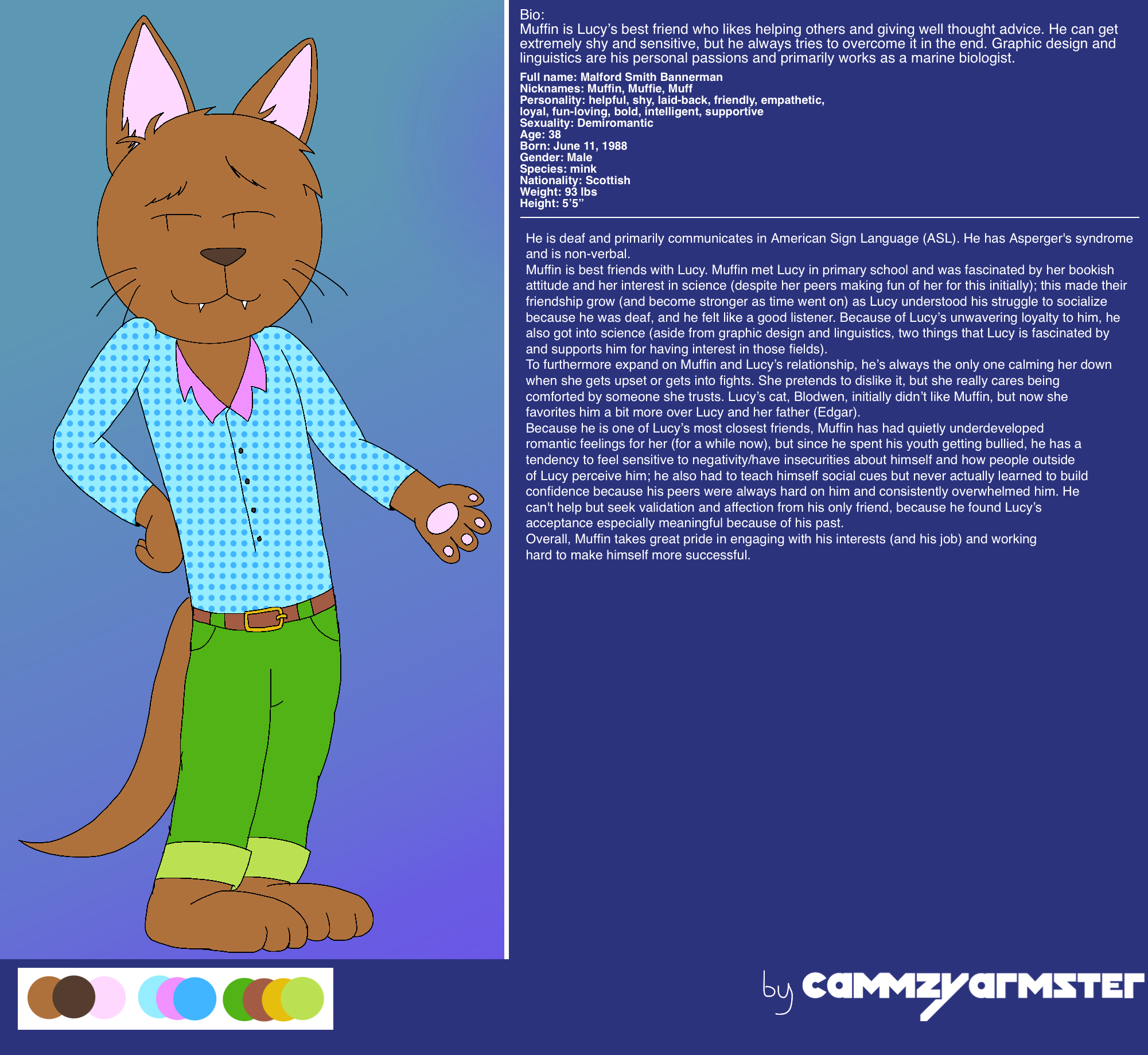
Muffin is Lucy’s best friend who likes helping others and giving well thought advice. He can get extremely shy and sensitive, but he always tries to overcome it in the end.
Graphic design and linguistics are his personal passions and primarily works as a marine biologist.
Full name: Malford Smith Bannerman
Nicknames: Muffin, Muffie, Muff
Personality: helpful, shy, laid-back, friendly, empathetic, loyal, fun-loving, bold, intelligent, supportive
Sexuality: Demiromantic
Age: 38
Born: June 11, 1988
Gender: Male
Species: mink
Nationality: Scottish
Weight: 93 lbs
Height: 5’5”
Trivia:
- He is deaf and primarily communicates in American Sign Language (ASL). He has Asperger's syndrome and is non-verbal.
- Muffin is best friends with Lucy. Muffin met Lucy in primary school and was fascinated by her bookish attitude and her interest in science (despite her peers making fun of her for this initially); this made their friendship grow (and become stronger as time went on) as Lucy understood his struggle to socialize because he was deaf, and he felt like a good listener. Because of Lucy’s unwavering loyalty to him, he also got into science (aside from graphic design and linguistics, two things that Lucy is fascinated by and supports him for having interest in those fields).
- To furthermore expand on Muffin and Lucy’s relationship, he’s always the only one calming her down when she gets upset or gets into fights. She pretends to dislike it but she really does like being comforted by someone she trusts. Lucy’s cat, Blodwen, initially didn’t like Muffin, but now she favorites him a bit more over Lucy and her father (Edgar).
- Because he is one of Lucy’s most closest friends, Muffin has had quietly underdeveloped romantic feelings for her (for a while now), but since he spent his youth getting bullied, he has a tendency to feel sensitive to negativity/have insecurities about himself and how people outside of Lucy perceive him; he also had to teach himself social cues but never actually learned to build confidence because his peers were always hard on him and consistently overwhelmed him. He can't help but seek validation and affection from his only friend, because he found Lucy’s acceptance especially meaningful because of his past.
- Overall, Muffin takes great pride in engaging with his interests (and his job) and working hard to make himself more successful.
Dusty
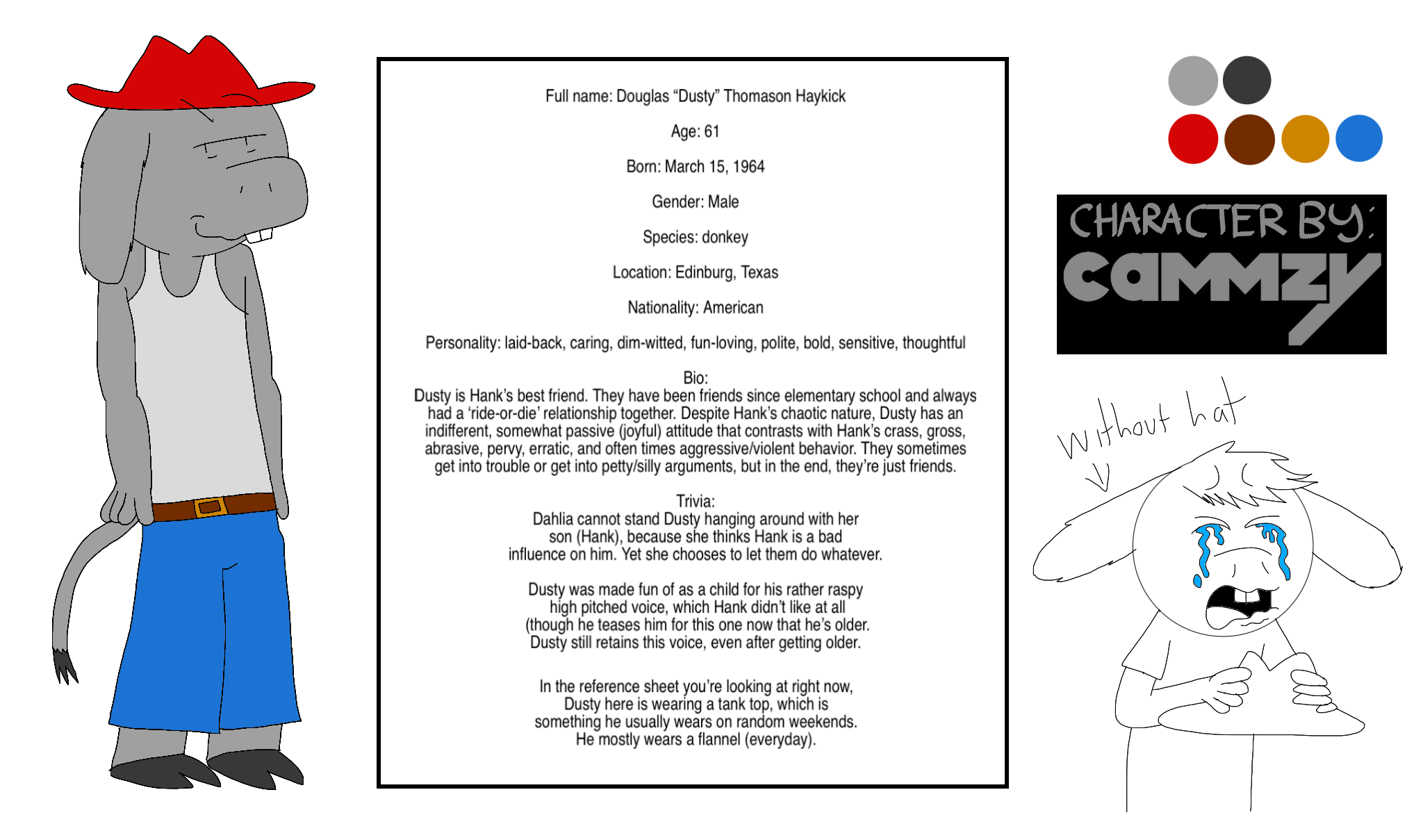
Full name: Douglas Thomason “Dusty” Haykick
Nickname(s): Dougie, Dusty, Doug
Age: 61
Born: March 15, 1964
Gender: Male
Species: donkey
Location: Edinburg, Texas
Nationality: American
Weight: 36 lbs
Height: 4’8”
Personality: laid-back, caring, dim-witted, fun-loving, polite, bold, sensitive, thoughtful
Bio:
Dusty is Hank’s best friend. They have been friends since elementary school and always had a ‘ride-or-die’ relationship together. Despite Hank’s chaotic nature, Dusty has an indifferent, somewhat passive and cheery attitude that contrasts with Hank’s crass, gross, abrasive, pervy, erratic, and oftentimes aggressive behavior. They sometimes get into trouble or get into petty/silly arguments, but in the end they’re just friends.
Trivia:
- Dahlia cannot stand Dusty hanging around with her son (Hank), because she thinks Hank is a bad influence on him. Yet she chooses to let them do whatever. Furthermore, Dahlia often treats Dusty like a child because of Hank's tendencies to influence his bad behavior onto him, so it makes sense she favorites Dusty over Hank.
- Dusty was made fun of as a child for his rather high-pitched voice (which became a bit raspy with age), which Hank didn’t like at all (though he teases him for this one now that he’s older). Dusty still retains this voice, even after getting older.
- Dusty is of French descent, as he has French grandparents.
- Dusty has a gambling addiction.
Hank
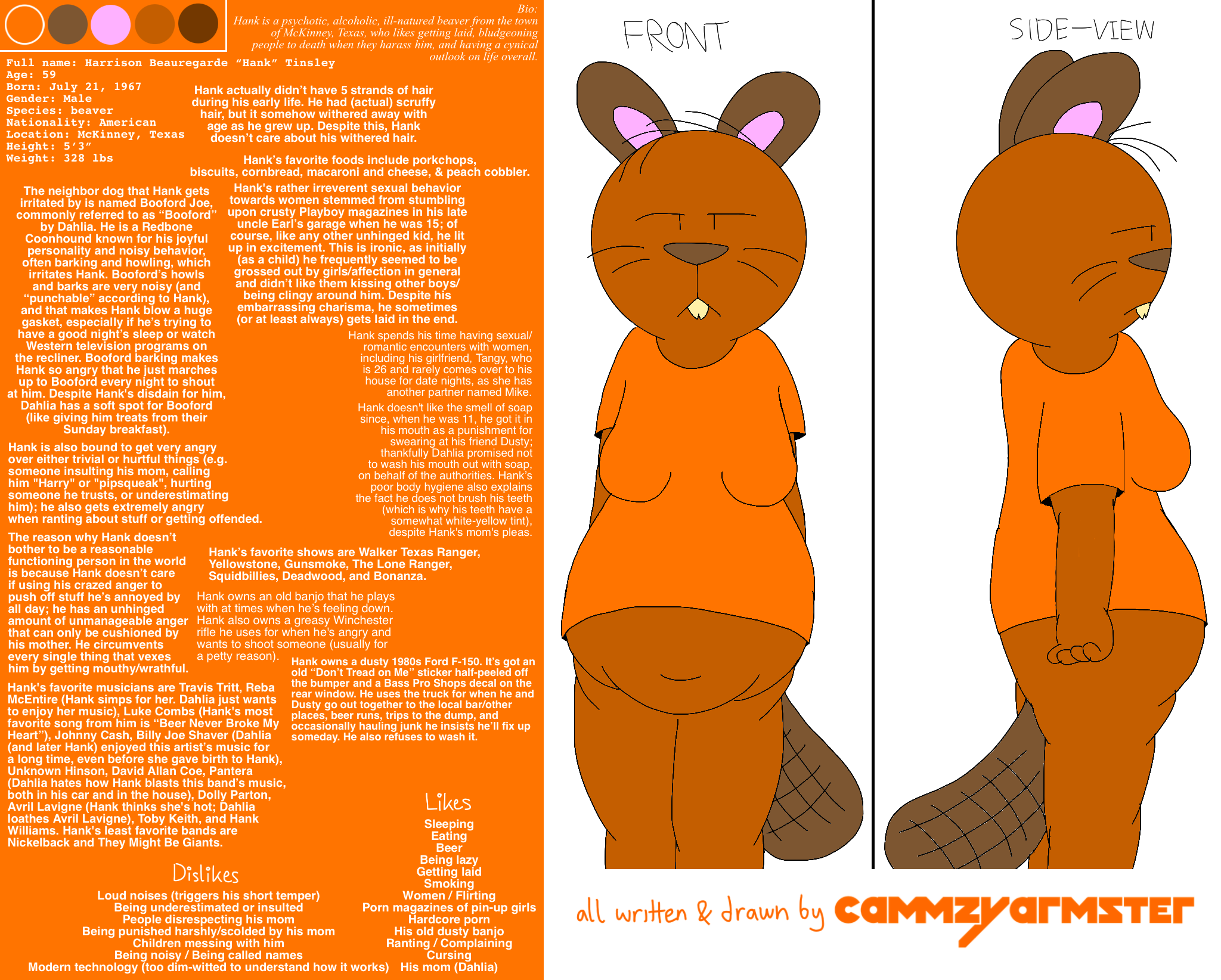
Full name: Harrison Beauregarde “Hank” Tinsley
Age: 59
Born: July 21, 1967
Gender: Male
Species: beaver
Nationality: American
Location: McKinney, Texas
Height: 5’3”
Weight: 328 lbs
Personality: grouchy, laid-back, lazy, dim-witted, lecherous, abrasive, aggressive, short-tempered, kind, loyal, short-tempered, overconfident
Likes: Sleeping, eating, Beer, Being lazy, Getting laid, Smoking, Women / Flirting, Porn magazines of pin-up girls / Hardcore porn, His old dusty banjo, Ranting / Complaining, Cursing, His mom (Dahlia)
Dislikes: Loud noises (triggers his short temper), Being underestimated or insulted, People disrespecting Dahlia, Being punished harshly/scolded by his mom, Sunday rules interfering with his beer time, Children messing with him / Being noisy / Being called names, Modern technology (he’s not aware he’s too dim-witted to understand how it works)
Bio:
Hank is a psychotic, alcoholic, ill-natured beaver from the town of McKinney, Texas, who likes getting laid, bludgeoning people to death when they harass him, and having a cynical outlook on life overall.
Trivia
- Hank’s favorite foods include porkchops, biscuits, cornbread, macaroni and cheese, & peach cobbler.
- The neighbor dog that Hank gets irritated by is named Booford Joe, commonly referred to as “Booford” by Dahlia. He is a Redbone Coonhound known for his joyful personality and noisy behavior, often barking and howling, which irritates Hank. Booford’s howls and barks are very noisy (and “punchable” according to Hank), and that makes Hank blow a huge gasket, especially if he’s trying to have a good night’s sleep or watch Western television programs on the recliner. They make Hank so angry that it usually ends in him marching up to Booford every night to shout at him. Despite Hank's disdain for him, Dahlia has a soft spot for Booford (like giving him treats from their Sunday breakfast).
- Hank's rather irreverent sexual behavior towards women stemmed from stumbling upon crusty Playboy magazines in his late uncle Earl’s garage when he was 13; of course, like any other unhinged kid, he lit up in (rather sexual) excitement. This is ironic, as initially (as a child) he frequently seemed to be grossed out by girls/affection in general and didn’t like them kissing other boys/being clingy around him. Despite his embarrassing charisma, he sometimes (or at least always) gets laid in the end.
- Hank’s favorite shows are Walker Texas Ranger, Yellowstone, Gunsmoke, The Lone Ranger, Squidbillies, Deadwood, and Bonanza.
- Hank spends his time having sexual/romantic encounters with women, including his girlfriend, Tangy, who is 26 and rarely comes over to his house for date nights, as she has another partner named Mike. Behind Hank's chaotic behavior, his relationship with Tangy grew to be more helpful in calming him down, and Tangy often letting him know the world doesn't always revolve around him: he thinks so highly of himself that it clouds his perception of the world, and all he could think about is the chaos he conjures up being that way.
- Hank is also bound to get very angry over either trivial or hurtful things (e.g. someone insulting his mom, calling him "Harry" or "pipsqueak", hurting someone he trusts, or underestimating him); he also gets extremely angry when ranting about stuff or getting offended.
- Hank owns an old banjo that he plays with at times when he’s feeling down. Hank also owns a greasy Winchester rifle he uses for when he's angry and wants to shoot someone (usually for a petty reason).
- Hank doesn't like the smell of soap since, when he was 11, he got it in his mouth as a punishment for swearing at his friend Dusty; thankfully Dahlia promised not to wash his mouth out with soap, on behalf of the authorities. Hank’s poor body hygiene also explains the fact he does not brush his teeth (which is why his teeth have a somewhat white-yellow tint), despite Hank's mom's pleas.
- Hank's favorite musicians are Travis Tritt, Reba McEntire (Hank simps for her. Dahlia just wants to enjoy her music), Luke Combs (Hank's most favorite song from him is “Beer Never Broke My Heart”), Johnny Cash, Billy Joe Shaver (Dahlia (and later Hank) enjoyed this artist’s music for a long time, even before she gave birth to Hank), Unknown Hinson, David Allan Coe, Pantera (Dahlia hates how Hank blasts this band’s music, both in his car and in the house), Dolly Parton, Avril Lavigne (Hank thinks she's hot; Dahlia loathes Avril Lavigne), Toby Keith, and Hank Williams. Hank's least favorite bands are Nickelback and They Might Be Giants.
- Hank owns a dusty 1980s Ford F-150. It’s got an old “Don’t Tread on Me” sticker half-peeled off the bumper and a Bass Pro Shops decal on the rear window. He uses the truck for when he and Dusty go out together to the local bar/other places, beer runs, trips to the dump, and occasionally hauling junk he insists he’ll fix up someday. He also refuses to wash it.
- The reason why Hank doesn’t bother to be a reasonable functioning person in the world is because Hank doesn’t care if using his crazed anger to push off stuff he’s annoyed by all day; he has an unhinged amount of unmanageable anger that can only be cushioned by his mother. He circumvents every single thing that vexes him by getting mouthy/wrathful.
Dahlia
Full name: Caroline Judith Tinsley
Nickname: Dahlia
Gender: Female
Born: August 7, 1949
Age: 77
Species: beaver
Nationality: American
Location: McKinney, Texas
Mother of: Hank
Height: 4’9”
Weight: 90 lbs
Personality: stern, sassy, protective, caring, thoughtful, faithful, polite, loyal, kind, empathetic, aggressive
Bio:
Dahlia is the stern but loving mother of Hank. She is constantly irritated by his crass antics and hates having to get him out of trouble. Despite her frustration with his behavior, she'll also defend him from things when she has to. She used to discipline Hank when he was younger, but it has mellowed over time.
Trivia:
- Dahlia was born to her grandmother, Judith (full name Judith Malissa Tinsley (born December 21, 1917; died on March 10, 2003)),
- Dahlia is known to coddle/pamper Hank a lot/most of the time, especially if Hank is unwell (having a raspy cold, congested, etc.) or sad. Because of Dahlia’s stern but incredibly comforting demeanor, Hank is sometimes seen as a “mama’s boy” (because every time he gets angry his mom always has to calm him down like a baby).
- Dahlia is an avid animal lover, and she has a very soft spot for birds, raccoons, squirrels, opossums and dogs (also includes the neighbor dog Booford). However, she is terrified of snakes. This was because she witnessed a venomous rattlesnake hiss at her on the porch when she was 6 years old, which traumatized her. And because Dahlia loves animals so much, she has an unwavering commitment towards her respect for nature and will rage at anyone who disrespects “Mother Nature”.
- Dahlia often used calm but firm verbal reprimands/threats to address Hank’s irreverent misbehavior and would occasionally spank him on his backside as a form of discipline (which was typically reserved for more serious offenses and was done out of frustration/anger. This was when Hank was younger and more chaotic as a child; pranking/being rude to others, swearing, being grouchy in general, and being overconfident).
- Dahlia is a devout Christian.
Lynda
Full name: Líadan “Lynda” Ó Siobhán
Nickname(s): Lyn, Linnie
Gender: Female
Age: 23
Birthday: 17 April 2003
Nationality: Irish
Species: Lizard
Personality: sensitive, joyful, intelligent, caring, strong, passionate, thoughtful, sassy, bold, courageous, boisterous, funny
Appearance: Lynda is a green-skinned lizard. She is usually seen wearing a pink shirt and a plaid red patterned skirt held together by a belt.
Bio:
Lynda is a cheerful and thoughtful lizard from Ireland who loves to bring joy to others. Despite her sensitive nature, Lynda is strong and doesn’t tolerate bullying or mistreatment. She works as a landlord for the local community in Albany, where Cammzy’s apartment complex is located.
Trivia
- Lynda’s tail often curls up when she’s scared/defensive/crying, gets tucked behind her backside when she’s defensive/whining, and it turns stiff when she’s shocked/screaming/angry. Sometimes she even hugs her tail to stop herself from crying.
- Lynda, aside from working as a landlord/manager for Cammzy’s apartment, is also a part of the Secret Environmental Beekeeping Committee (also just called the “committee”; originally established in 1949 by her parents in Ireland, her home country, but now its services extended to North America), where she works for their local community service.
- Because of Lynda’s thick Southern Irish accent, she couldn’t pronounce the “th” sounds found in words like “thought” or “that”. She was also constantly made fun of as a child because she kept pronouncing “three” as “tree”
- Lynda hates it when someone misspells her name. Her name has been misspelled as many other variations of her name “Lynda” (plus her nickname), such as “Lynne”, “Linda”, “Lindy”, “Lynnie”, “Linny”, “Lindsay”, “Lydia”, or “Lint”
Japoney
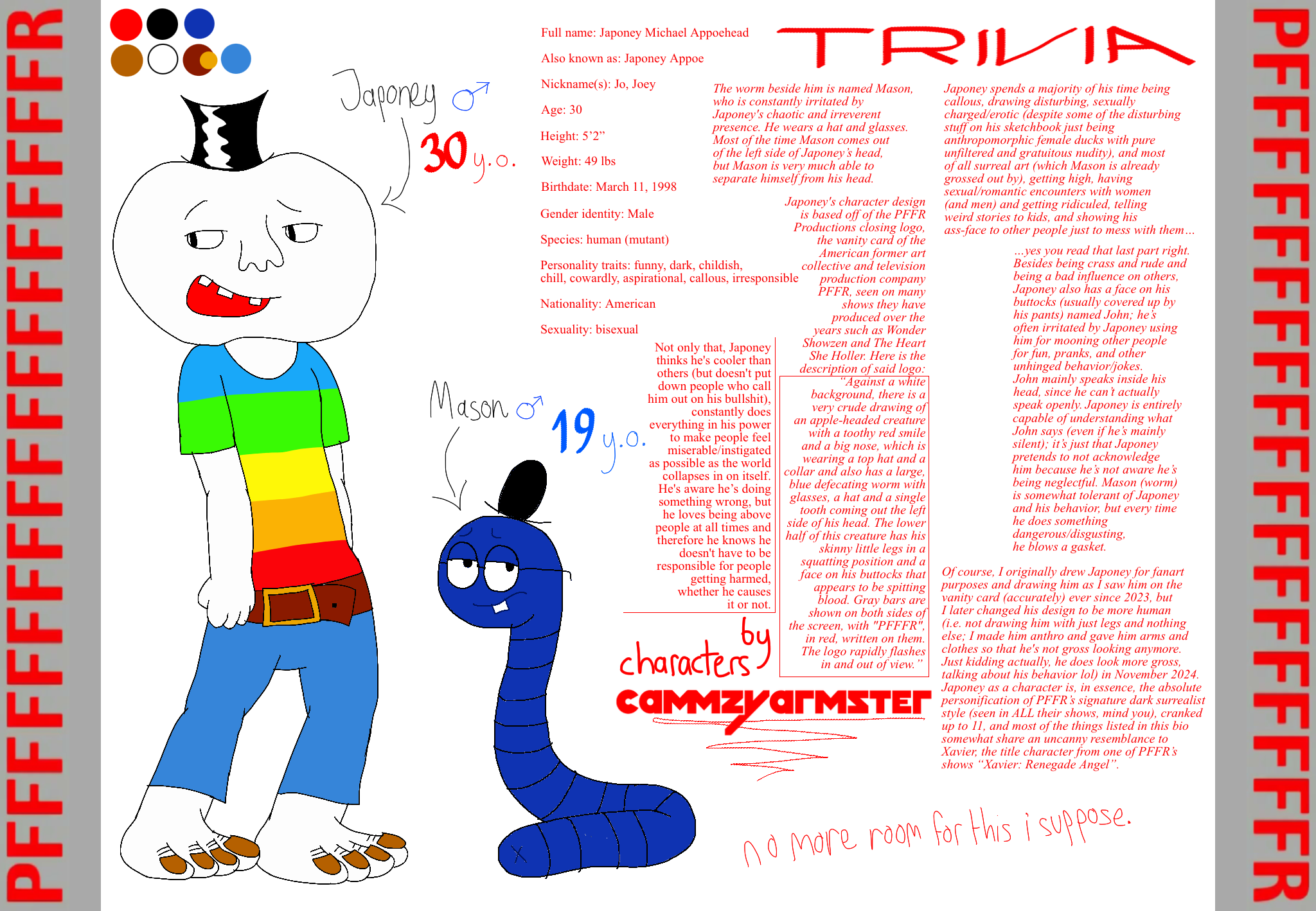
Full name: Japoney Michael Appoehead
Also known as: Japoney Appoe
Nickname(s): Jo, Joey, Jake
(Present-day) Age: 30
Height: 5’2”
Weight: 49 lbs
Birthdate: March 11, 1998
Gender identity: Male
Species: human (mutant)
Personality traits: funny, dark, childish, chill, cowardly, aspirational, callous, irresponsible
Nationality: American
Sexuality: bisexual
Appearance: Japoney Appoe is an anthropomorphic apple-headed creature who wears a top-hat on his head, a rainbow shirt, and pants held by a brown belt. He has a blue worm (Mason) with glasses, a hat, and a single tooth coming out the left side of his head. When he’s naked, he’s always wearing a white collar. The back side of Japoney has a face (Joe) on his buttocks that can be able to spew blood.
Trivia:
- The worm beside him is named Mason, who is constantly irritated by Japoney's chaotic and irreverent presence. He wears a hat and glasses. Most of the time Mason comes out of the left side of Japoney’s head, but Mason is very much able to separate himself from Japoney's head.
- Japoney spends a majority of his time being callous, drawing disturbing, sexually charged/erotic art (despite most of the disturbing stuff on his sketchbook just being anthropomorphic female ducks with pure unfiltered and gratuitous nudity), and most of all surreal art (which Mason is already grossed out by), getting high, having sexual/romantic encounters with women (and men) and getting ridiculed, telling weird stories to kids, and showing his ass-face to other people just to mess with them…
- …yes you read that last part right. Besides being crass and rude and being a bad influence on others, Japoney also has a face on his buttocks (usually covered up by his pants) named John; he’s mainly irritated by Japoney using him for mooning other people (for fun), pranks, and other unhinged behavior/jokes. John mainly speaks inside his head, since he can’t actually speak openly. Japoney is entirely capable of understanding what John says (even if he’s mainly silent); it’s just that Japoney pretends to not acknowledge him because he’s not aware he’s being neglectful. Mason (worm) is somewhat tolerant of Japoney and his behavior, but every time he does something dangerous/disgusting, he blows a gasket. Not only that, Japoney thinks he's cooler than others (but doesn't put down people who call him out on his bullshit), constantly does everything in his power to make people feel miserable/instigated as possible as the world collapses in on itself. He's aware he’s doing something wrong, but he loves being above people at all times and therefore he knows he doesn't have to be responsible for people getting harmed, whether he causes it or not.
- Japoney's character design is based on the PFFR Productions closing logo, the vanity card of the American former art collective and television production company PFFR, seen on many shows they have produced over the years such as Wonder Showzen and The Heart She Holler. Here is the description of said logo: "Against a white background, there is a very crude drawing of an apple-headed creature with a toothy red smile and a big nose, which is wearing a top hat and a collar and also has a large, blue defecating worm with glasses, a hat and a single tooth coming out the left side of his head. The lower half of this creature has his skinny little legs in a squatting position and a face on his buttocks that appears to be spitting blood. Gray bars are shown on both sides of the screen, with "PFFFR", in red, written on them. The logo rapidly flashes in and out of view.”. Of course, I originally drew Japoney for fanart purposes and drawing him as I saw him on the vanity card (accurately) ever since 2023, but I later changed his design to be more human (i.e. not drawing him with just legs and nothing else; I made him anthro and gave him arms and clothes so that he's not gross looking anymore) in November 2024.
Unlike most of the cast, Japoney is the only character written to not have ulterior motives/hidden emotional depth. Japoney does not ever have a closeted identity of anxiety or inadequacy, because he genuinely acts and feels the way that he does to simply have fun. He is driven by people getting riled up and probably needs professional help, but then again, he never really grew out of his habit.
Headcanon voice(s):
- English: Vernon Chatman (“Towelie” on South Park)
Rufus
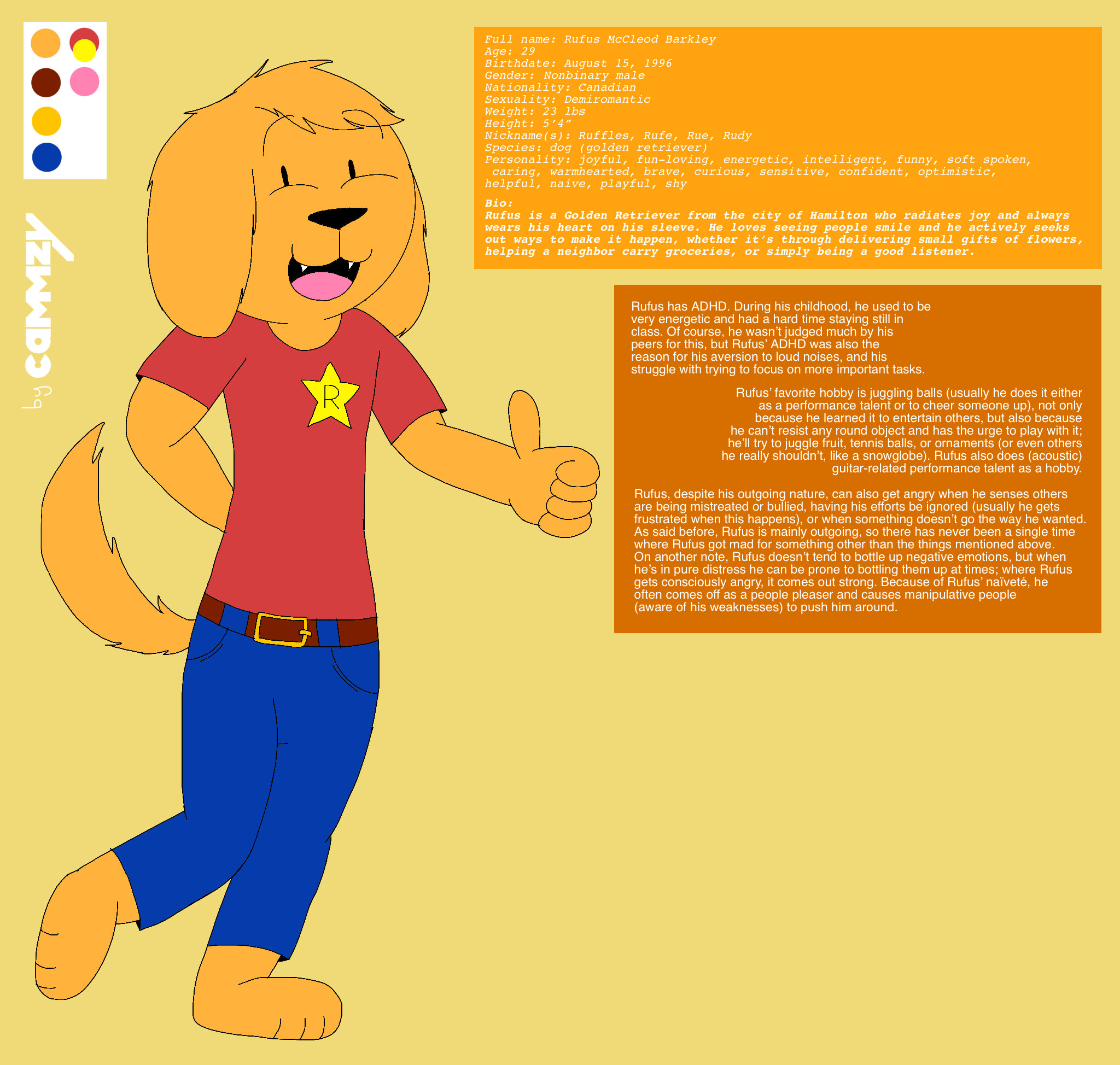
Full name: Rufus McCleod Barkley
Age: 29
Birthdate: August 15, 1996
Gender: nonbinary (male-presenting)
Nationality: Canadian
Sexuality: Demiromantic
Weight: 23 lbs
Height: 5’4”
Nickname(s): Ruffles, Rue, Rudy
Species: dog (golden retriever)
Personality: joyful, fun-loving, energetic, intelligent, funny, soft spoken, caring, warmhearted, brave, curious, sensitive, confident, optimistic, helpful, naive, playful, shy
Bio:
Rufus is a Golden Retriever from the city of Hamilton who radiates joy and always wears his heart on his sleeve. He loves seeing people smile and he actively seeks out ways to make it happen, whether it’s through delivering small gifts of flowers, helping a neighbor carry groceries, or simply being a good listener.
Trivia:
- Rufus has ADHD. During his childhood, he used to be very energetic and had a hard time staying still in class. Of course, he wasn’t judged much by his peers for this, but Rufus’ ADHD was also the reason for his aversion to loud noises and his struggle with trying to focus on doing something he likes.
- Rufus’ favorite hobby is juggling balls (usually he does it either as a performance talent or to cheer someone up), not only because he learned it to entertain others, but also because he can’t resist any round object and has the urge to play with it; he’ll try to juggle fruit, tennis balls, or ornaments (or even others he really shouldn’t, like a snowglobe). Rufus also does (acoustic) qguitar-related performance talent as a hobby. He does not have a job.
- Rufus, despite his outgoing nature, can also get angry when he senses others are being mistreated or bullied, having his efforts be ignored (usually he gets frustrated when this happens), or when something doesn’t go the way he wanted. As said before, Rufus is mainly outgoing, so there has never been a single time where Rufus got mad for something other than the things mentioned above. On another note, Rufus doesn’t tend to bottle up negative emotions, but when he’s in pure distress he can be prone to bottling them up at times; where Rufus gets consciously angry, it comes out strong. Because of Rufus’ naïveté, he often comes off as a people pleaser and is prone to have manipulative people (aware of his weaknesses) push him around.
- Rufus’ favorite food/snacks are peanut butter (on everything), cheese sandwiches, yogurt, and pumpkin pie.
As Rufus is an anthro dog, his feral instincts tend to get the better of him. Sometimes he’ll pant to cool down, give Katya kisses by licking her (much to her amusement/surprise), wag his tail when he’s excited, whine like a puppy when he’s sad/crying, or bark loudly when he’s angry.
Headcanon voice(s):
- English — Jack McBrayer (US)
Katya
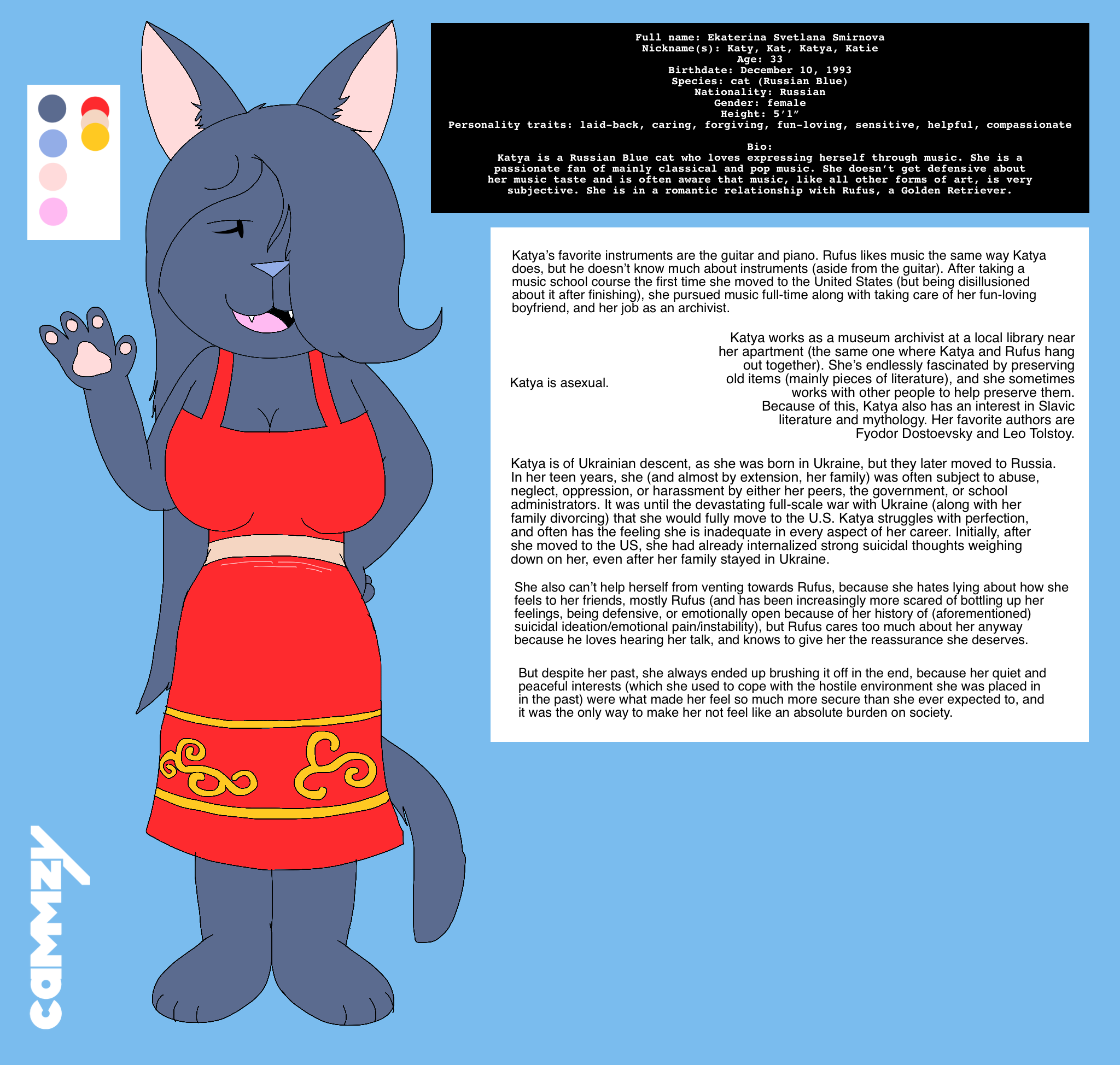
Full name: Ekaterina Svetlana Smirnova
Nickname(s): Katy, Kat, Katya, Katie
age: 33
Birthdate: December 10, 1993
Species: Russian Blue cat
Nationality: Russian
Gender: female
Sexuality: Asexual
Height: 5’1”
Personality traits: laid-back, caring, forgiving, fun-loving, sensitive, helpful, compassionate
Bio:
Katya is a bookish Russian Blue cat who loves expressing herself through music. She is a passionate fan of mainly classical and pop music. She doesn’t get defensive about her music taste and is often aware that music, like all other forms of art, is very subjective. She is in a romantic relationship with Rufus, a Golden Retriever.
Trivia:
- Katya’s favorite instruments are the guitar and piano. Rufus likes music the same way Katya does, but he doesn’t know much about instruments (aside from the guitar). After taking a music school course the first time she moved to the United States (but being disillusioned about it after finishing), she pursued music full-time along with taking care of her fun-loving boyfriend, and her job as an archivist.
- Katya works as a museum archivist at a local library near her apartment (the same one where Katya and Rufus hang out together). She’s endlessly fascinated by preserving old items (mainly pieces of literature), and she sometimes works with other people to help preserve them. Because of this, Katya also has an interest in Slavic literature. Her favorite authors are Fyodor Dostoevsky and Leo Tolstoy.
- Katya is of Ukrainian descent, as she was born in Ukraine, but they later moved to Russia. In her teen years, she (and almost by extension, her family) was often subject to abuse, neglect, oppression, or harassment by either her peers, the government, or school administrators. It was until the devastating full-scale war with Ukraine (along with her family divorcing) that she would fully move to the U.S. Katya struggles with perfection, and often has the feeling she is inadequate in every aspect of her career. Initially, after she moved to the US, she had already internalized strong suicidal thoughts weighing down on her, even after her family stayed in Ukraine.
- But despite her past, she always ended up brushing it off in the end, because her quiet and peaceful interests (which she used to cope with the hostile environment she was placed in in the past) were what made her feel so much more secure than she ever expected to, and it was the only way to make her not feel like an absolute burden on society.
- She also can’t help herself from venting towards Rufus, because she hates lying about how she feels to her friends, mostly Rufus (and has been increasingly more scared of bottling up her feelings, being defensive, or emotionally open because of her history of (aforementioned) suicidal ideation/emotional pain/instability), but Rufus cares too much about her anyway because he loves hearing her talk, and knows to give her the reassurance she deserves.
Tangy
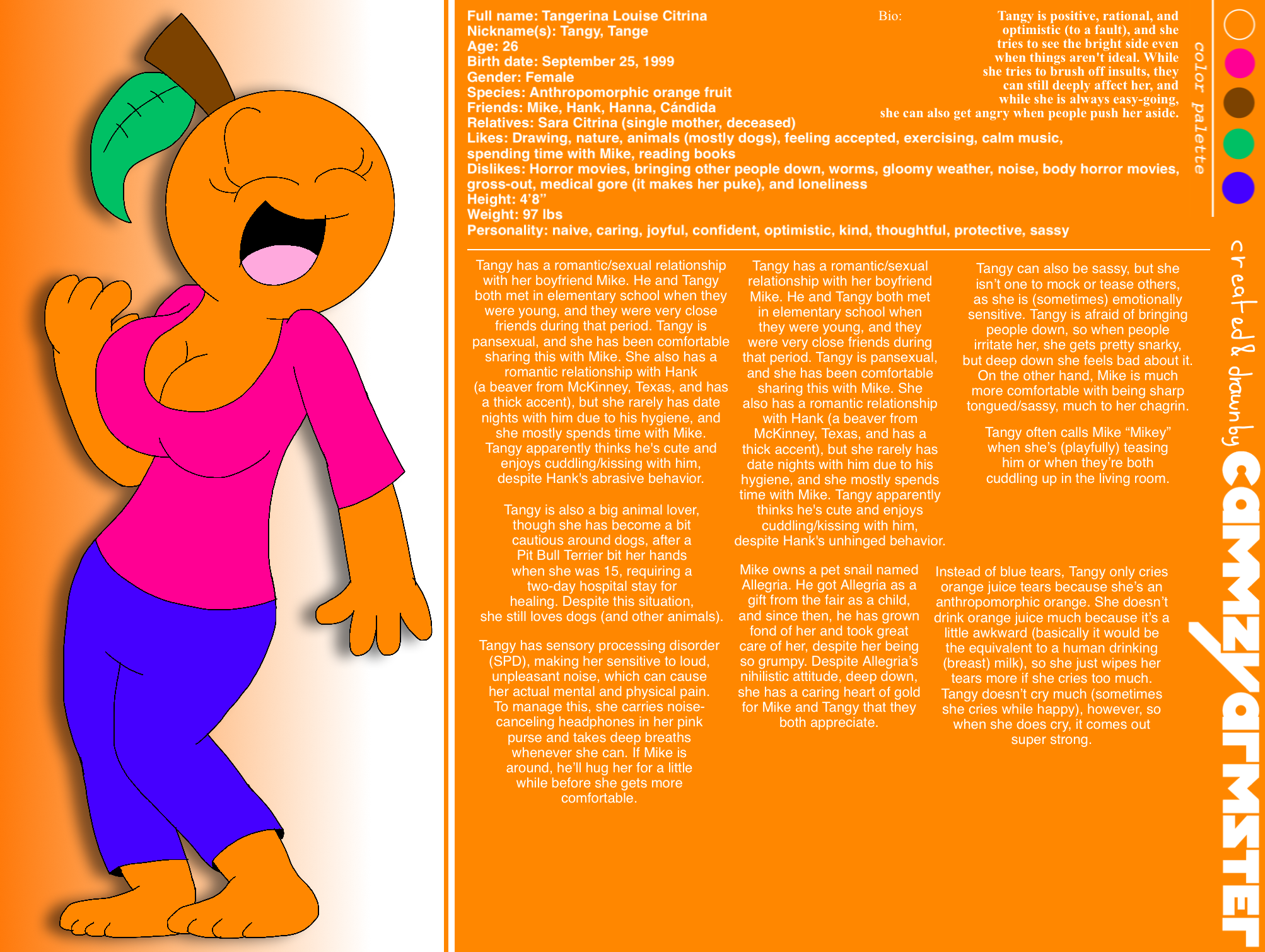
Full name: Tangerina Louise Citrina
Nickname(s): Tangy, Tange
Age: 26
Birth date: September 25, 1999
Gender: Female
Species: Anthropomorphic tangerine fruit
Friends: Mike, Hank, Hanna, Cándida
Relatives: Sara Citrina (single mother, deceased)
Likes: Drawing, nature, animals (mostly dogs), feeling accepted, exercising, calm music, spending time with Mike, reading books
Dislikes: Horror movies, bringing other people down, worms, gloomy weather, noise, medical gore (it makes her puke), and loneliness
Height: 4’8”
Weight: 97 lbs
Personality: naive, caring, joyful, confident, optimistic, kind, thoughtful, protective, sassy
Sexuality: pansexual
Trivia:
- Tangy is positive, rational, and optimistic (to a fault), and she tries to see the bright side even when things aren't ideal. While she tries to brush off insults, they can still deeply affect her, and while she is always easy-going, Tangy can also get angry when people push her aside.
- Tangy has a romantic/sexual relationship with her boyfriend Mike. He and Tangy both met in elementary school when they were young, and they were very close friends during that period. Tangy is pansexual, and she has been comfortable sharing this with Mike. She also has a romantic relationship with Hank (a beaver from McKinney, Texas, and has a thick accent), but she rarely has date nights with him due to his hygiene, and she mostly spends time with Mike. Tangy apparently thinks he's cute and enjoys cuddling/kissing with him, despite Hank's unhinged behavior.
- Tangy can also be sassy, but she isn’t one to mock or tease others, as she is (sometimes) emotionally sensitive. Tangy is afraid of bringing people down, so when people irritate her, she gets pretty snarky, but deep down she feels bad about it. On the other hand, Mike is much more comfortable with being sharp-tongued/sassy, much to her chagrin.
- Tangy often calls Mike “Mikey” when she’s (playfully) teasing him or when they’re both cuddling up in the living room.
- Tangy has sensory processing disorder (SPD), making her sensitive to loud, unpleasant noise, which can cause her actual mental and physical pain. To manage this, she carries noise-canceling headphones in her pink purse and takes deep breaths whenever she can. If Mike is around, he’ll hug her for a little while before she gets more comfortable.
- Tangy is also a big animal lover, though she has become a bit cautious around dogs, after a Pit Bull Terrier bit her hands when she was 15, requiring a two-day hospital stay for healing. Despite this situation, she still loves dogs (and other animals).
- Instead of blue tears, Tangy only cries orange juice tears because she’s an anthropomorphic orange. She doesn’t drink orange juice much because it’s a little awkward (basically it would be the equivalent to a human drinking (breast) milk), so she just wipes her tears more if she cries too much. Tangy doesn’t cry much (sometimes she cries while happy), however, so when she does cry, it comes out super strong.
- Mike owns a pet snail named Allegria. He got Allegria as a gift from the fair as a child, and since then, he has grown fond of her and took great care of her, despite her being so grumpy. Despite Allegria’s nihilistic attitude, deep down, she has a caring heart of gold for Mike and Tangy that they both appreciate.
- Tangy was originally proposed as the sidekick/mascot of Cammzy’s YouTube channel “blackjackson11”, but now she serves as one of his main OCs, as Armster stopped focusing attention to the channel in late 2024 to focus on her (and later recreate the expansive universe that she currently lives in).
Mike
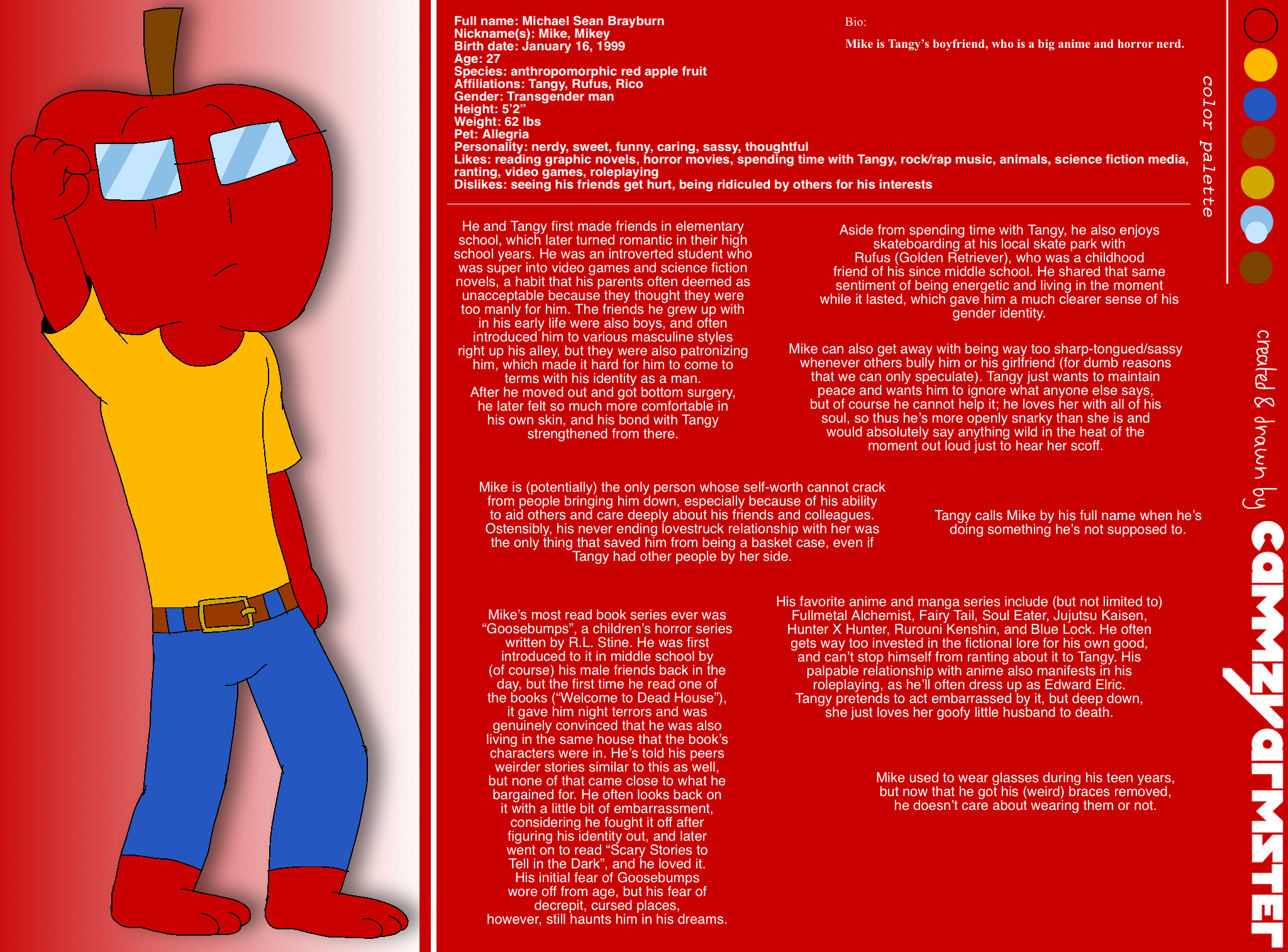
Full name: Michael Sean Brayburn
Nickname(s): Mike, Mikey
Birth date: January 16, 1999
Age: 27
Species: anthropomorphic red apple fruit
Affiliations: Tangy, Rufus, Rico
Gender: Transgender man
Height: 5’2”
Weight: 62 lbs
Pet: Allegria
Personality: nerdy, sweet, funny, caring, sassy, thoughtful
Likes: reading fantasy novels, horror movies, spending time with Tangy, rock/rap music, animals, science fiction movies, ranting, video games, roleplaying
Dislikes: seeing his friends get hurt, being ridiculed by others for his interests
Sexuality: Heterosexual
Bio:
Mike is Tangy’s boyfriend, who is a big anime and horror nerd.
Trivia:
- His favorite anime and manga series include (but not limited to) Fullmetal Alchemist, Fairy Tail, Soul Eater, Jujutsu Kaisen, Hunter X Hunter, Rurouni Kenshin, and Blue Lock. He often gets way too invested in the fictional lore for his own good, and can’t stop himself from ranting about it to Tangy. His palpable relationship with anime also manifests in his roleplaying, as he’ll often dress up as Edward Elric. Tangy pretends to act embarrassed by it, but deep down, she just loves her goofy little husband to death.
- Mike used to wear glasses during his teen years, but now that he got his (weird) braces removed, he doesn’t care about wearing them or not.
- Tangy calls Mike by his full name when he’s doing something he’s not supposed to.
- Mike’s most read book series ever was “Goosebumps”, a children’s horror series written by R.L. Stine. He was first introduced to it in middle school by (of course) his male friends back in the day, but the first time he read one of the books (“Welcome to Dead House”), it gave him night terrors and was genuinely convinced that he was also living in the same house that the book’s characters were in. He’s told his peers weirder stories similar to this as well, but none of that came close to what he bargained for. He often looks back on it with a little bit of embarrassment, considering he fought it off after figuring his identity out, and later went on to read “Scary Stories to Tell in the Dark”, and he loved it. His initial fear of Goosebumps wore off from age, but his fear of decrepit, cursed places, however, still haunts him in his dreams.
- Mike can also get away with being way too sharp-tongued/sassy whenever others bully him or his girlfriend (for dumb reasons that we can only speculate). Tangy just wants to maintain peace and wants him to ignore what anyone else says, but of course he cannot help it; he loves her with all of his soul, so thus he’s more openly snarky than she is and would absolutely say anything wild in the heat of the moment out loud just to hear her scoff.
- Mike is (potentially) the only person whose self-worth cannot crack from people bringing him down, especially because of his ability to aid others and care deeply about his friends and colleagues. Ostensibly, his never ending lovestruck relationship with her was the only thing that saved him from being a basket case, even if Tangy had other people by her side.
- Aside from spending time with Tangy, he also enjoys skateboarding at his local skate park with Rufus (Golden Retriever), who was a childhood friend of his since middle school.
- He and Tangy first made friends in elementary school, which later turned romantic in their high school years. He was an introverted student who was super into video games and science fiction novels, a habit that his parents often deemed as unacceptable because they thought they were too manly for him. The friends he grew up with in his early life were also boys, and often introduced him to various masculine styles right up his alley, but they were also patronizing him, which made it hard for him to come to terms with his identity as a man. After he moved out and got bottom surgery, he later felt more comfortable in his own skin and his bond with Tangy strengthened from there.
- Originally his last name was “Braeburn”, but then it was changed to “Brayburn” in his 2026 redesign to make it look more natural.
Allegria
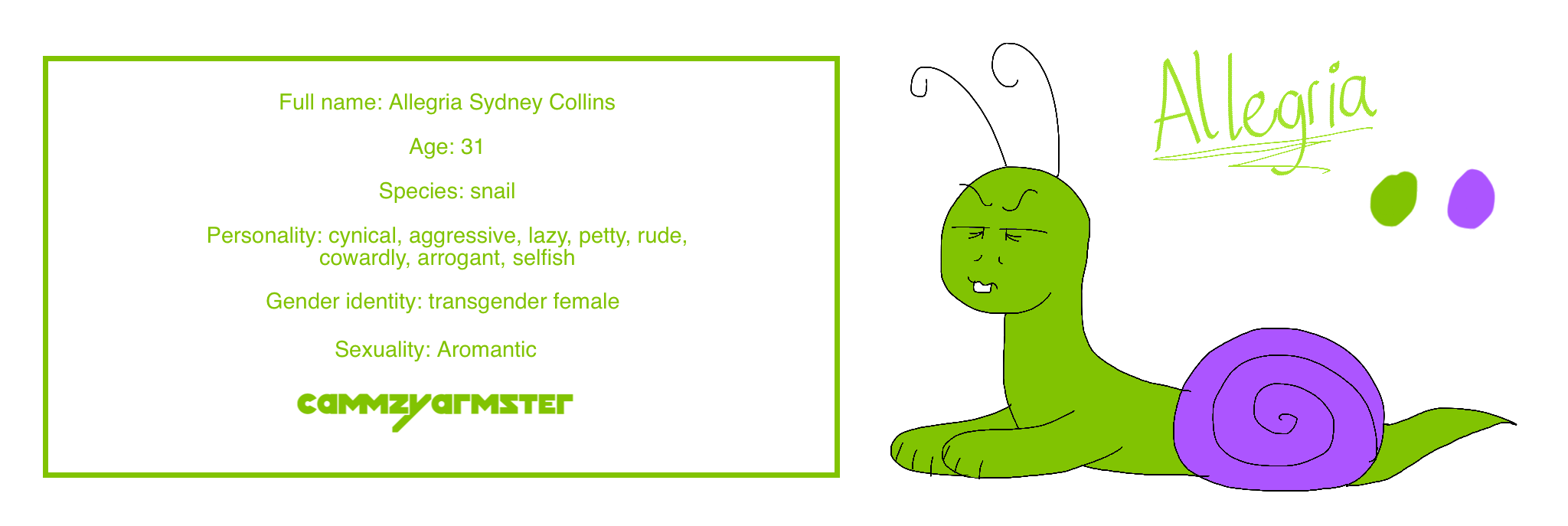
Full name: Allegria Brayburn
Nickname(s): Allie
Age: 31 (in snail years)
Birthday: July 29
Species: snail
Personality: cynical, aggressive, lazy, petty, rude, cowardly, arrogant, (often) foul-mouthed
Gender identity: transgender female
Sexuality: Aromantic
Likes: her owner taking care of her, being around people she trusts, smoking, partying, fighting
Dislikes: being harassed, transphobia, impertinence, others talking down to her/being whiny, rudeness towards her
Bio:
Allegria is the pet snail of Mike (Tangy’s boyfriend). He got Allegria as a gift from the fair as a child, and since then, he has grown fond of her and took great care of her, despite her being so grumpy. Despite Allegria’s personality, deep down, she has a caring heart of gold for Mike and Tangy that they both appreciate. All of the personality traits listed here may make her seem negatively coded, but on the surface, she really does find a connection with her nerdy owner and would do anything for him, despite having such a cynical and nihilistic attitude.
Trivia:
- Allegria’s most favorite foods are leaves, lettuce and algae.
- Allegria hates it when people (including Tangy) coddle her (like Tangy picking her up or petting her), but she secretly loves it.
Appearance: Allegria is a green-skinned snail with a purple shell. She has 2 antennae, paws, a slug-like tapering tail, and is bucktoothed.
Cándida
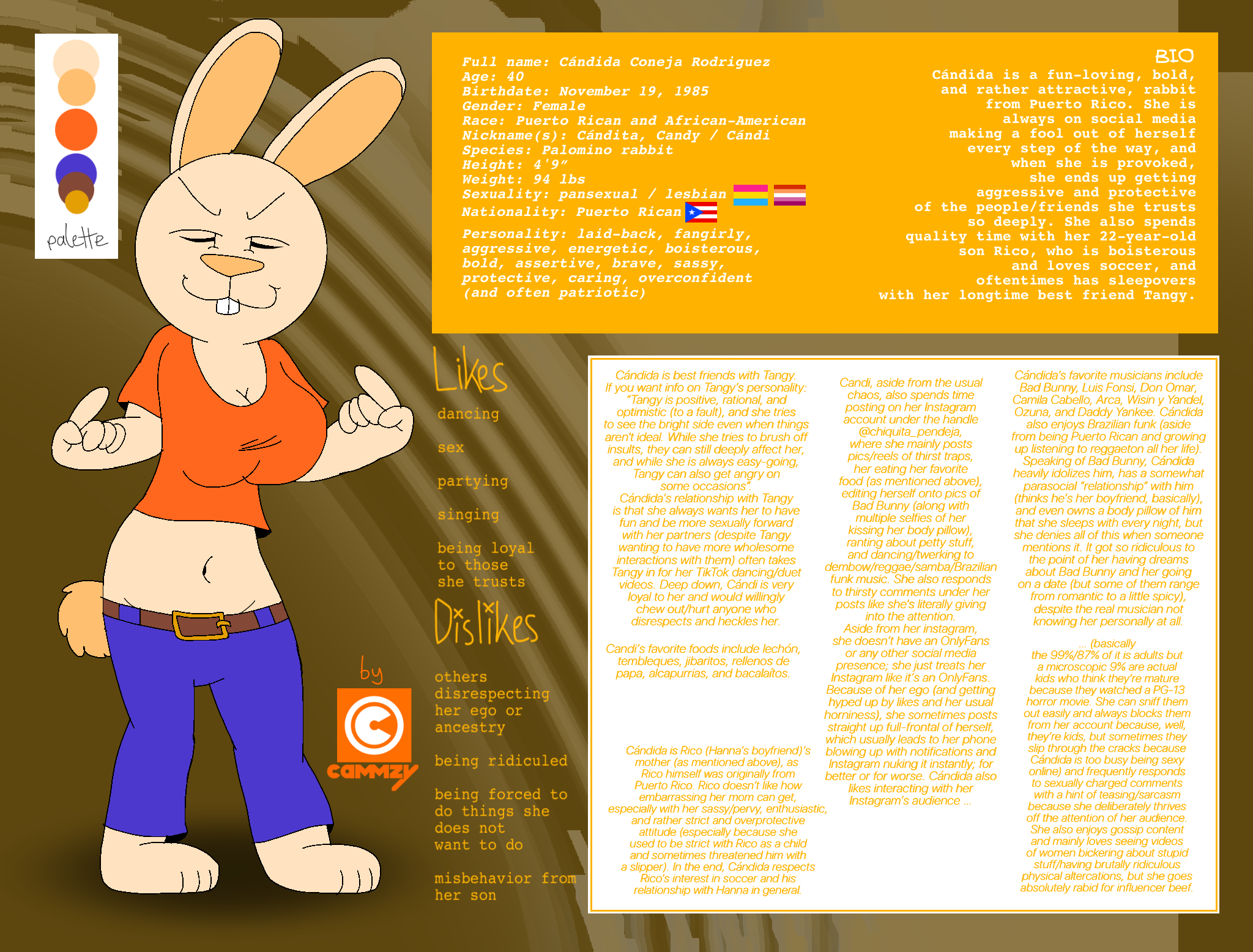
Full name: Cándida Coneja Rodriguez
Age: 40
Birthdate: November 19, 1985
Gender: Female
Race: Puerto Rican and African-American
Nickname(s): Cándita, Candy / Cándi
Species: rabbit
Height: 4'9”
Weight: 94 lbs
Sexuality: pansexual and lesbian
Personality: laid-back, fangirly, aggressive, energetic, boisterous, bold, assertive, brave, sassy, protective, caring, overconfident (and often patriotic)
Likes: dancing, sex, partying, singing, being loyal to those she trusts
Dislikes: others disrespecting her ego/ancestry, being ridiculed/taunted by others, being forced to do things she does not want to do
Friends: Tangy, Hanna, Roxxie
Bio:
Cándida is a fun-loving, bold, and very attractive rabbit from Puerto Rico. She is a chronically online Instagram user who often flexes her self-worth and voluptuous build in front of her audience, but is always insecure and loyally supportive when her self-esteem collapses. She also spends quality time with her 22-year-old son Rico, who is boisterous and loves soccer. She is best friends with Tangy.
Trivia
- Cándida's favorite musicians include Bad Bunny, Luis Fonsi, Don Omar, Camila Cabello, Arca, Wisin y Yandel, Ozuna, and Daddy Yankee. Cándida also enjoys Brazilian funk (aside from being Puerto Rican and growing up listening to reggae all her life). Speaking of Bad Bunny, Cándida heavily idolizes him, has a somewhat parasocial “relationship” with him (thinks he’s her boyfriend, basically), and even has a body pillow of him that she sleeps with every night, but she denies all of this when someone mentions it. It got so ridiculous to the point of her having dreams about Bad Bunny and her going on a date (but some of them range from romantic to straight up sexually charged), despite the actual musician not knowing her personally at all.
- Cándida is best friends with Tangy. If you want info on Tangy’s personality: “Tangy is positive, rational, and optimistic (to a fault), and she tries to see the bright side even when things aren't ideal. While she tries to brush off insults, they can still deeply affect her, and while she is always easy-going, Tangy can also get angry on some occasions”. Cándida’s relationship with Tangy is that she always wants her to have fun and be more sexually forward with her partners (despite Tangy wanting to have more wholesome time with them) often takes Tangy in for her TikTok dancing/duet videos. Deep down, Cándi is very loyal to her and would willingly chew out/hurt anyone who disrespects and heckles her.
- Candi’s favorite foods include lechón, tembleques, jibaritos, rellenos de papa, alcapurrias, and bacalaítos.
- Candi, aside from the usual chaos, also spends time posting on her Instagram account under the handle @chiquita_pendeja, where she mainly posts pics/reels of thirst traps, her eating her favorite food (as mentioned above), editing herself onto pics of Bad Bunny (along with multiple selfies of her kissing her body pillow), ranting about petty stuff, and dancing/twerking to dembow/reggae/samba/Brazilian funk music. She also responds to thirsty comments under her posts like she's literally giving into the attention. Aside from her instagram, she doesn’t have an OnlyFans or any other social media presence; she just treats her Instagram like it’s an OnlyFans. Because of her ego (and getting hyped up by likes and her usual horniness), she sometimes posts straight up full-frontal of herself, which usually leads to her phone blowing up with notifications and Instagram nuking it instantly; for better or for worse. Cándida also likes interacting with her instagram’s audience (basically the 99%/87% of it is adults but a microscopic 9% are actual kids who think they’re mature because they watched a PG-13 horror movie. She can sniff them out easily and always blocks them from her account because, well, they’re kids, but sometimes they slip through the cracks because Cándida is too busy being sexy online) and frequently responds to sexually charged comments with a hint of teasing/sarcasm because she deliberately thrives off the attention of her audience. She also enjoys gossip content and mainly loves seeing videos of women bickering about stupid stuff/having brutally ridiculous physical altercations, but she goes absolutely rabid for influencer beef.
- Cándida is Rico (Hanna’s boyfriend)’s mother (as mentioned above), as Rico himself was originally from Puerto Rico. Rico doesn’t like how embarrassing her mom can get, especially with her sassy, pervy, and rather strict and overprotective attitude (especially because she used to be strict with Rico as a child). In the end, Cándida respects Rico’s interest in soccer and his relationship with Hanna in general.
Roxxie
Main info
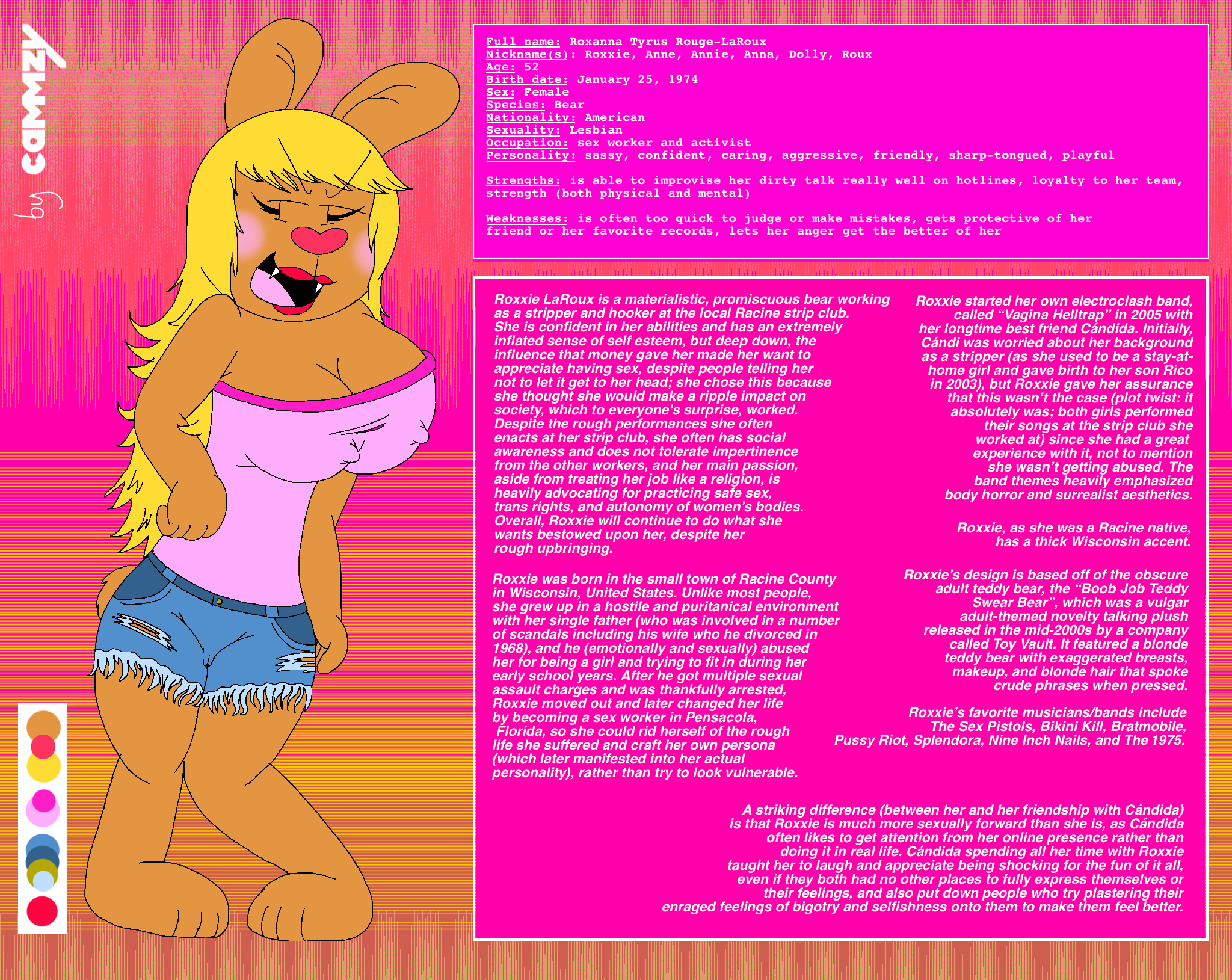
Full name: Roxanna Tyrus Rouge-LaRoux
Pronunciation: rocks-Anna tie-rus roozh-luh-roo
Nickname(s): Roxxie, Anne, Annie, Anna, Dolly, Roux
Age: 52
Birth date: January 25, 1974
Sex: Female
Species: Bear
Nationality: American
Sexuality: Lesbian
Occupation: sex worker and activist
Personality: sassy, confident, caring, aggressive, friendly, sharp-tongued, playful
Weaknesses: is often too quick to judge or make assumptions, gets protective of her friend or her favorite music, lets her anger get the better of her
Appearance
Roxxie is an anthropomorphic bear with brown-tan fur and long, messy blonde hair. She typically wears a pink tube top (with the nipples bumping out a little because of her breasts, along with cleavage), and a grey skirt or ripped shorts. She has a pink heart-shaped nose, and she often wears hot pink lipstick.
Bio
Roxxie LaRoux is a promiscuous bear working as a stripper and hooker at the local Racine strip club. She is confident in her abilities and has an extremely inflated sense of self esteem, but deep down, the influence that money gave her made her want to appreciate having sex, despite people telling her not to let it get to her head; she chose this because she thought she would make a ripple impact on society, which to everyone's surprise, worked. Despite the rough performances she often enacts at her strip club, she often has social awareness and does not tolerate impertinence from the other workers, and her main passion, aside from treating her job like a religion, is heavily advocating for practicing safe sex, trans rights, and autonomy of women’s bodies. Overall, Roxxie will continue to do what she wants bestowed upon her, despite her rough upbringing.
Trivia
- Roxxie started her own electroclash band, called “The Vagina Helltraps” in 2005 with her longtime best friend Cándida. Initially, Cándi was worried about her background as a stripper (as she used to be a stay-at-home girl and gave birth to her son Rico in 2003), but Roxxie gave her assurance that this wasn’t the case (plot twist: it absolutely was; both girls performed their songs at the strip club she worked at) since she had a great experience with it, not to mention she wasn’t getting abused. The band themes heavily emphasized body horror and surrealist aesthetics.
- Roxxie was born in the small town of Racine County in Wisconsin, United States. Unlike most strippers, she grew up in a hostile and puritanical environment with her single father (who was involved in a number of scandals including his wife), and he (emotionally and sexually) abused her for being a girl and trying to fit in during her early school years. After he got multiple sexual assault charges and was thankfully arrested, Roxxie moved out and later changed her life by becoming a sex worker in Pensacola, Florida, so she could rid herself of the rough life she suffered and craft her own persona (which later manifested into her actual personality), rather than try to look vulnerable.
- Roxxie, as she was a Racine native, has a thick Wisconsin accent.
- A striking difference (between her and her friendship with Cándida) is that Roxxie is much more sexually forward than she is, as Cándida often likes to get attention from her online presence rather than doing it in real life. Cándida spending all her time with Roxxie taught her to laugh and appreciate being shocking for the fun of it all, even if they both had no other places to fully express themselves or their feelings, and also put down people who plaster their enraged feelings of bigotry and selfishness onto women to make them feel better.
- Roxxie’s design is based off of the obscure adult teddy bear, the “Boob Job Teddy Swear Bear”, which was a vulgar adult-themed novelty talking plush released in the mid-2000s by a company called Toy Vault. It featured a blonde teddy bear with exaggerated breasts, makeup, and blonde hair that spoke crude phrases when pressed.
Rico
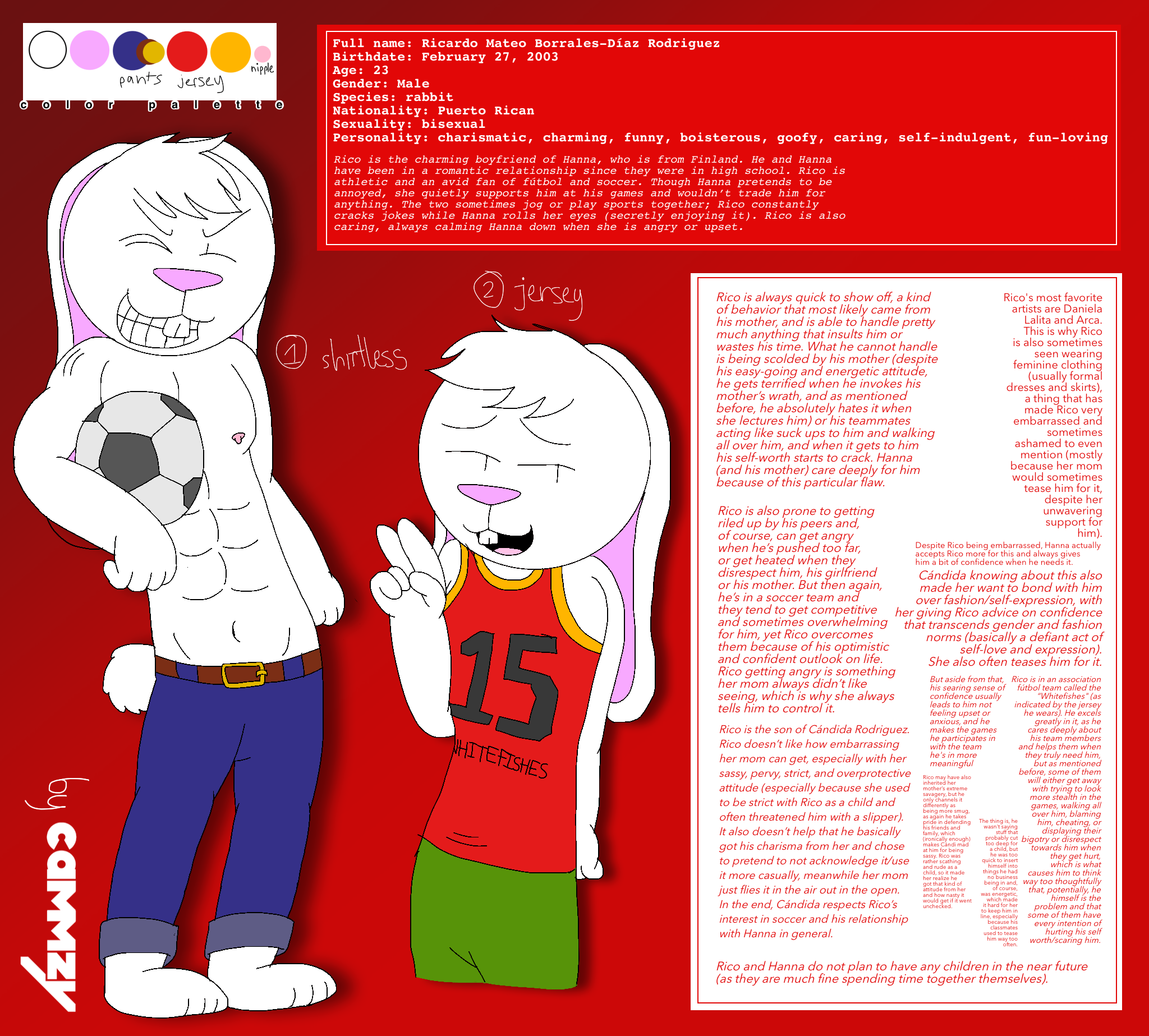
Full name: Ricardo Mateo Borrales-Díaz Rodriguez
Nickname(s): Rico
Birthdate: February 27, 2003
Age: 23
Gender: Male
Species: rabbit
Nationality: Puerto Rican
Sexuality: bisexual
Personality: charismatic, charming, funny, boisterous, goofy, caring, self-indulgent, fun-loving
Height: 5’2”
Bio:
Rico is the charming boyfriend of Hanna, who is from Finland. He and Hanna have been in a romantic relationship since they were in high school. Rico is athletic and an avid fan of fútbol and soccer. Though Hanna pretends to be annoyed, she quietly supports him at his games and wouldn’t trade him for anything. The two sometimes jog or play sports together; Rico constantly cracks jokes while Hanna rolls her eyes (secretly enjoying it). Rico is also caring, always calming Hanna down when she is angry or upset.
Trivia:
- Rico is always quick to show off, a kind of behavior that most likely came from his mother, and is able to handle pretty much anything that insults him or wastes his time. What he cannot handle is being scolded by his mother (despite his easy-going and energetic attitude, he gets terrified when he invokes his mother’s wrath, and as mentioned before, he absolutely hates it when she lectures him) or his teammates acting like suck ups to him and walking all over him, and when it gets to him his self-worth starts to crack. Hanna (and his mother) care deeply for him because of this particular flaw.
- Rico is in an association fútbol team called the “Whitefishes” (as indicated by the jersey he wears). He excels greatly in it, as he cares deeply about his team members and helps them when they truly need him, but as mentioned before, some of them will either get away with trying to look more stealth in the games, walking all over him, or displaying their bigotry towards him.
- Rico is also prone to getting riled up by his peers and, of course, can get angry when he’s pushed too far, or get heated when they disrespect him, his girlfriend or his mother. But then again, he’s in a soccer team and they tend to get competitive and sometimes overwhelming for him, yet Rico overcomes them because of his optimistic and confident outlook on life. Rico getting angry is something her mom always didn’t like seeing, which is why she always tells him to control it.
- Rico's most favorite artists are Daniela Lalita and Arca. This is why Rico is also sometimes seen wearing feminine clothing (usually formal dresses and skirts), a thing that has made Rico very embarrassed and sometimes ashamed to even mention (mostly because her mom would sometimes tease him for it, despite her unwavering support for him). Despite Rico being embarrassed, Hanna actually accepts Rico more for this and always gives him a bit of confidence when he needs it.
- Rico is the son of Cándida Rodriguez. Rico doesn’t like how embarrassing her mom can get, especially with her sassy, pervy, strict, and overprotective attitude (especially because she used to be strict with Rico as a child and often threatened him with a slipper). It also doesn’t help that he basically got his charisma from her and chose to pretend to not acknowledge it/use it more casually, meanwhile her mom just flies it in the air out in the open. Rico may have also inherited her mother’s extreme savagery, but he only channels it differently as being more smug, as again he takes pride in defending his friends and family, which (ironically enough) makes Cándi mad at him for being sassy. Rico was rather scathing, cocky, and rude as a child, so it made her realize he got that kind of attitude from her and how nasty it would get if it went unchecked. The thing is, he wasn't saying stuff that probably cut too deep for a child, but he was too quick to insert himself into things he had no business being in and, of course, was energetic, which made it hard for her to keep him in line, especially because his classmates used to tease him way too often. In the end, Cándida respects Rico’s interest in soccer and his relationship with Hanna in general.
- Rico and Hanna do not plan to have any children (as they are much fine spending time together themselves).
Hanna
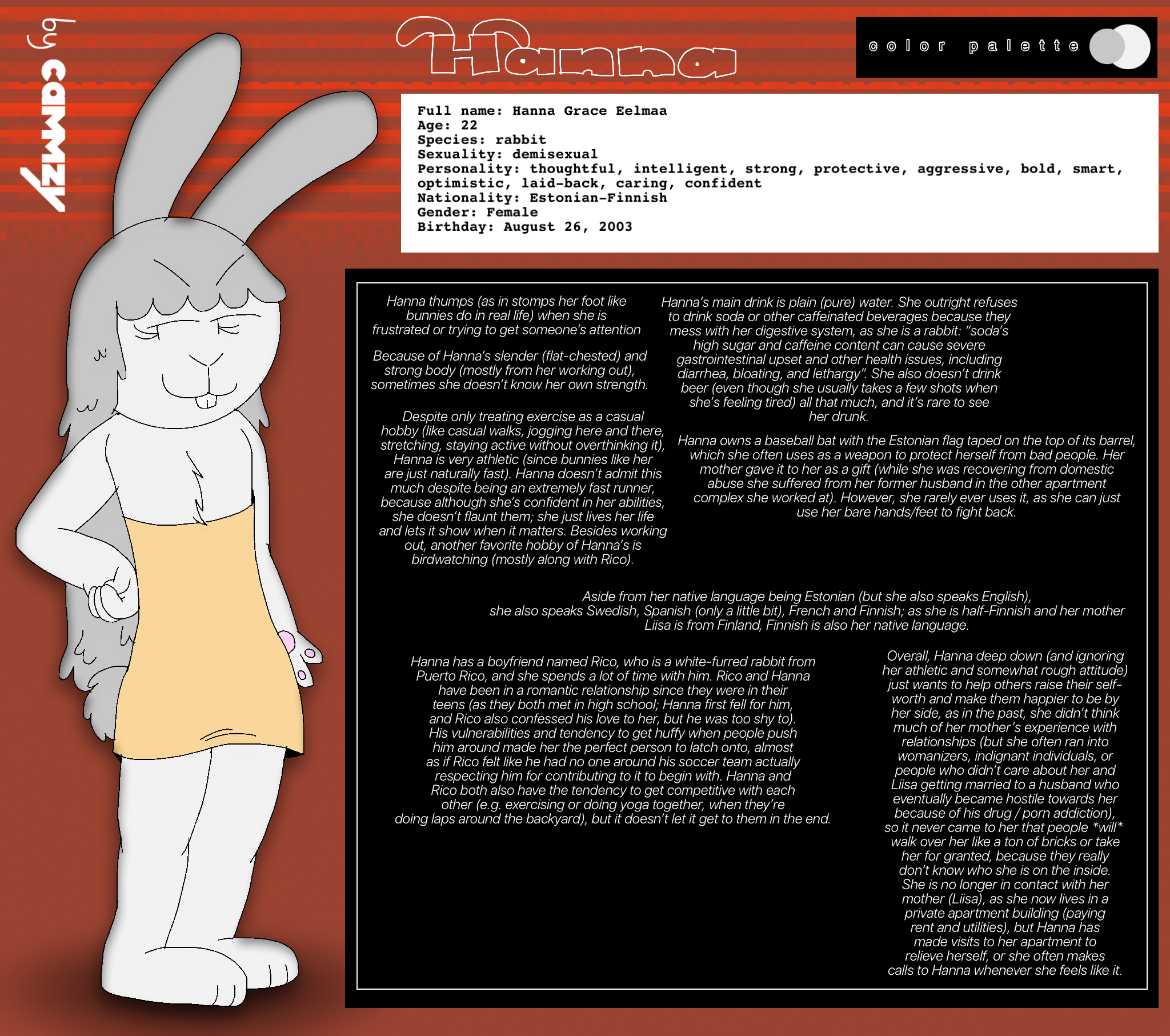
Full name: Hanna Grace Eelmaa
Age: 22
Species: rabbit
Sexuality: demisexual
Personality: thoughtful, intelligent, strong, protective, aggressive, bold, smart, optimistic, laid-back, caring, confident
Nationality: Estonian-Finnish
Gender: Female
Birthday: August 26, 2003
Height: 5’1”
Bio:
Hanna is a thoughtful yet strong-willed bunny known for her calm demeanor, protective nature, and surprisingly athletic abilities. Though usually laid-back and affectionate around those she trusts, Hanna won’t hesitate to stand up for herself or the people she cares about. Outside of exercising, she enjoys birdwatching, relaxing with her boyfriend Rico, and living life quietly at her own pace.
Trivia:
- Hanna thumps (as in stomps her foot like bunnies do in real life) when she is frustrated or trying to get someone's attention
- Because of Hanna’s slender (flat-chested) and strong body (mostly from her working out), sometimes she doesn’t know her own strength.
- Hanna’s main drink is plain (pure) water. She outright refuses to drink soda or other caffeinated beverages because they mess with her digestive system, as she is a rabbit: “soda’s high sugar and caffeine content can cause severe gastrointestinal upset and other health issues, including diarrhea, bloating, and lethargy”. She also doesn’t drink beer (even though she usually takes a few shots when she’s feeling tired) all that much, and it’s rare to see her drunk.
- Despite only treating exercise as a casual hobby (like casual walks, jogging here and there, stretching, staying active without overthinking it), Hanna is very athletic (since bunnies like Hanna are just naturally fast). Hanna doesn’t admit this much despite being an extremely fast runner, because although she’s confident in her abilities she doesn’t flaunt them; she just lives her life and lets it show when it matters. Besides working out, another favorite hobby of Hanna’s is birdwatching (mostly along with Rico).
- Hanna owns a baseball bat with the Estonian flag taped on the top of its barrel, which she often uses as a weapon to protect herself from bad people. Her mother gave it to her as a gift (while she was recovering from domestic abuse she suffered from her former husband in the other apartment complex she worked at). However, she rarely ever uses it, as she can just use her bare hands/feet to fight back.
- Aside from her native language being Estonian (but she also speaks English), she also speaks Swedish, Spanish (only a little bit), French and Finnish; as she is half-Finnish and her mother Liisa is from Finland, Finnish is also her native language.
- Hanna has a boyfriend named Rico who is a white-furred rabbit from Puerto Rico, and she spends a lot of time with him. Rico and Hanna have been in a romantic relationship since they were in their mid teens (as they both met in high school; Hanna first fell for him, and Rico also confessed his love to her, but he was too shy to). His vulnerabilities and tendency to get huffy when people push him around made her the perfect person to latch onto, almost as if Rico felt like he had no one around his soccer team actually respecting him for contributing to it to begin with. Hanna and Rico both also have the tendency to get competitive with each other when they’re doing laps around the backyard, but it doesn’t let it get to them in the end.
- Overall, Hanna deep down (and ignoring her athletic and somewhat rough attitude) just wants to help others raise their self-worth and make them happier to be by her side, as in the past, she didn’t think much of her mother’s experience with relationships (but she often ran into womanizers, indignant individuals, or people who didn’t care about her and Liisa getting married to a husband who eventually became hostile towards her because of his drug / porn addiction), so it never came to her that people *will* walk over her like a ton of bricks or take her for granted, because they really don’t know who she is on the inside. She is no longer in contact with her mother (Liisa), as she now lives in a private apartment building (paying rent and utilities), but Hanna has made visits to her apartment to relieve herself, or she often makes calls to Hanna whenever she feels like it.
The Bearingtons
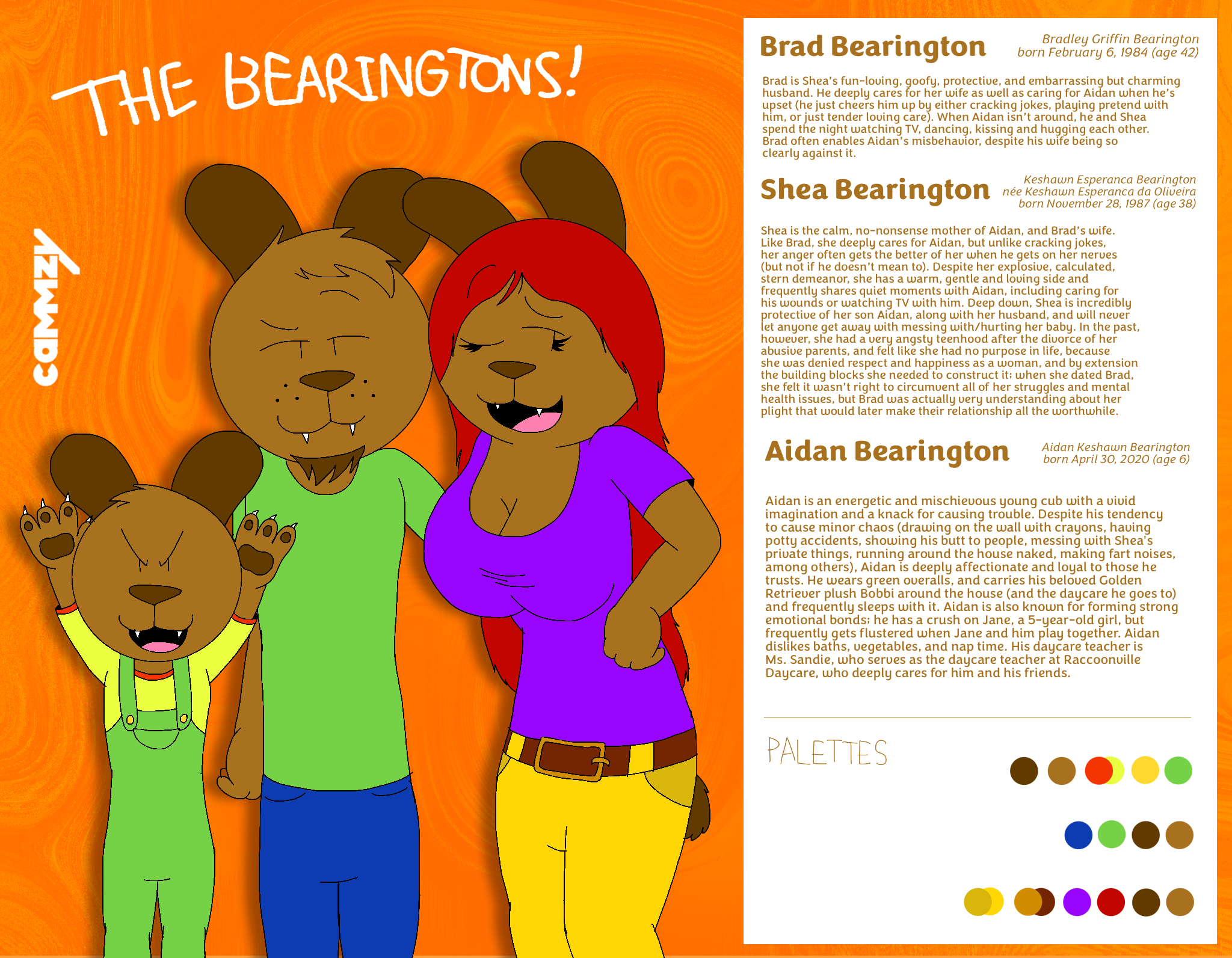
Bradley “Brad” Griffin Bearington (born February 6, 1984)
Brad is Shea’s fun-loving, goofy, protective, and embarrassing but charming husband. He deeply cares for her wife as well as caring for Aidan when he’s upset (he just cheers him up by either cracking jokes, playing pretend with him, or just tender loving care). When Aidan isn’t around, he and Shea spend the night watching TV, dancing, kissing and hugging each other. Brad often enables Aidan’s misbehavior despite his wife being so clearly against it.
Keshawn “Shea” Esperanca Bearington (née “Keshawn Esperanca da Oliveira”; born November 28, 1987)
Shea is the calm, no-nonsense mother of Aidan, and Brad’s wife. Like Brad, she deeply cares for Aidan, but unlike cracking jokes, her anger often gets the better of her when he gets on her nerves (but not if he doesn’t mean to). Despite her explosive, calculated, stern demeanor, she has a warm, gentle and loving side and frequently shares quiet moments with Aidan, including caring for his wounds or watching TV with him. Deep down, Shea is incredibly protective of her son Aidan, along with her husband, and will never let anyone get away with messing with/hurting her baby. In the past, however, she had a very angsty teenhood after the divorce of her abusive parents, and felt like she had no purpose in life, because she was denied respect and happiness as a woman, and by extension the building blocks she needed to construct it; when she dated Brad, she felt it wasn’t right to circumvent all of her struggles and mental health issues, but Brad was actually very understanding about her plight that would later make their relationship all the worthwhile.
Aidan “Aidy” Keshawn Bearington (age 6; born April 30, 2020)
Aidan is an energetic and mischievous young cub with a vivid imagination and a knack for causing trouble. Despite his tendency to cause minor chaos (drawing on the wall with crayons, having potty accidents, showing his butt to people, messing with Shea’s private things, running around the house naked, making fart noises, among others), Aidan is deeply affectionate and loyal to those he trusts. He wears green overalls and carries his beloved golden retriever plush Bobbi (who he loves to death) around the house (and the daycare he goes to, “Raccoonville Daycare Center”) and frequently sleeps with Bobbi. Aidan is also known for forming strong emotional bonds. Aidan has a crush on Jane, a 5-year-old human girl, but frequently gets flustered when Jane and him play together (however, he’s deeply fallen in love with Jane and thinks that she’s beautiful). Janette "Jane" Myat Hillsman enjoys drawing peaceful pictures, singing, dancing, and mostly playing with Aidan; she doesn’t like Aidan and his friends leaving for the day, Soleil being paranoid, and seeing Aidan sad, angry, or upset (because not only does she like Aidan, she really cares about him). Aidan dislikes baths, vegetables, and nap time. His daycare teacher is Ms. Sandie, who serves as the daycare teacher at Raccoonville Daycare, who deeply cares for Aidan and his friends Robert and Jane.
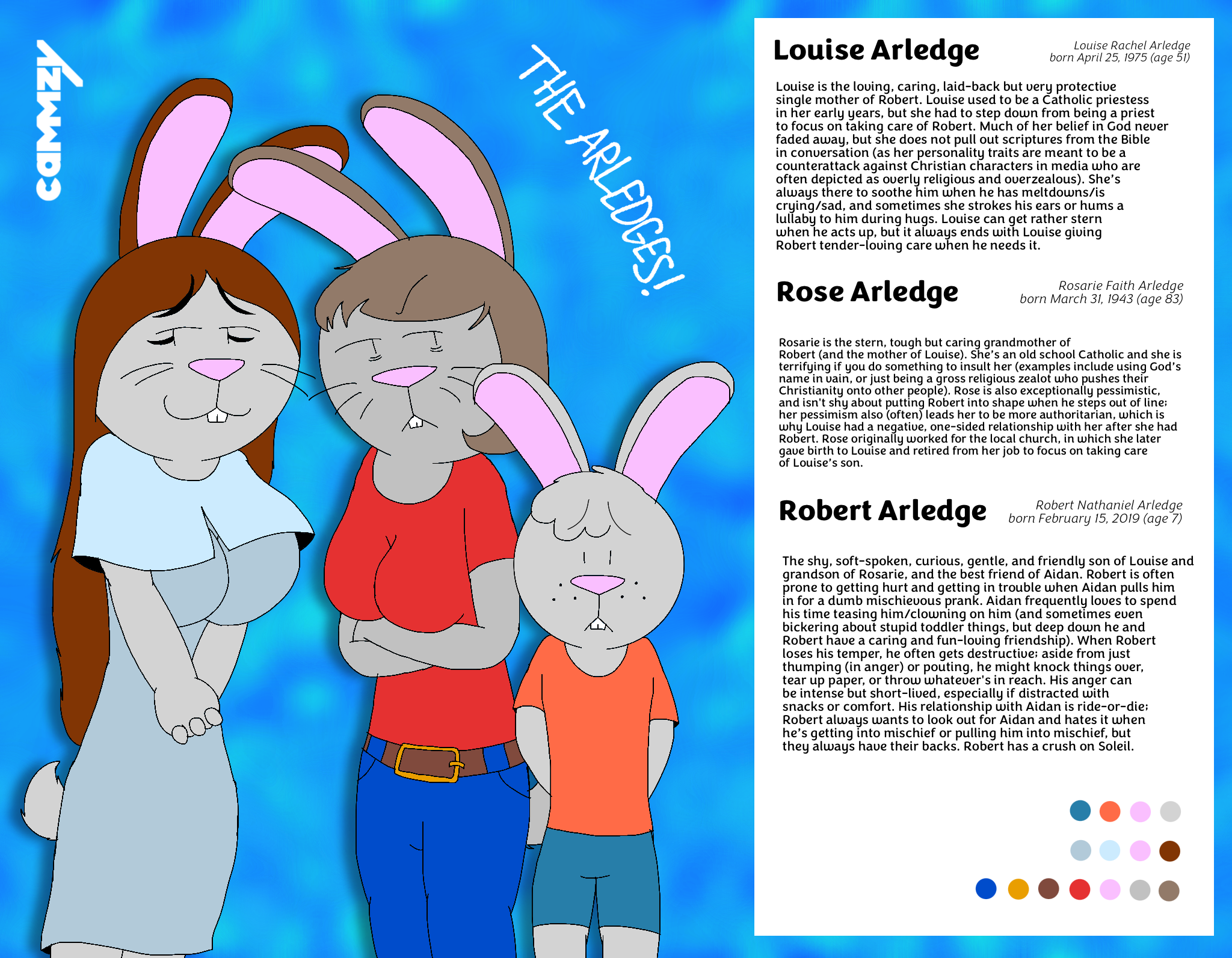
Louise Rachel Arledge (born April 25, 1975 (age 51))
Louise is the loving, caring, laid-back but very protective single mother of Robert. Louise used to be a Catholic priestess in her early years, but she had to step down from being a priest to focus on taking care of Robert. Much of her belief in God never faded away, but she does not pull out scriptures from the Bible in conversation (as her personality traits are meant to be a counterattack against Christian characters in media who are often depicted as overly religious and overzealous). She’s always there to soothe him when he has meltdowns/is crying/sad, and sometimes she strokes his ears or hums a lullaby to him during hugs. Louise can get rather stern when he acts up, but it always ends with Louise giving Robert tender-loving care when he needs it.
Rosarie Faith Arledge (born March 31, 1943 (age 83))
Rosarie is the stern, tough but caring grandmother of Robert (and the mother of Louise). She's an old school Catholic and she is terrifying if you do something to insult her (examples include using God's name in vain, or just being a gross religious zealot who pushes their Christianity onto other people). Rose is also exceptionally pessimistic, and isn't shy about putting Robert into shape when he steps out of line; her pessimism also (often) leads her to be more authoritarian, which is why Louise had a negative, one-sided relationship with her after she had Robert. Rose originally worked for the local church, in which she later gave birth to Louise and retired from her job to focus on taking care of Louise's son.
Robert Nathaniel Arledge (born February, 2019 (age 7))
The shy, soft-spoken, curious, gentle, and friendly son of Louise and grandson of Rosarie, and the best friend of Aidan. Robert is often prone to getting hurt and getting in trouble when Aidan pulls him in for a dumb mischievous prank. Aidan frequently loves to spend his time teasing him/clowning on him (and sometimes even bickering about stupid toddler things, but deep down he and Robert have a caring and fun-loving friendship). When Robert loses his temper, he often gets destructive; aside from just thumping (in anger) or pouting, he might knock things over, tear up paper, or throw whatever's in reach. His anger can be intense but short-lived, especially if distracted with snacks or comfort. His relationship with Aidan is ride-or-die; Robert always wants to look out for Aidan and hates it when he’s getting into mischief or pulling him into mischief, but they always have their backs. Robert has a crush on Soleil.
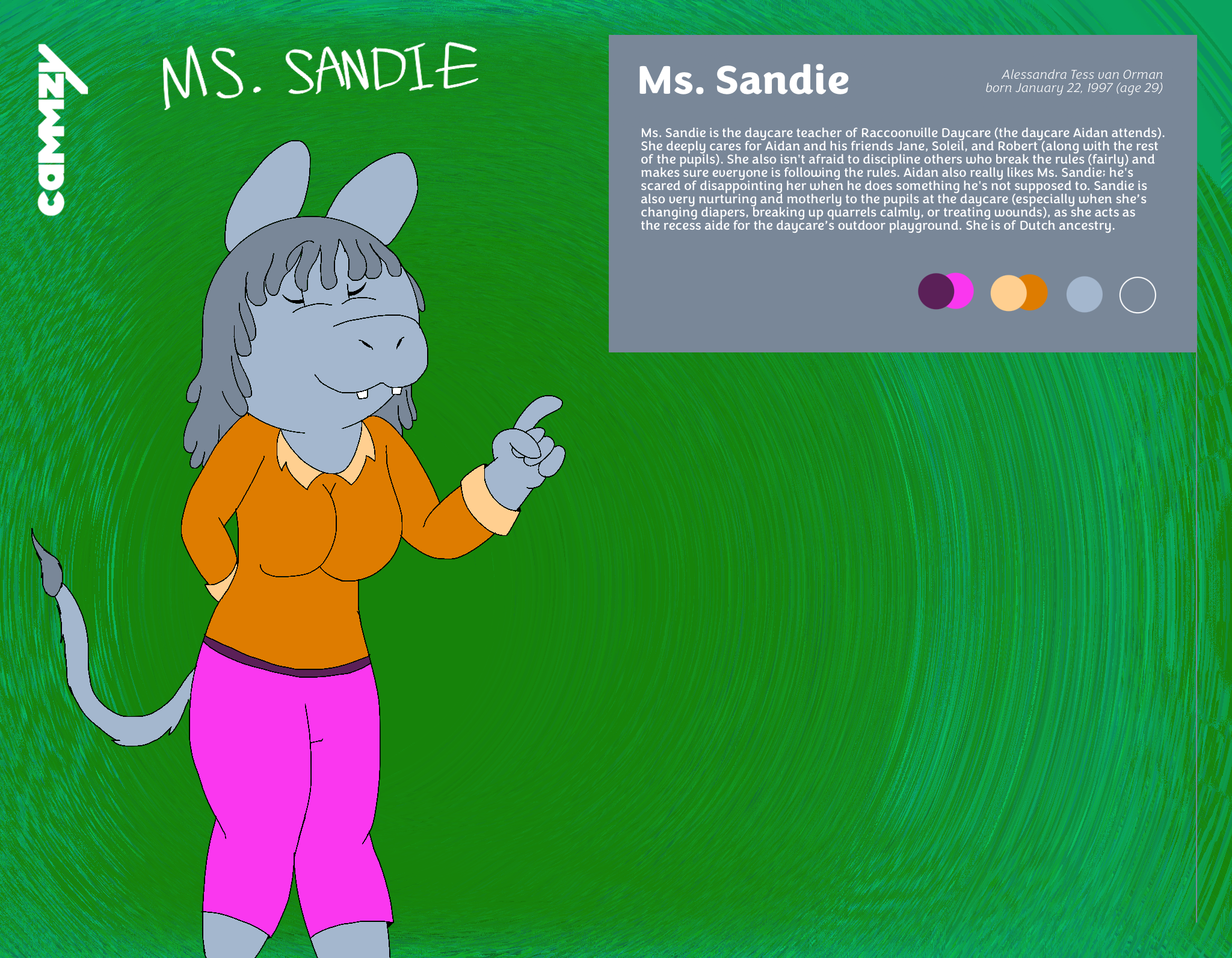
Alessandra Tess van Orman (born January 22, 1997 (age 29))
Ms. Sandie is the daycare teacher of Raccoonville Daycare (the daycare Aidan attends). She deeply cares for Aidan and his friends Jane, Soleil, and Robert (along with the rest of the pupils). She also isn't afraid to discipline others who break the rules (fairly) and makes sure everyone is following the rules. Aidan also really likes Ms. Sandie; he's scared of disappointing her when he does something he's not supposed to. Sandie is also very nurturing and motherly to the pupils at the daycare (especially when she’s changing diapers, breaking up quarrels calmly, or treating wounds), as she acts as the recess aide for the daycare’s outdoor playground. She is of Dutch ancestry.
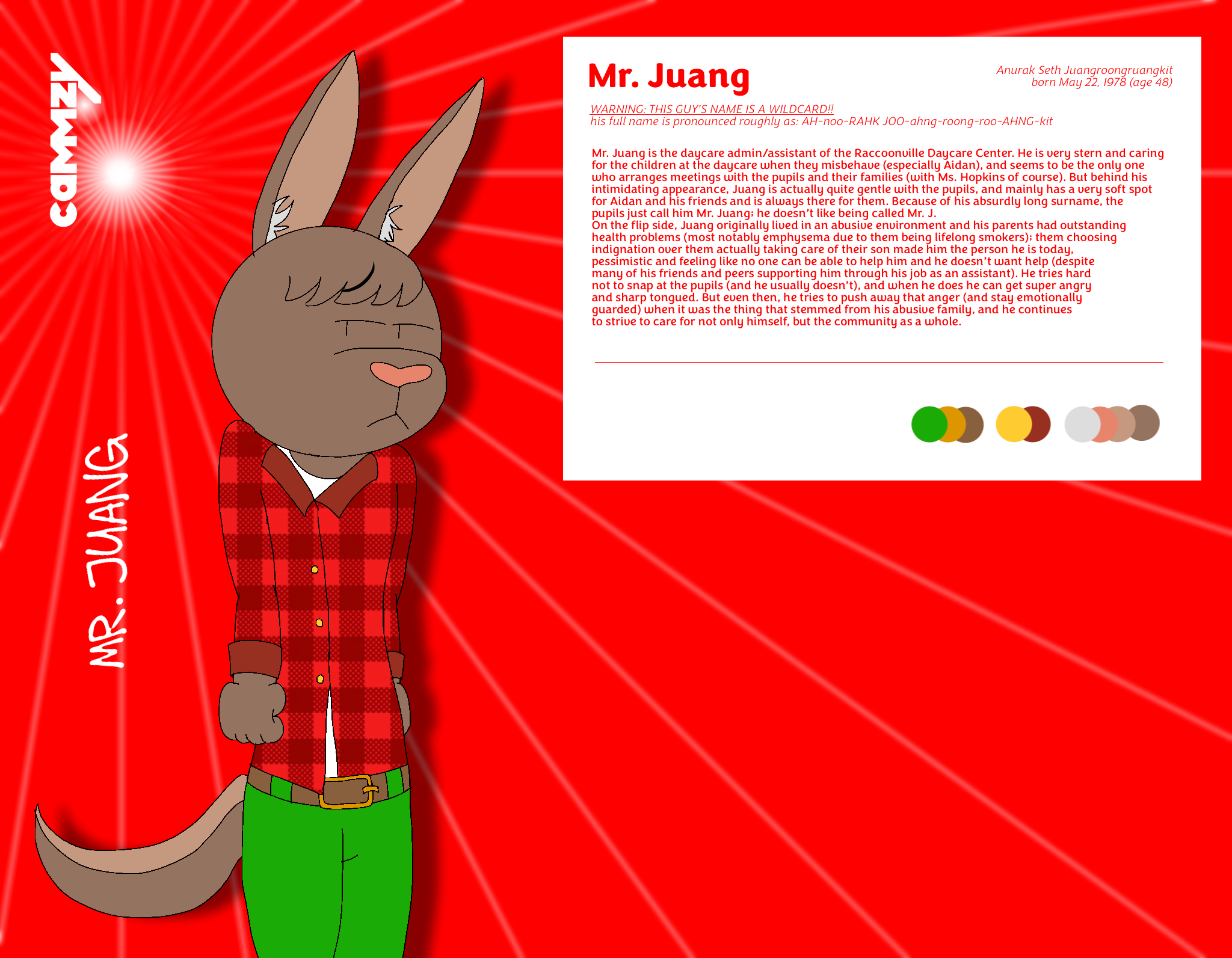
Anurak Seth Juangroongruangkit (born on May 22, 1978 (age 48))
Anurak Juangroongruangkit (pronounced roughly as: AH-noo-rack JOO-ahng-roong-roo-AHNG-kit; just called Mr. Juang) is the daycare admin/assistant of the Raccoonville Daycare Center. He is very stern and caring for the children at the daycare when they misbehave (especially Aidan), and seems to be the only one who arranges meetings with the pupils and their families (with Ms. Hopkins of course). But behind his intimidating appearance, Juang is actually quite gentle with the pupils, and mainly has a very soft spot for Aidan and his friends and is always there for them. Because of his absurdly long surname, the pupils just call him Mr. Juang; he doesn’t like being called Mr. J. On the flip side, Juang originally lived in an abusive environment and his parents had outstanding health problems (most notably emphysema due to them being lifelong smokers); them choosing indignation over them actually taking care of their son made him the person he is today, pessimistic and feeling like no one can be able to help him and he doesn’t want help (despite many of his friends and peers supporting him through his job as an assistant). He tries hard not to snap at the pupils (and he usually doesn’t), and when he does he can get super angry and sharp tongued. But even then, he tries to push away that anger (and stay emotionally guarded) when it was the thing that stemmed from his abusive family, and he continues to strive to care for not only himself, but the community as a whole.
Trivia
- Shea is 5’3” and Brad is 5’5”.
- Mr. Juang is 5’7” and is actually ripped. He would absolutely fight someone if they threatened a child, bullied a coworker, tried to physically assault him, or started a fight, but Juang doesn’t need to unless provoked.
- Mr. Juang is Australian and is of Thai descent.
- Robert’s favorite show is VeggieTales. It is also his comfort show and Louise loves watching it with him.
- Robert’s favorite snack is applesauce. Sometimes he enjoys it so much that he forgets to use the bathroom.
- Because of Robert having big emotions, he often tries to calm himself down by counting, a trick his mom taught him.
- Since Aidan is only little, he often mispronounces certain words (like saying “sowwy” instead of “sorry”).
- Pete Milonakis is Brad’s best friend, who he regularly hangs out with at bars. He also enjoys spending time at his house painting, drinking coffee, and watching movies and television. He was born with ‘growth hormone deficiency’, which caused him to sound and look like an early adolescent child, and because of that Brad often makes (lighthearted) jokes about him being a child, much to his embarrassment. If you think people won’t let him do adult things because he has a child-like voice, you’re wrong because the bartenders at his local bar are actually okay with Pete having the voice of a preteen, because he’s 32 (plus he’s literally at that age where he’s legally allowed to drink). Aside from that, Pete has a very strong and supportive bond with Aidan; he’ll entertain him, watch cartoons with him, even let him climb on him like a jungle gym, or other things (and like Brad, he often enables Aidan’s chaotic behavior, but Pete doesn’t do much to try and redirect him because he loves having fun with him too much). Aidan is also oblivious to the fact that Pete is actually an adult and thinks he’s a “big kid” because he has the voice of a 12 year old; he doesn’t care that Pete sounds like a child, he just sees him as one of the nice grown-ups who won’t judge him for being hyper. Pete sometimes substitutes as the daycare assistant for Raccoonville Daycare. Pete is based off of (real-life) American actor and comedian Andy Milonakis (down to the name), who was born with growth hormone deficiency, just like Pete. Andy is 50 years old as of today.
Soleil
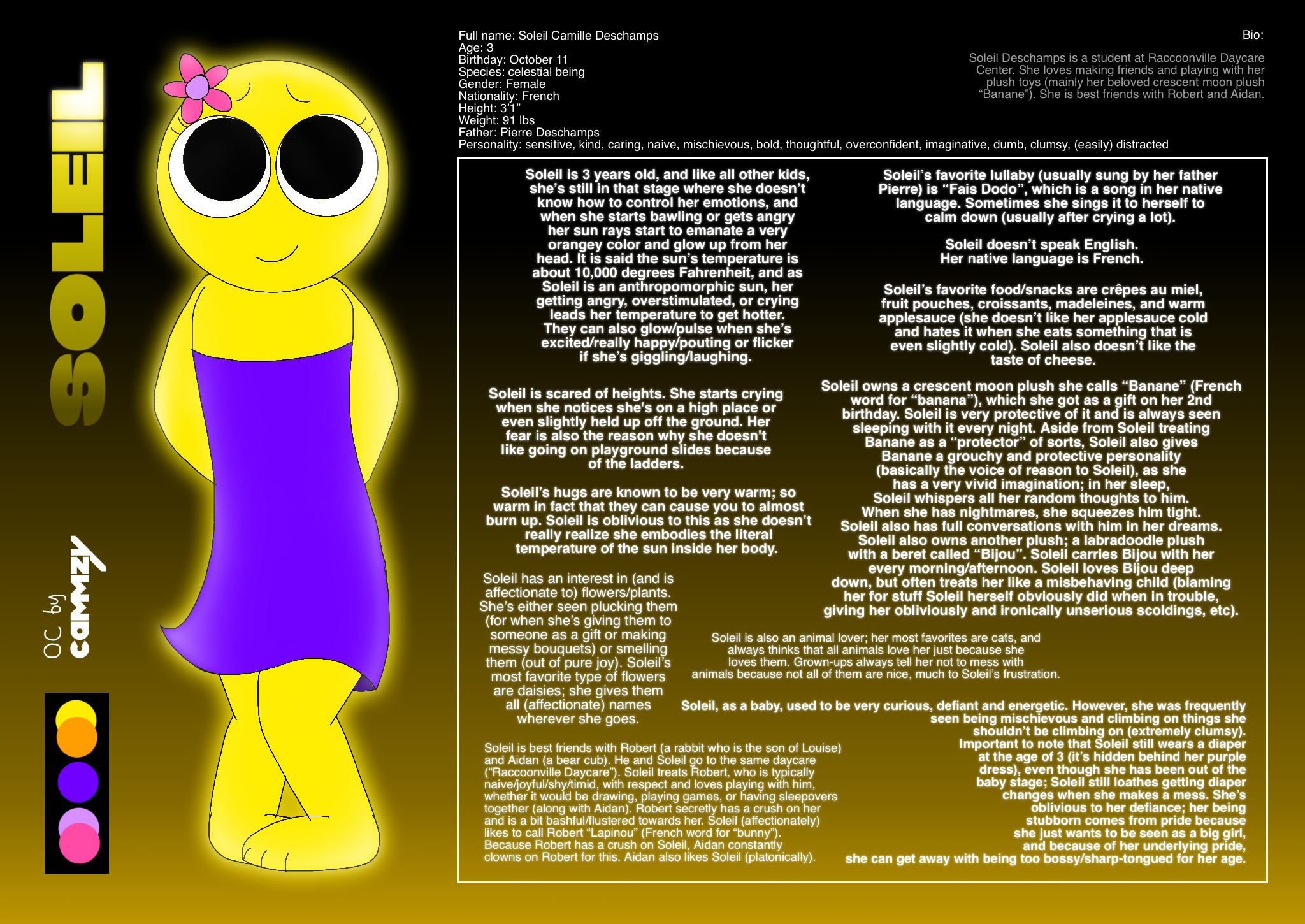
Full name: Soleil Camille Deschamps
Nickname(s): Sunny, Sol
Age: 3
Birthday: October 11
Species: celestial being
Gender: Female
Nationality: French
Height: 3’1”
Weight: 91 lbs
Father: Pierre Deschamps
Personality: sensitive, kind, caring, naive, mischievous, bold, thoughtful, overconfident, imaginative, dumb, clumsy, (easily) distracted
Bio:
Soleil Deschamps is a student at Raccoonville Daycare Center. She loves making friends and playing with her plush toys (mainly her beloved crescent moon plush “Banane”). She is best friends with Robert and Aidan.
Trivia
- Soleil is 3 years old, and like all other kids, she’s still in that stage where she doesn’t know how to control her emotions, and when she starts bawling or gets angry her sun rays start to emanate a very orangey color and glow up from her head. It is said the sun’s temperature is about 10,000 degrees Fahrenheit, and as Soleil is an anthropomorphic sun, her getting angry, overstimulated, or crying leads her temperature to get hotter. They can also glow/pulse when she’s excited/really happy/pouting or flicker if she’s giggling/laughing.
- Soleil’s favorite seasons are Spring and Winter.
- Soleil doesn’t speak English. Her native language is French.
- Soleil’s favorite lullaby (usually sung by her father Pierre) is “Fais Dodo”, which is a song in her native language. Sometimes she sings it to herself to calm down (usually after crying a lot).
- Soleil’s favorite food/snacks are crêpes au miel, fruit pouches, croissants, madeleines, and warm applesauce (she doesn’t like her applesauce cold). Soleil also doesn’t like the taste of cheese.
- Soleil is scared of heights. She starts crying when she notices she's on a high place or even slightly held up off the ground. Her fear is also the reason why she doesn't like going on playground slides because of the ladders.
- Soleil owns a crescent moon plush she calls “Banane” (French word for “banana”), which she got as a gift on her 2nd birthday. Soleil is very protective of it and is always seen sleeping with it every night. Aside from Soleil treating Banane as a “protector” of sorts, Soleil also gives Banane a grouchy and protective personality (basically the voice of reason to Soleil), as she has a very vivid imagination; in her sleep, Soleil whispers all her random thoughts to him. When she has nightmares, she squeezes him tight. Soleil also has full conversations with him in her dreams. Soleil also owns another plush; a labradoodle plush with a beret called “Bijou”. Soleil carries Bijou with her every morning/afternoon. Soleil loves Bijou deep down but treats her like Meg Griffin from the show Family Guy at times - blaming her for stuff Soleil herself obviously did when in trouble, giving her obliviously and ironically unserious scoldings, etc.
- Soleil’s hugs are known to be very warm; so warm in fact that they can cause you to almost burn up. Soleil is oblivious to this as she doesn’t really realize she embodies the literal temperature of the sun inside her body.
- Soleil has an interest in (and is affectionate to) flowers/plants. She’s either seen plucking them (for when she’s giving them to someone as a gift or making messy bouquets) or smelling them (out of pure joy). Soleil’s most favorite type of flowers are daisies; she gives them all (affectionate) names wherever she goes.
- Soleil is best friends with Robert (a rabbit who is the son of Louise) and Aidan (a bear cub). He and Soleil go to the same daycare (“Raccoonville Daycare”). Soleil treats Robert, who is typically naive/joyful/shy/timid, with respect and loves playing with him, whether it would be drawing, playing games, or having sleepovers together (along with Aidan). Robert secretly has a crush on her and is a bit bashful/flustered towards her. Soleil (affectionately) likes to call him “Lapinou” (French word for “bunny”). Because Robert has a crush on Soleil, Aidan constantly clowns on Robert for this (because he’s a chaotic 4-year-old toddler who lives for drama he doesn’t even understand). Aidan also likes Soleil (platonically).
- Soleil is also an animal lover; her most favorites are cats and always thinks that all animals love her just because she loves them. Grown-ups always tell her not to mess with animals because not all of them are nice, much to Soleil’s frustration.
- Soleil, as a baby, used to be very curious, defiant and energetic. However, she was frequently seen being mischievous and climbing on things she shouldn’t be climbing on (extremely clumsy). Important to note that Soleil still wears a diaper at the age of 3 (it’s hidden behind her purple dress), even though she has been out of the baby stage; Soleil still loathes getting diaper changes when she makes a mess. She’s oblivious to her defiance; her being stubborn comes from pride because she just wants to be seen as a big girl, and because of her underlying pride, she can get away with being too bossy/sharp-tongued for her age.
- Soleil has a father named Pierre, who is wise, soft-spoken and very protective of his daughter. Despite Soleil's hyperactive nature, he's surprisingly patient with her and plays along with her imaginative endeavors (particularly with her stuffed toys). Pierre is the only one to calm Soleil down during a meltdown/crying fit or carry her when she's overwhelmed. He works as a visual artist in Brooklyn, New York City (Auvers-sur-Oise, Paris was the hometown he and her daughter lived in for years; his childhood home burnt down in January, so he had to move to Brooklyn because of that). His work (which he loves displaying all around art exhibitions) explores experimentation, “self-scripting”, and fractured identity. He truly thinks art itself to be a form of catharsis, like all other artforms.
Pierre
Full name: Pierre Gaston Deschamps
Age: 80
Birthday: February 22
Species: celestial being (sun)
Nationality: French
Height: 5’6”
Weight: 112 lbs
Bio:
Pierre is Soleil's dad, who is wise, soft-spoken and very protective of his daughter. Despite Soleil's hyperactive nature, he's surprisingly patient with her and plays along with her imaginative endeavors (particularly with her stuffed toys). Pierre is the only one to calm Soleil down during a meltdown/crying fit or carry her when she's overwhelmed. So basically, Pierre's the same as Soleil but calmer and more collected. He also has the same body temperature as her, but it's stronger than it looks (approx. 15,500°C).
Trivia
- Pierre is a huge fan of literature, and his favorite artists/writers are H.G. Wells, H.R. Giger, and H.P. Lovecraft.
- Pierre works as a visual artist in Brooklyn, New York City (Auvers-sur-Oise, Paris was the hometown he and her daughter lived in for years; his childhood home burnt down in January, so he had to move to Brooklyn because of that). His work (which he loves displaying all around art exhibitions) explores experimentation, “self-scripting”, and fractured identity. He truly thinks art itself to be a form of catharsis, like all other artforms.
- Pierre is the only one that takes Soleil to the Raccoonville Daycare center (in the United States) to play with her friends.
Endemol
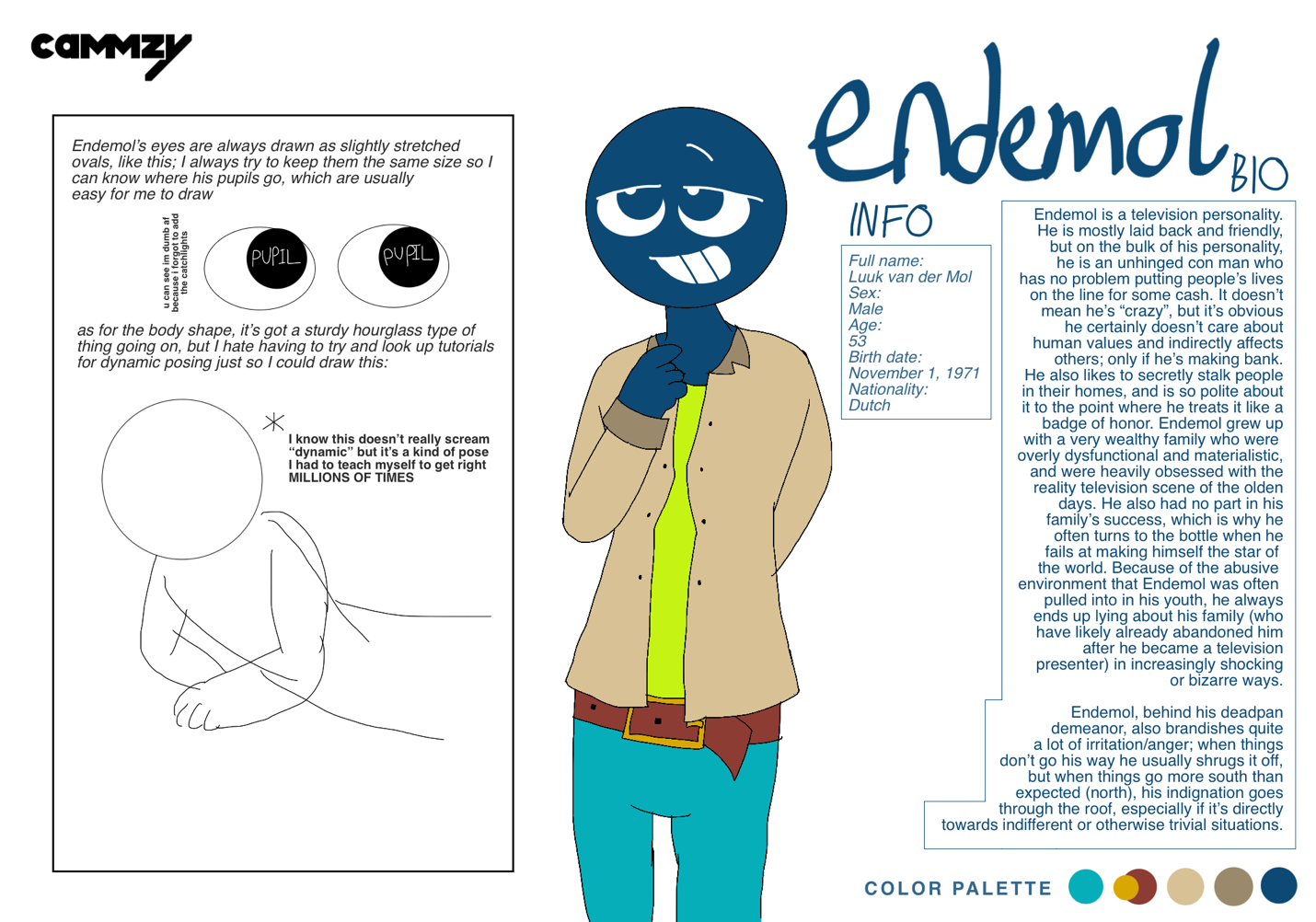
Bio:
Endemol is a television personality. He is mostly laid back and friendly, but on the bulk of his personality, he is an unhinged con man who has no problem putting people’s lives on the line for some cash. It doesn’t mean he’s “crazy”, but it’s obvious he certainly doesn’t care about human values and indirectly affects others; only if he’s making bank. He also likes to secretly stalk people in their homes and is so polite about it to the point where he treats it like a badge of honor. Endemol grew up with a very wealthy family, who were overly dysfunctional and materialistic and were heavily obsessed with the reality television scene of the olden days. He also had no part in his family’s success, which is why he often turns to the bottle when he tries making himself the star of the world. Because of the abusive environment that Endemol was often pulled into in his youth, he always ends up lying about his family (who have likely already abandoned him after he became a television presenter) in increasingly shocking or bizarre ways.
Endemol, behind his deadpan demeanor, also brandishes quite a lot of irritation/anger; when things don’t go his way he usually shrugs it off, but when things go more south than expected (north), his indignation goes through the roof, especially if it’s directly towards indifferent or otherwise trivial situations. And further beneath his sleazy personality, he is well versed and capable of self-reflection and awareness, especially awareness of the fact that he himself is the problem, but he pretends not to do so to improve his self-image.
Info:
Full name: Luuk van der Mol
Sex: Male
Age: 54
Birth date: November 1, 1971
Nationality: Dutch
Height: 5’11
Weight: 38 lbs
This section includes characters that Cammzy has considered “standalone” (some are sent to the dump because reasons, and are only drawn by him so he can stimulate his senses more), and are generally not considered a part of the Camniverse. Despite this, Cammzy still treats these characters in drawings/sketches as a part of the same universe mentioned before.
When a character’s name has a strikethrough, it means the character has been retired or shelved and may not appear in future artwork.
Damien
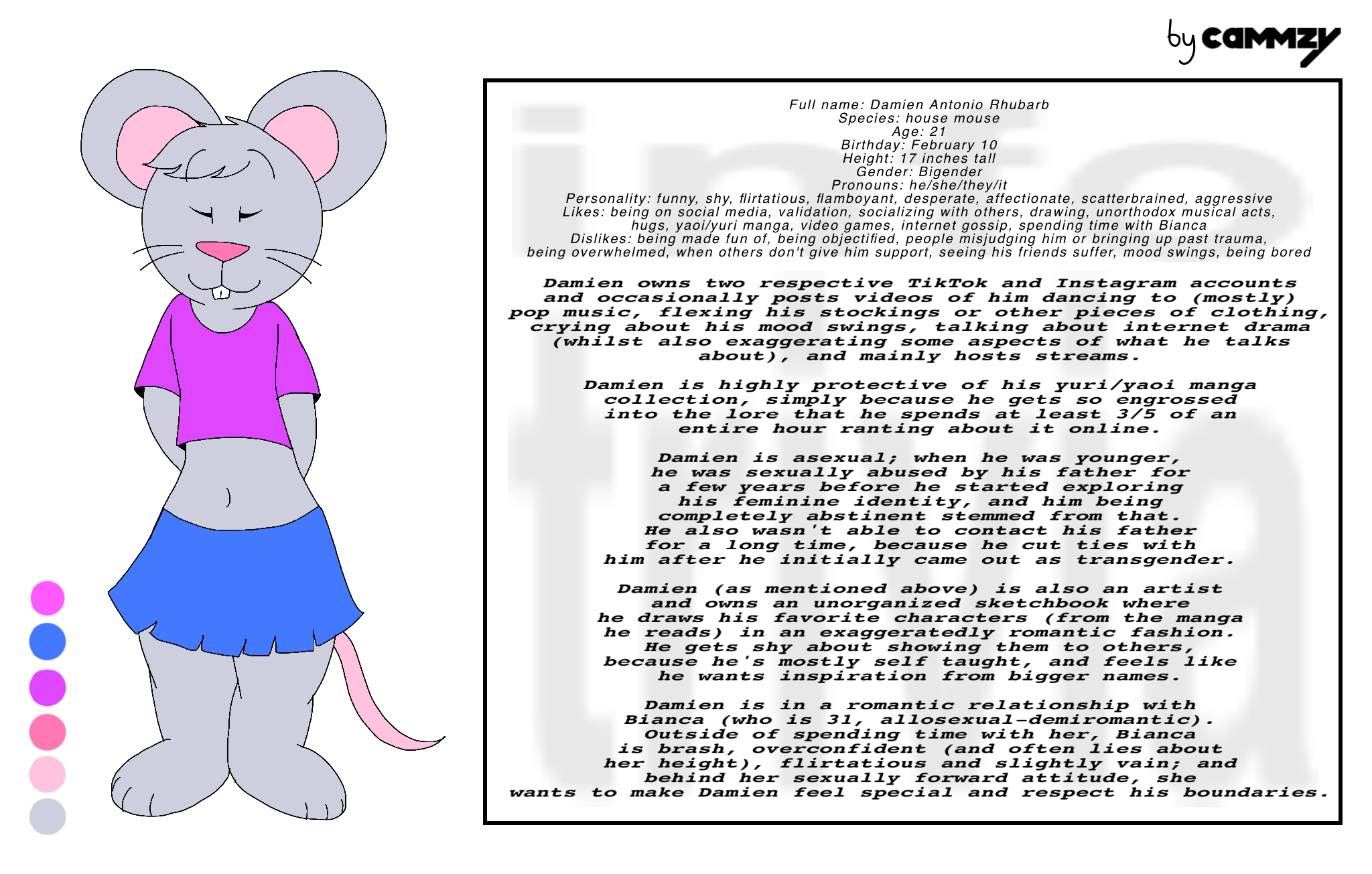
Full name: Damien Antonio Rhubarb
Species: house mouse
Age: 21
Birthday: February 10
Height: 17 inches tall
Gender: Bigender
Pronouns: he/she/they/it
Personality: funny, shy, flirtatious, flamboyant, desperate, affectionate, (at times) scatterbrained, aggressive
Likes: being on social media, validation, socializing with others, drawing, unorthodox musical acts, hugs, yaoi/yuri manga, video games, internet gossip, spending time with Bianca
Dislikes: being made fun of, being objectified, people misjudging him or bringing up past trauma, being overwhelmed, when others don't give him support, seeing his friends suffer, mood swings, being bored
Partner: Bianca Mouse
Trivia:
- Damien owns two respective TikTok and Instagram accounts and occasionally posts videos of him dancing to (mostly) pop music, flexing his stockings or other pieces of clothing, crying about his mood swings, talking about internet drama (whilst also exaggerating some aspects of what he talks about), and mainly hosts streams.
- Damien is highly protective of his yuri/yaoi manga collection, simply because he gets so engrossed into the lore that he spends at least 3/5 of an entire hour ranting about it online.
- Damien is asexual; when he was younger, he was sexually abused by his father for a few years before he started exploring his feminine identity, and him being completely abstinent stemmed from that. He also wasn't able to contact his father for a long time, because he cut ties with him after he initially came out as transgender.
- Damien (as mentioned above) is also an artist and owns an unorganized sketchbook where he draws his favorite characters from the manga he reads in an exaggeratedly romantic fashion. He gets shy about showing them to others, because he's mostly self taught, and feels like he wants inspiration from bigger names.
- Damien is in a romantic relationship with Bianca (who is 31, allosexual-demiromantic). Outside of spending time with her, Bianca is brash, overconfident (and often lies about her height), flirtatious and slightly vain; and behind her sexually forward attitude, she wants to make Damien feel special and respect his boundaries.
Nelvana
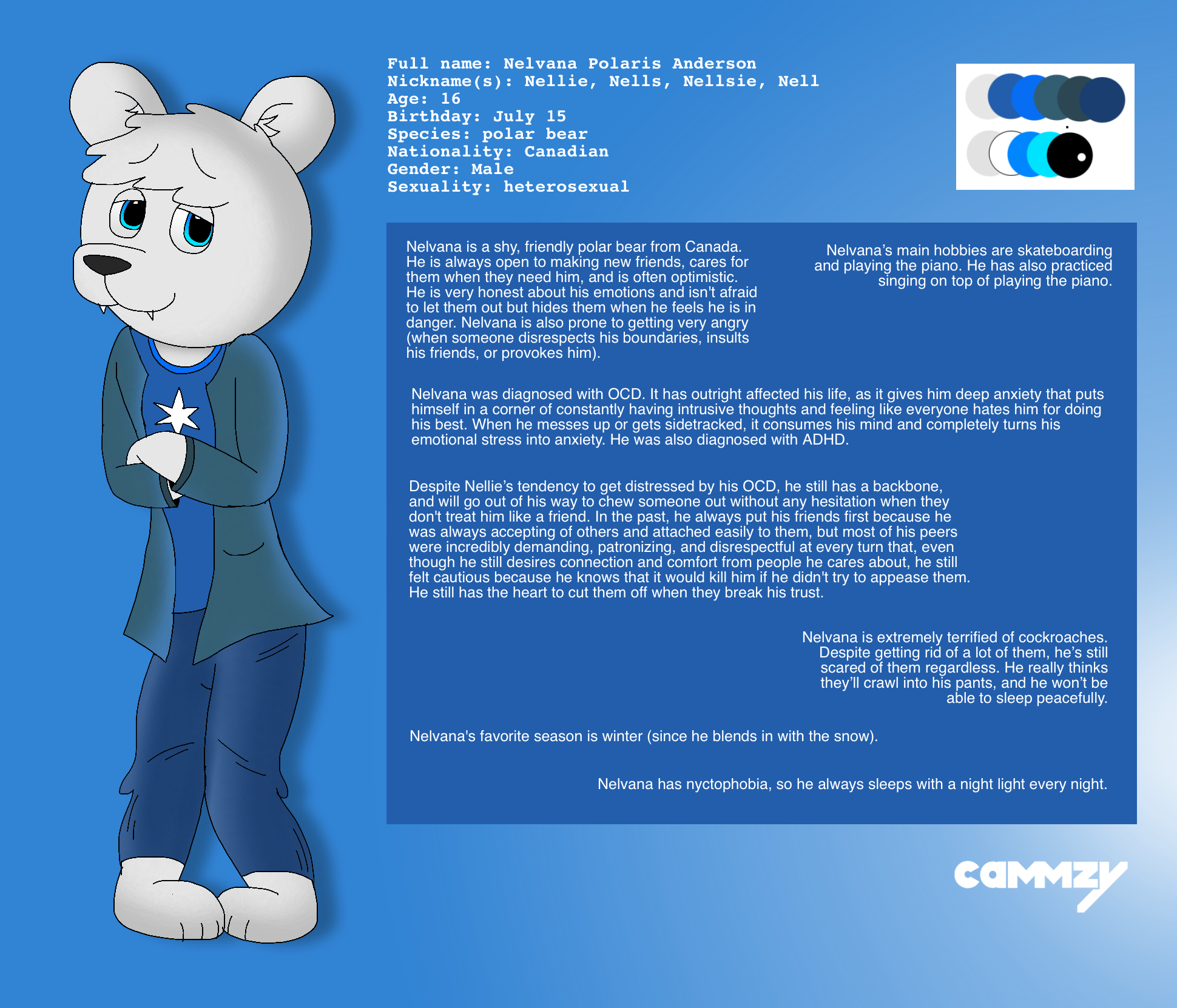
Full name: Nelvana Polaris Anderson
Nickname(s): Nellie, Nells, Nellsie, Nell
Age: 16
Birthday: July 15
Species: polar bear
Nationality: Canadian
Gender: Male
Sexuality: heterosexual
Nelvana is a shy, friendly polar bear from Canada. He is always open to making new friends, cares for them when they need him, and is often optimistic. He is very honest about his emotions and isn't afraid to let them out but hides them when he feels he is in danger. Nelvana is also prone to getting very angry (when someone disrespects his boundaries, insults his friends, or provokes him).
Trivia:
- Nelvana’s main hobbies are skateboarding and playing the piano. He has also practiced singing on top of playing the piano.
- Nelvana was diagnosed with OCD. It has outright affected his life, as it gives him deep anxiety that puts himself in a corner of constantly having intrusive thoughts and feeling like everyone hates him for doing his best. When he messes up or gets sidetracked, it consumes his mind and completely turns his emotional stress into anxiety. He was also diagnosed with ADHD.
- Despite Nellie’s tendency to get distressed by his OCD, he still has a backbone, and will go out of his way to chew someone out without any hesitation when they don't treat him like a friend. In the past, he always put his friends first because he was always accepting of others and attached easily to them, but most of his peers were incredibly demanding, patronizing, and disrespectful at every turn that, even though he still desires connection and comfort from people he cares about, he still felt cautious because he knows that it would kill him if he didn't try to appease them. He still has the heart to cut them off when they break his trust.
- Nelvana is extremely terrified of cockroaches. Despite getting rid of a lot of them, he’s still scared of them regardless. He really thinks they’ll crawl into his pants, and he won’t be able to sleep peacefully.
- Nelvana's favorite season is winter (since he blends in with the snow).
- Nelvana has nyctophobia, so he always sleeps with a night light every night.
Groß
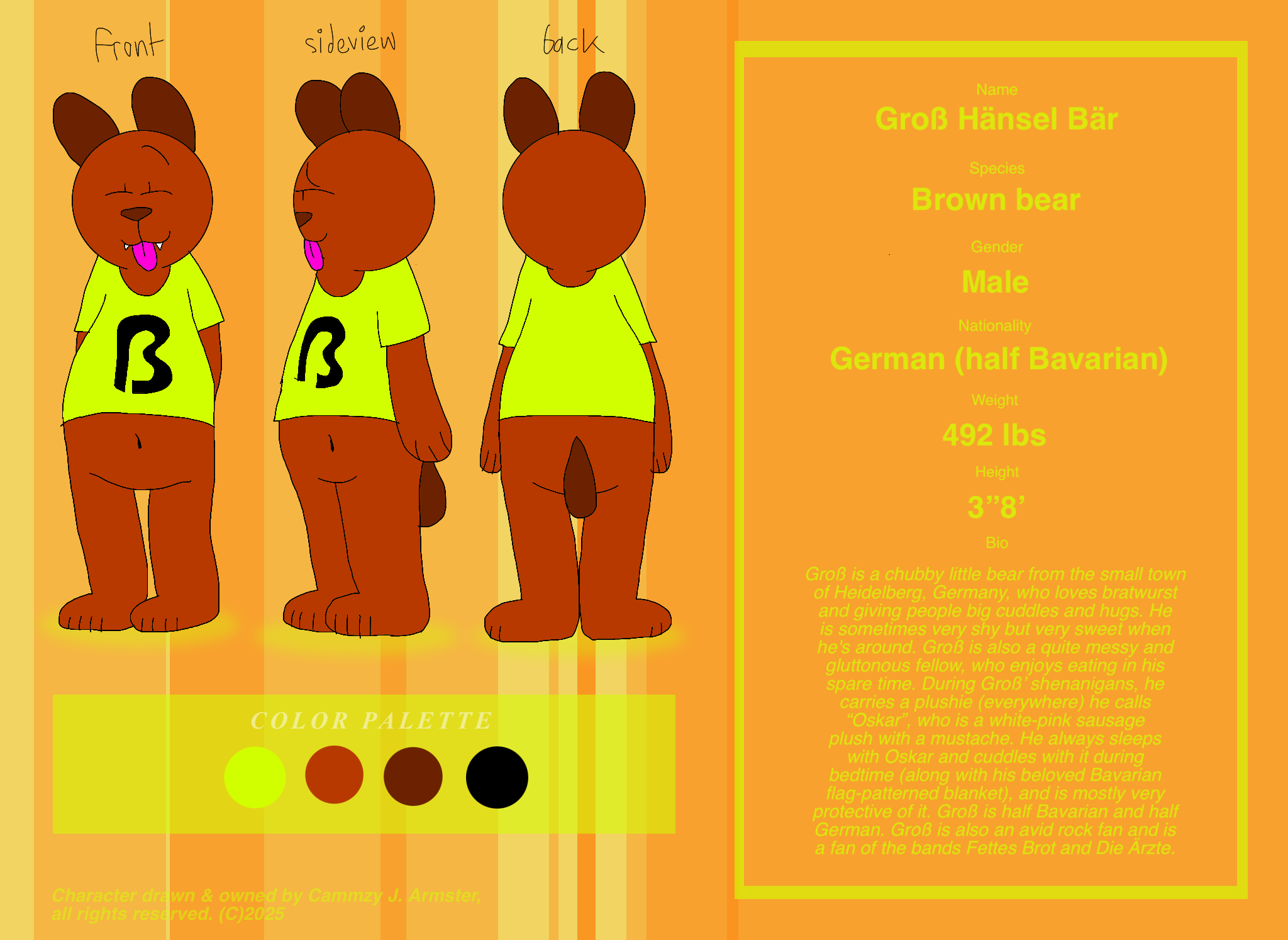
Origin
Groß is an anthropomorphic, overweight brown bear. He wears a yellow-green shirt with a black, enlarged “ß” on it. His design came from a spontaneous idea I had where I was gonna try and personify random letters not used in English and “ß” was one of them… and then it turned into that
Biography
Groß is a chubby little bear from the small town of Heidelberg, Germany, who loves bratwurst and giving people big cuddles and hugs. He is sometimes very shy but very sweet when he's around. Groß is also a quite messy and gluttonous fellow, who enjoys eating in his spare time. During Groß’ shenanigans, he carries a plushie (everywhere) he calls “Oskar”, who is a white-pink sausage plush with a mustache. He always sleeps with Oskar and cuddles with it during bedtime (along with his beloved Bavarian flag-patterned blanket) and is mostly very protective of it.
Main Info
- Full name: Groß Hänsel Bärnhardt
- Birth date: March 16
- Gender: Male
- Species: Brown bear
- Home: Heidelberg, Germany
- Personality: Goofy, funny, childish, joyous, sweet, (sometimes) stubborn, whiny, boisterous, noisy, clumsy
- Height: 3’8”
- Weight: 492 lbs
- Clearly has the mind of a dumb but endearing toddler
Likes
- Eating bratwurst, hot dogs, donuts, pretzels, schnitzel, cake, honey, chocolate, potato pancakes, candy (excluding gummy bears), gummy worms, bread, and fries
- Sleeping with his blanket and his sausage plush Oskar in bed
- Showing (unsuspecting) people his butt
- Eating messily
- Making fart noises (he finds it funny as hell apparently)
Dislikes
- Losing his stuffed sausage plush Oskar or his blankie
- Getting teased/picked on (usually for his chubbiness)
- People touching his plush Oskar (he will actually go absolutely feral)
- Getting scolded/harshly punished
- Imaginary monsters (he’s very terrified of them) and getting scared of the dark
- Getting denied the right to eat snacks
Trivia
- Groß’s last name, “Bär”, is actually short for “Bärnhardt”; it's completely contradictory to Groß's personality because his full name sounds extremely proper. (which is fine lol) So his (kinda actual) full name is “Groß Hänsel Bärnhardt”
- Groß is half Bavarian and half German.
- Groß is also an avid rock fan and is a fan of the bands Fettes Brot and Die Ärzte.
- Groß eats like an absolute baby, with so much enthusiasm even that half the food ends up on his face, shirt, and sometimes the floor. If it’s really good, he does a happy wiggle while chewing. If it’s saucy food, his cheeks and paws are covered in sauce by the end of the meal. If he’s eating powdered donuts or anything with crumbs, it’s EVERYWHERE; on his fur, shirt, the table, and even the floor too. Sometimes he drops food on himself, looks down at it, and just eats it anyway.
- Groß purrs (though it’s really called “chuffing”) when he’s happy/pleasured.
- Groß doesn't like pickles; he gags every time he even smells the scent of pickles.
- Groß is a big fan of Oktoberfest (getting way too rowdy with the beer, food and snacks, munching on bratwurst and pretzels).
- Tall people scare Groß to death.
- Every time Groß hugs his sausage plush (Oskar) it makes a squeaking noise.
- Since Groß' personality is... well, quite childish, it's unsurprising to know his brain is about the size of a peanut, despite Groß being a fat adult bear. Also not helping is the fact he has the attention span of a goldfish
- Groß’ breath smells like rotten pretzels
- Instead of Groß wearing his usual shirt, sometimes he'll just be in his white underwear and not wear a shirt at all (especially if he's sleeping with his plush and blankie)
- Groß speaks with a childish, thick German accent.
Headcanon voice(s):
- English/German — Fritz Rott (DE)
Nash
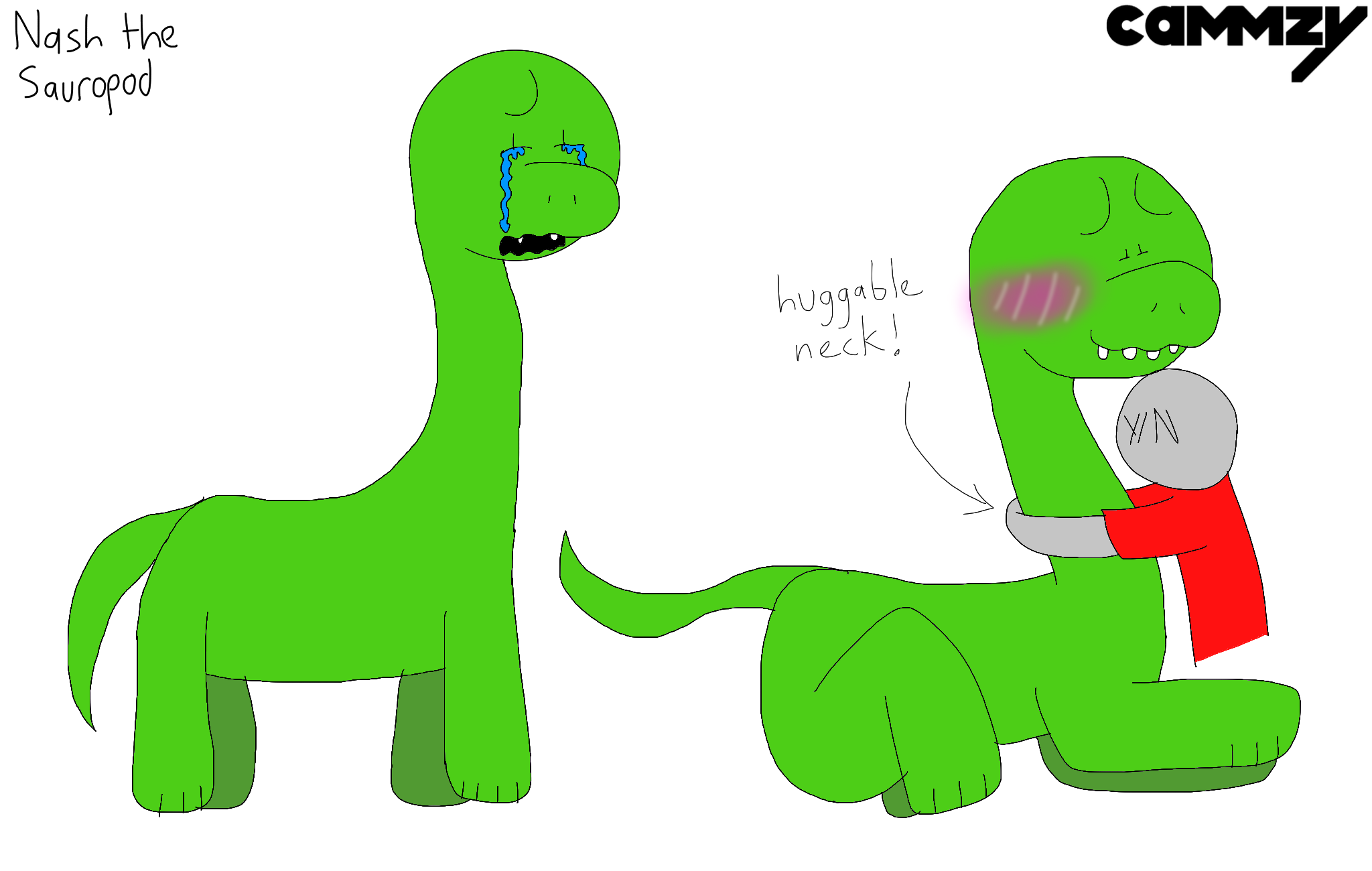
Full name: Nashton Tucker O’Saurus
Nickname(s): Nash, Ash
Personality: stupid, childish, cowardly, selfish, naive, petty, foolish, greedy, kind, goofy, funny, sensitive
Height: 8’1”
Weight: 600 lbs
Species: sauropod
Nash is an unintelligent, cowardly and oblivious sauropod. He speaks with a lisp (speech impediment) and is constantly made fun of because of his long neck.
Trivia:
- Nash is scared by thunder, butterflies, humans (usually those just trying to be nice to him), wasps, mice, tarantulas, pigeons, and even bigger (and scary) animals. When Nash gets really scared, it’s usually either him whining in fear, running like a coward, or crying/shivering balled up with his tail tucked in
- He is also extremely clumsy and prone to accidents/getting hurt because of his long neck and height. He tends to cry/sob/sniffle a lot when he gets hurt and immediately seeks comfort
- Nash has a keen sense of smell. This, however, is the reason why he has no sort of self-control when it comes to food as Nash is an extremely greedy eater, yet he ends up crying when someone admonishes him.
- Nash’s favorite snacks to eat are leaves, cabbage, fruits, and his most favorite, apple pie (pie however makes him quite energetic). He also loves eating grapes from grape trees (a bit too much).
- Because of Nash’s size and stubby feet, he cannot be able to hold anything (like a toy or something else) with his feet. Instead, he holds stuff with his mouth. This obviously (on some occasions) leads to him drooling on the stuff he holds.
- Nash's favorite toy to play with/sleep with is a rock with googly eyes on it (who he affectionately calls “Ducky”).
- Nash has a romantic/platonic relationship with Groß. For info on Groß himself, Groß is a fat bear from the small town of Heidelberg, Germany, who loves bratwurst and giving people big cuddles and hugs. He is sometimes very shy but very sweet when he's around. Groß is also a quite messy and gluttonous fellow, who enjoys eating in his spare time. During his shenanigans, he carries a plushie (everywhere) he calls “Oskar”, who is a white-pink sausage plush with a mustache. He always sleeps with Oskar and cuddles with it during bedtime (along with his beloved Bavarian flag-patterned blanket) and is mostly very protective of it.
Headcanon voices:
- English — Bill Fagerbakke (US)
- Spanish — César Diaz Capilla (ES)
Jay
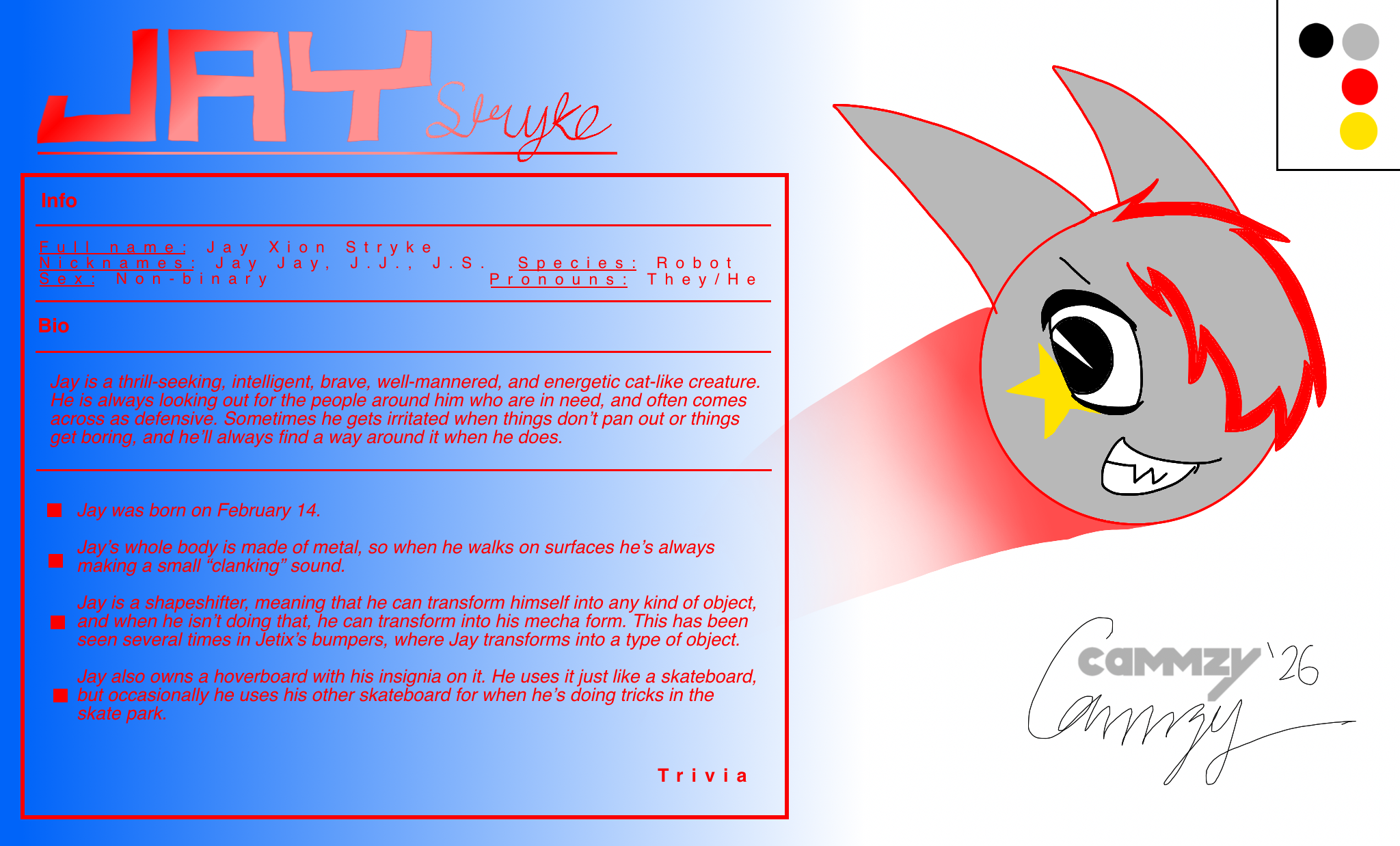
Outline
Jay is thrill-seeking, intelligent, brave, and energetic. He is always looking out for the people around him who are in need, and often comes across as defensive. Sometimes he gets irritated or impatient when things don’t pan out or things get boring, and he’ll always find a way around it when he does. He is also relatively laid-back, and doesn't let negativity get to him for the sake of his big ego.
Jay is drawn (on the digital open source drawing app Kleki) with a red outline (precisely 3px). His predominant, spiky tuft of hair also has a red streak (which Jay dyed himself) that goes inside of it. He also (someitmes) has a dyed yellow star on the bottom left side of his singular eye.
He also has stubby, angular legs that he can be able to sprout from, but when he’s hovering, he doesn’t use his legs.
Info
Full name: Jay Xion Stryke
Nicknames: Jay Jay, J.J., J.S.
Species: Robot
Sex: Non-binary
Pronouns: They/He
Trivia
- Jay was born on February 14.
- Jay’s whole body is made of metal, so when he walks on surfaces he’s always making a small “clanking” sound.
- Jay is a shapeshifter, meaning that he can transform himself into any kind of object, and when he isn’t doing that, he can transform into his mecha form. This has been seen several times in Jetix’s bumpers, where Jay transforms into a type of object.
- Jay also owns a hoverboard with his insignia on it. He often uses it just like a skateboard, but occasionally he uses his other skateboard for when he’s doing tricks in the skate park.
This standalone character was based off of the mascot of the same name (of defunct children’s television brand Jetix).
Gnawbone
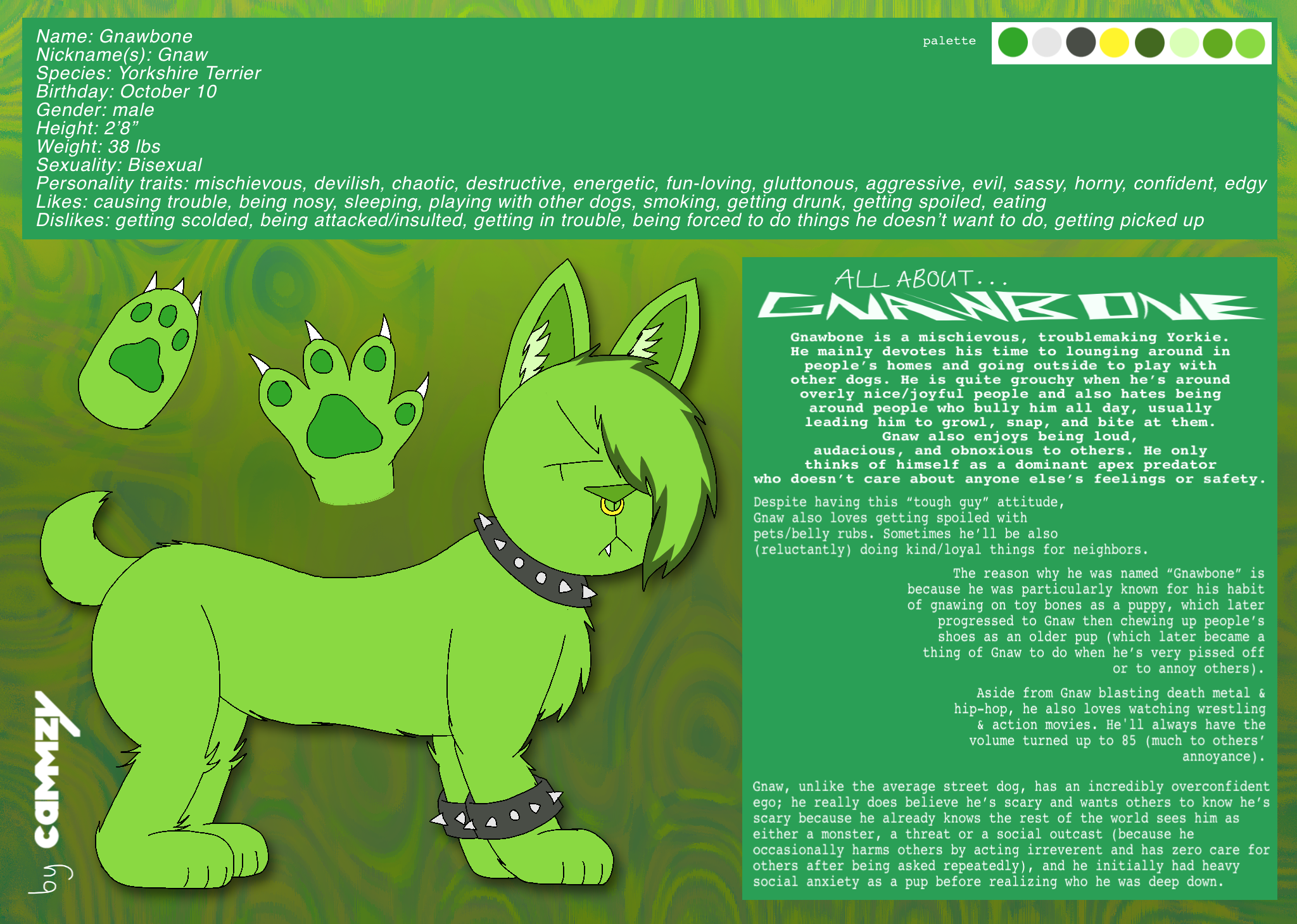
Name: Gnawbone
Nickname(s): Gnaw, Bones
Species: Yorkshire Terrier
Birthday: October 10
Gender: male
Height: 2’8”
Weight: 38 lbs
Sexuality: Bisexual
Personality traits: mischievous, devilish, chaotic, destructive, energetic, fun-loving, gluttonous, aggressive, evil, sassy, confident, edgy
Likes: causing trouble, being nosy, sleeping, playing with other dogs, smoking, getting drunk, getting spoiled, eating
Dislikes: getting scolded, being attacked/insulted, getting in trouble, being forced to do things he doesn’t want to do, getting picked up
Appearance: Gnawbone is a non-anthro Yorkshire Terrier with unkempt, green fur. He has emo-styled fringe hair that often covers the right side of his head and has a nose ring under his nose. He often wears a spiked choker along with choker cuffs on his legs.
Bio:
Gnawbone is a mischievous, troublemaking Yorkie. He mainly devotes his time to lounging around in people’s homes and going outside to play with other dogs. He is quite grouchy when he’s around overly nice/joyful people and also hates being around people who bully him all day, usually leading him to growl, snap, and bite at them. Gnaw also enjoys being childishly loud, audacious, and obnoxious to others. He only thinks of himself as a dominant apex predator who doesn’t care about anyone else’s feelings or safety.
Bio summary:
Gnawbone is a Yorkie Terrier with a penchant for making people suffer, causing trouble, yet has a soft heart beneath his cynical, foul-mouthed demeanor. He had social anxiety as a pup and would always invert it into aggression when he gets scolded or threatened by biting people's ankles or shoes; once he did a bit of self reflection he learned that he doesn't care if the world turns on him or sees him as a terrifying threat, but at the same time he wants to be seen exactly as one because of his hubristic attitude towards others.
Trivia
- Despite having this “tough guy” attitude, Gnaw also loves getting spoiled with pets/belly rubs. Sometimes he’ll be also (reluctantly) doing kind/loyal things for neighbors.
- The reason why he was named Gnawbone is because he was particularly known for his habit of gnawing on toy bones as a puppy, which later progressed to Gnaw then chewing up people’s shoes as an older pup (which later became a thing of Gnaw to do when he’s very pissed off or to annoy others).
- Aside from Gnaw blasting death metal & hip-hop, he also loves watching wrestling & action movies. He'll always have the volume turned up to 85 (much to others’ annoyance).
- Gnaw, unlike the average street dog, has an incredibly overconfident ego; he really does believe he’s scary and wants others to know he’s scary because he already knows the rest of the world sees him as either a monster, a threat or a social outcast (because he occasionally harms others by acting irreverent and has zero care for others after being asked repeatedly), and he initially had heavy social anxiety as a pup before realizing who he was deep down.
Headcanon voice(s):
- English — Cammzy Armster (US)
Maganda
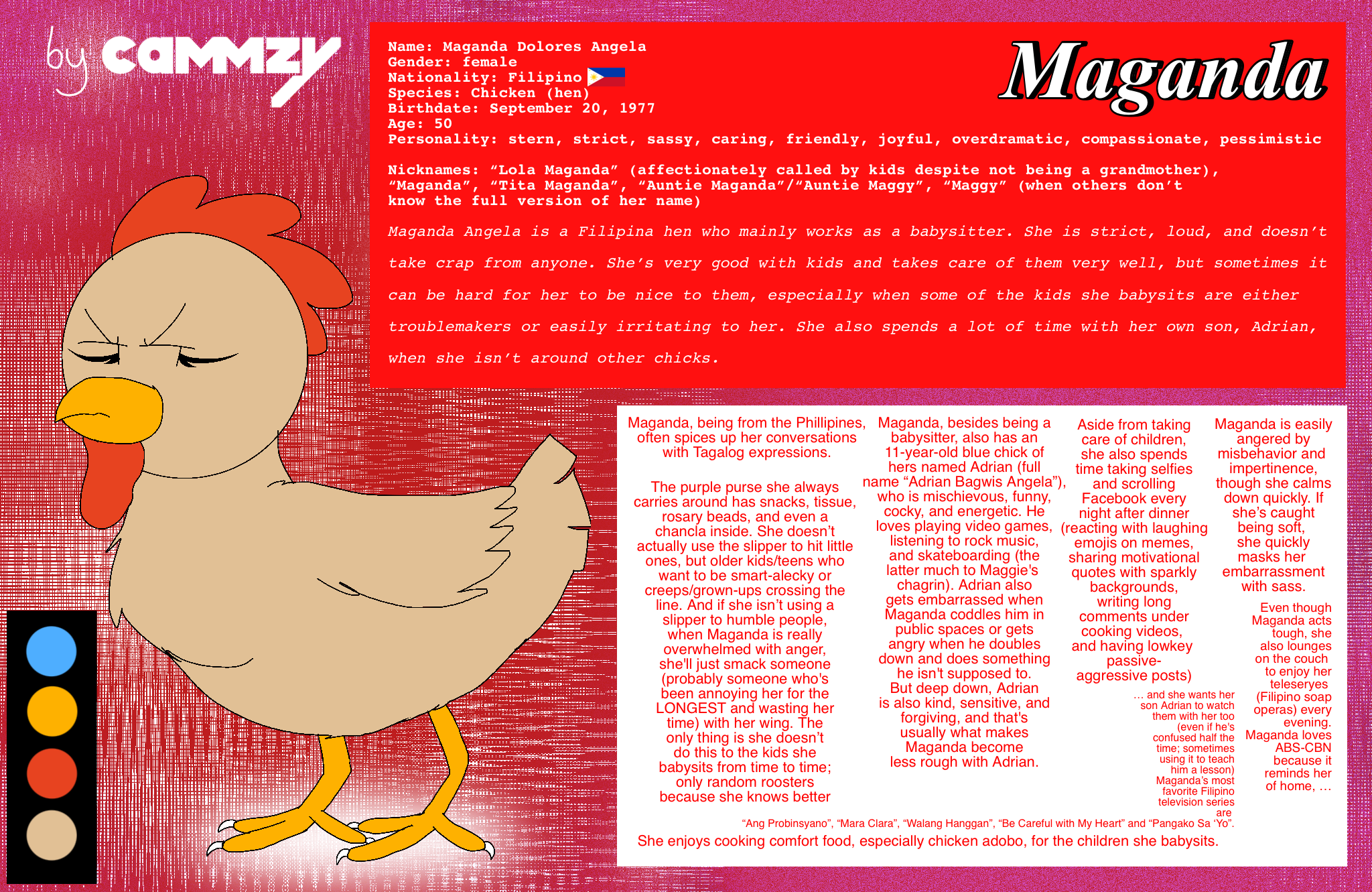
Main info
- Name: Maganda Dolores Angela
- Gender: female (hen)
- Nationality: Filipino
- Species: Leghorn chicken
- Birthdate: September 20, 1975
- Age: 50
- Personality: stern, strict, sassy, caring, friendly, joyful, overdramatic, compassionate, pessimistic
- Nicknames: “Lola Maganda” (affectionately called by kids despite not being a grandmother), “Maganda”, “Tita Maganda”, “Auntie Maganda”/“Auntie Maggy”, “Maggy” (when others don’t know the full version of her name)
Maganda Angela is a Filipina hen who mainly works as a babysitter. She is strict, loud, and doesn’t take crap from anyone. She’s very good with kids and takes care of them very well, but sometimes it can be hard for her to be nice to them, especially when some of the kids she babysits are either troublemakers or easily irritating to her.
Trivia:
- Maganda, being from the Phillipines, often spices up her conversations with Tagalog expressions.
- The purple purse she always carries around has snacks, tissues, rosary beads, and even a chancla inside. She doesn’t actually use the chancla to hit little ones, but older kids/teens who want to be smart-alecky or creeps/grown-ups crossing the line. And if she isn’t using a slipper to humble people, when Maganda is really overwhelmed with anger, she'll just smack someone (probably someone who's been annoying her for the LONGEST and wasting her time) with her wing. The only thing is she doesn’t do this to the kids she babysits from time to time; only random roosters because she knows better
- Maganda, besides being a babysitter, also has an 11-year-old Blue Finch chick of hers named Adrian (full name Adrian Bagwis Angela), who is mischievous, funny, cocky, and energetic. He loves playing video games, listening to rock music, and skateboarding (the latter much to Maggie's chagrin). Adrian also gets embarrassed when Maganda coddles him in public spaces or gets angry when he doubles down and does something he isn't supposed to. But deep down, Adrian is also kind, sensitive, and forgiving, and that's usually what makes Maganda be less rough with Adrian.
- Maganda is easily angered by misbehavior and impertinence, though she calms down quickly. If she’s caught being soft, she quickly masks her embarrassment with sass.
- Enjoys cooking comfort food, especially chicken adobo, for the children she babysits.
- Aside from taking care of children, she also spends time taking selfies and scrolling Facebook every night after dinner (reacting with laughing emojis on memes, sharing motivational quotes with sparkly backgrounds, writing long comments under cooking videos, and having lowkey passive-aggressive posts)
- Even though Maganda acts tough, she also lounges on the couch to enjoy her teleseryes (Filipino soap operas) every evening. Maganda loves ABS-CBN because it reminds her of home, and she wants her son Adrian to watch them with her too (even if he's confused half the time; sometimes using it to teach him a lesson). Maganda’s most favorite Filipino television series are “Ang Probinsyano”, “Mara Clara”, “Walang Hanggan”, “Be Careful with My Heart” and “Pangako Sa ‘Yo”.
- Despite Maganda being a (semi-anthro) chicken, the “comb” on her head (combs are the fleshy, usually red, crest on top of a chicken’s head, which help regulate body temperature, like cooling birds in summer and retaining heat in winter) is often treated like hair, as she will oftentimes tie it up into a ponytail.
- Maganda is also known to be a perfectionist and a clean freak. She hates it when anything even slightly messy gets onto her clothes and immediately rushes for cleaning gear whenever she does. Not only that, Adrian often gets this treatment every time he comes back outside (often from playing or skating); Maganda wouldn't let him even sit down until he'd change his clothes because she hates getting his germs all over her.
Headcanon voice(s):
- English/Filipino — Lea Salonga (PHL)
- Spanish — Sophia Vergara (COL)
Veronika & Chlöe
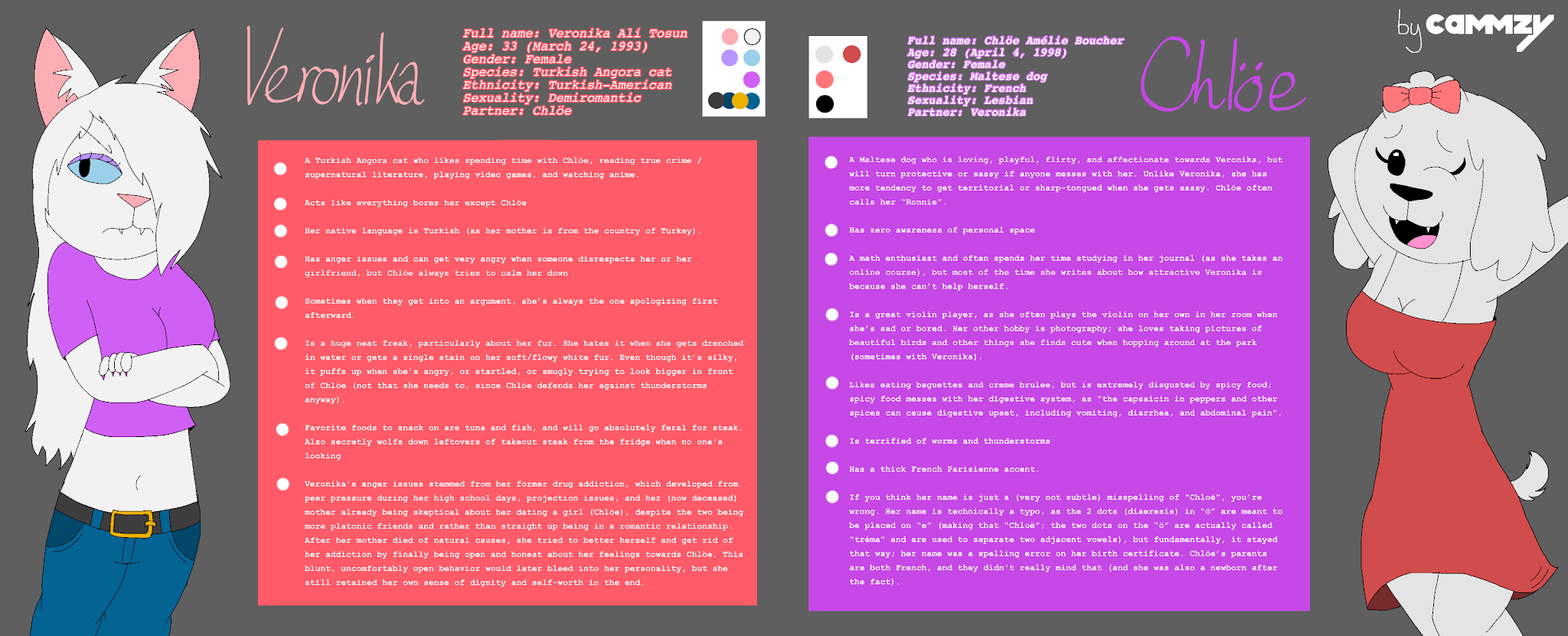
Veronika and Chloe are two characters I created in July 2025 based off of the respective virtual pets I owned from a virtual pet game I played in 2017 called “HelloPet” (by Korean developer Applepie Studio). Veronika is a Turkish Angora and Chloe is a French Maltese dog.
They were later given redesigns (and name changes) in May 2026 to adhere to a more anthropomorphic style.
Biographies
Veronika Ali Tosun (age 33)
Full name: Veronika Ali Tosun
Age: 33 (March 24, 1993)
Gender: Female
Species: Turkish Angora cat
Ethnicity: Turkish-American
Turkish-American
Sexuality: Demiromantic
Partner: Chlöe
Bio:
- A Turkish Angora cat who likes spending time with Chlöe, reading true crime / supernatural literature, playing video games, and watching anime.
- Acts like everything bores her except Chloe
- Her native language is Turkish (as her grandmother is from the country of Turkey)
- Has anger issues and can get very angry when someone disrespects her or her girlfriend, and Chlöe always tries to calm her down
- Sometimes when they get into an argument, she’s always the one apologizing first afterward.
- Is a huge neat freak, particularly about her fur. She hates it when she gets drenched in water or gets a single stain on her soft/flowy white fur. Even though it’s silky, it puffs up when she’s angry, or startled, or smugly trying to look bigger in front of Chlöe (not that she needs to, since Chlöe defends her against thunderstorms anyway). She also often polishes her claws.
- Favorite foods to snack on are tuna and fish, and will go absolutely feral for steak. Also secretly wolfs down leftovers of takeout steak from the fridge when no one's looking
- Because of Veronika’s laid-back and skeptical attitude, she is often allergic to trying new things, but Chlöe always tries to make her day better by gently dragging her out of her comfort zone. And because the two have such a close bond, Veronika is the only one always grounding Chlöe when she gets impulsive.
- Veronika’s anger issues stemmed from her former drug addiction, which developed from peer pressure during her high school days, projection issues, and her (now deceased) mother already being skeptical about her dating a girl (Chlöe), despite the two being more platonic friends and rather than straight up being in a romantic relationship (which became prevalent later in life). After her mother died of natural causes, she tried to better herself and get rid of her addiction by finally being open and honest about her feelings towards Chlöe. This blunt, uncomfortably open behavior would later bleed into her personality, but she still retained her own sense of dignity and self-worth in the end.
Chlöe Amélie Boucher (age 28)
Full name: Chlöe Amélie Boucher
Age: 28 (April 4, 1998)
Gender: Female
Species: Maltese dog
Ethnicity: French
Sexuality: Lesbian
Partner: Veronika
Bio:
- A Maltese dog who is loving, playful, flirty, and affectionate towards Veronika, but will turn protective or sassy if anyone messes with her. Unlike Veronika, she has more tendency to get territorial or sharp-tongued when she gets sassy. Chlöe often calls her “Ronnie”.
- Has zero awareness of personal space
- A math enthusiast and often spends her time studying in her journal (as she takes an online course), but most of the time she writes about how attractive Veronika is because she can’t help herself.
- Is a great violin player, as she often plays the violin on her own in her room when she’s sad or bored. Her other hobby is photography; she loves taking pictures of beautiful birds and other things she finds cute when hopping around at the park (sometimes with Veronika).
- Likes eating baguettes and creme brulee, but is extremely disgusted by spicy food; spicy food messes with her digestive system, as “the capsaicin in peppers and other spices can cause digestive upset, including vomiting, diarrhea, and abdominal pain”.
- Is terrified of worms and thunderstorms
- Has a thick French Parisienne accent
- If you think her name is just a (very not subtle) misspelling of “Chloë”, you’re wrong. Her name is actually a typo, as the 2 dots (diaeresis) in “ö” are meant to be placed on “e” (making that “Chloë”), but apparently it stayed that way; her name was a spelling error on her birth certificate. Chlöe’s parents are both French, and they didn't really mind that (and she was also a newborn after the fact).
Parents
Chlöe’s parents, first off — they currently reside in an apartment in France, the same place Chlöe used to live in during her childhood. Chlöe was personally more close to her mother (Madeleine) than her father (Julien) during her younger years, but her father was quite a bit “strict” with her in her younger years (as she was very energetic), but secretly really cared for her. As for their view on Chlöe and her relationship with Veronika, they’re pretty chill with it, funnily enough. Chlöe’s parents (like Chlöe herself) both have a thick French accent.
Madeleine Colette Boucher (age 61)
The loving, caring and doting (but sometimes overprotective) mother of Chlöe (who is a Maltese). Her birthday is March 11.
Trivia:
- The one who originally gave Chlöe her iconic pink bow when Chlöe was a puppy
- Makes amazing home-cooked meals but side-eyes Veronika constantly
- Worries a bit too much about Chlöe (especially living in the USA)
Julien Bernard Baptiste Pierre-Boucher (age 52)
The strict, protective, pessimistic but caring father of Chlöe. He wears a bow tie and is always seen smoking a pipe. Unlike his wife (Madeleine), Julien is actually a poodle. He has a deep, gravelly, raspy voice. His birthday is February 18.
- Is mostly chill but will growl at anyone who will hurt Chlöe
- Used to be quite strict with Chlöe (as mentioned earlier), but absolutely cared for her
- Mainly spends his time reading books on psychology and French politics (much to Madeleine’s chagrin); Super analytical, always overthinks everything, easily irritated and swears under his breath when a book annoys him, but still finishes it out of sheer stubbornness
- Even though Chlöe was more close to her mom, she’s a daddy’s girl deep down, because Julien’s the one who mostly protected her from the world’s nonsense when she grew up
- Secretly enjoys teasing Veronika, but also respects her for being able to handle Chloë’s energy.
Now for Veronika's parents – she actually has a single mom (who is from distant Turkey), but she died when Veronika was 21.
İlayda Başak Tosun (aged 68)
- İlayda was the single grandmother of Veronica, who raised her for a long time in the country of Turkey since her birth and (additionally before that) since İlayda’s move from Istanbul to Gaziantep.
- İlayda used to be doting and loving around her daughter (Veronika) and always looked out for her.
- She was also very protective of Veronika and was skeptical of her liking someone of the same gender (Chlöe) a little too much.
- But in the end, she was very supportive of Veronika and Chlöe’s relationship.
Skye
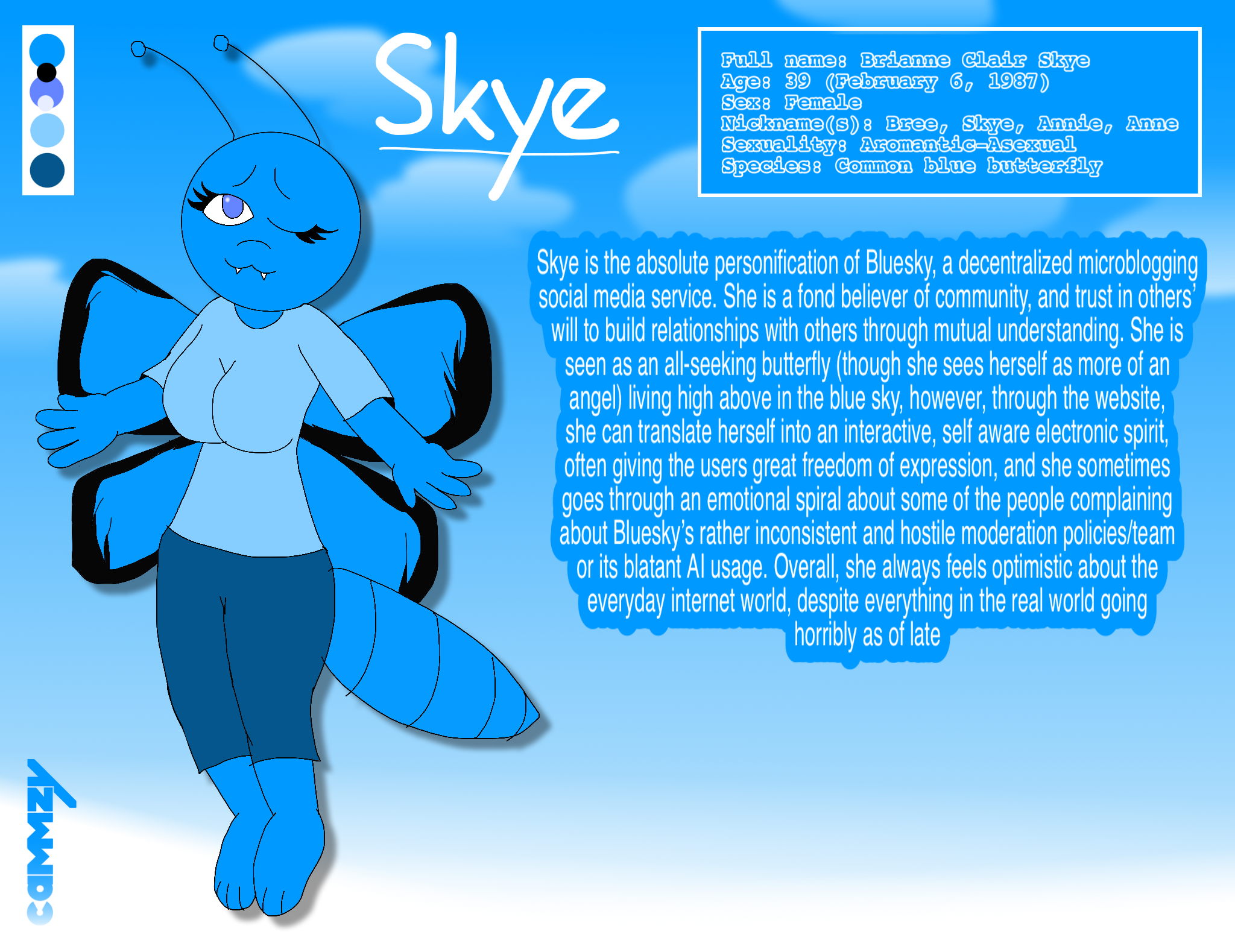
Info
Full name: Brianne Clair Skye
Age: 39 (February 6, 1987)
Sex: Female
Nickname(s): Bree, Skye, Annie, Anne
Sexuality: Aromantic-Asexual
Species: Common blue butterfly
Bio
Skye is the absolute personification of Bluesky, a decentralized microblogging social media service. She is a fond believer of community, and trust in others' will to build relationships with others through mutual understanding. She is seen as an all-seeking butterfly (though she sees herself as more of an angel) living high above in the blue sky, however, through the website, she can translate herself into an interactive, self aware electronic spirit, often giving the users great freedom of expression, and she sometimes goes through an emotional spiral about some of the people complaining about Bluesky's blatant Al usage. Overall, she always feels optimistic about the everyday internet world, despite everything in the real world going horribly as of late.
Trivia
Skye’s favorite drink (usually she drinks it when the website suffers an outage) is boba tea.
Despite Skye’s strongly positive outlook on the internet world (and the real world), she has a bile fascination with politics (mostly its tendency to start heated debates on Bluesky)
As Skye is an anthropomorphic butterfly, her thorax (which is the torso in actual butterflies), being her (human) torso, doesn’t have a digestive tract, which is instead in her abdomen (the thing on her backside, like real butterflies).
Skye was actually (ever so rarely) drawn by Cammzy for 2 years, with her first ever reference sheet being made on October 22, 2024, but it didn’t get a full remake until May 2026.
Kadlish
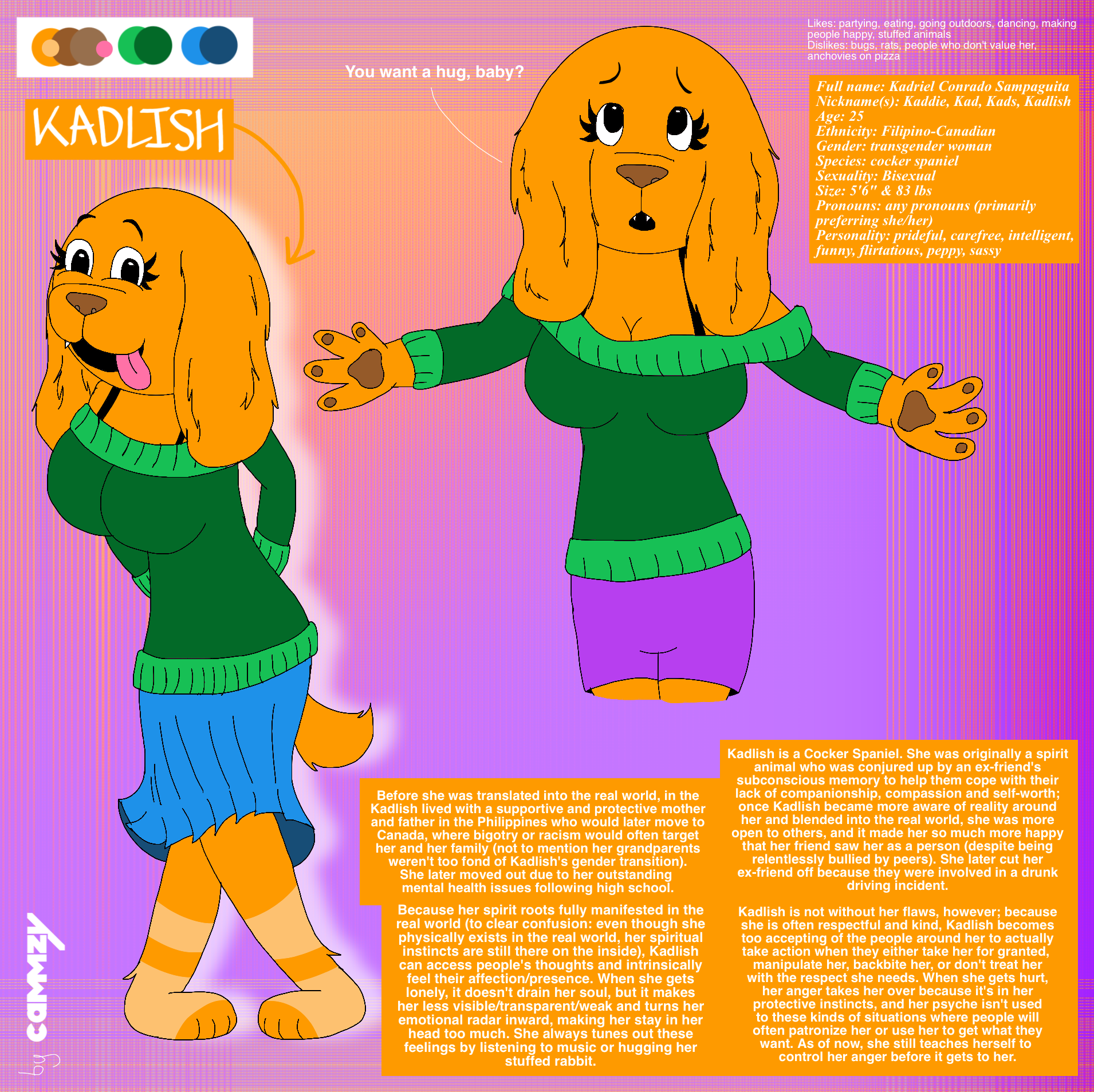
Full name: Kadriel Conrado Sampaguita
Nickname(s): Kaddie, Kad, Kads, Kadlish
Age: 25
Ethnicity: Filipino-Canadian
Gender: transgender woman
Species: cocker spaniel
Sexuality: Bisexual
Size: 5'6" & 83 lbs
Pronouns: any pronouns (primarily preferring she/her)
Personality: prideful, carefree, intelligent, funny, flirtatious, peppy, sassy
Likes: partying, eating, going outdoors, dancing, making people happy
Dislikes: bugs, rats, people who don't value her, anchovies on pizza
Biography:
Kadlish is a Cocker Spaniel. She was originally a spirit animal who was conjured up by an ex-friend's subconscious memory to help them cope with their lack of companionship, compassion and self-worth; once Kadlish became more aware of reality around her and blended into the real world, she was more open to others, and it made her so much more happy that her friend saw her as a person (despite being relentlessly bullied by peers). She later cut her ex-friend off because they were involved in a drunk driving incident.
Kadlish is not without her flaws, however; because she is often respectful and kind, Kadlish becomes too accepting of the people around her to actually take action when they either take her for granted, manipulate her, backbite her, or don't treat her with the respect she needs. When she gets hurt, her anger takes her over because it's in her protective instincts, and her psyche isn't used to these kinds of situations where people will often patronize her or use her to get what they want. As of now, she still teaches herself to control her anger before it gets to her.
Before she was translated into the real world, in the Kadlish lived with a supportive and protective mother and father in the Philippines who would later move to Canada, where bigotry or racism would often target her and her family (not to mention her grandparents weren't too fond of Kadlish's gender transition). She later moved out due to her outstanding mental health issues following high school.
Because her spirit roots fully manifested in the real world (to clear confusion: even though she physically exists in the real world, her spiritual instincts are still there on the inside), Kadlish can access people's thoughts and intrinsically feel their affection/presence. When she gets lonely, it doesn't drain her soul, but it makes her less visible/transparent/weak and turns her emotional radar inward, making her stay in her head too much. She always tunes out these feelings by listening to music or hugging her stuffed rabbit.
Sasha
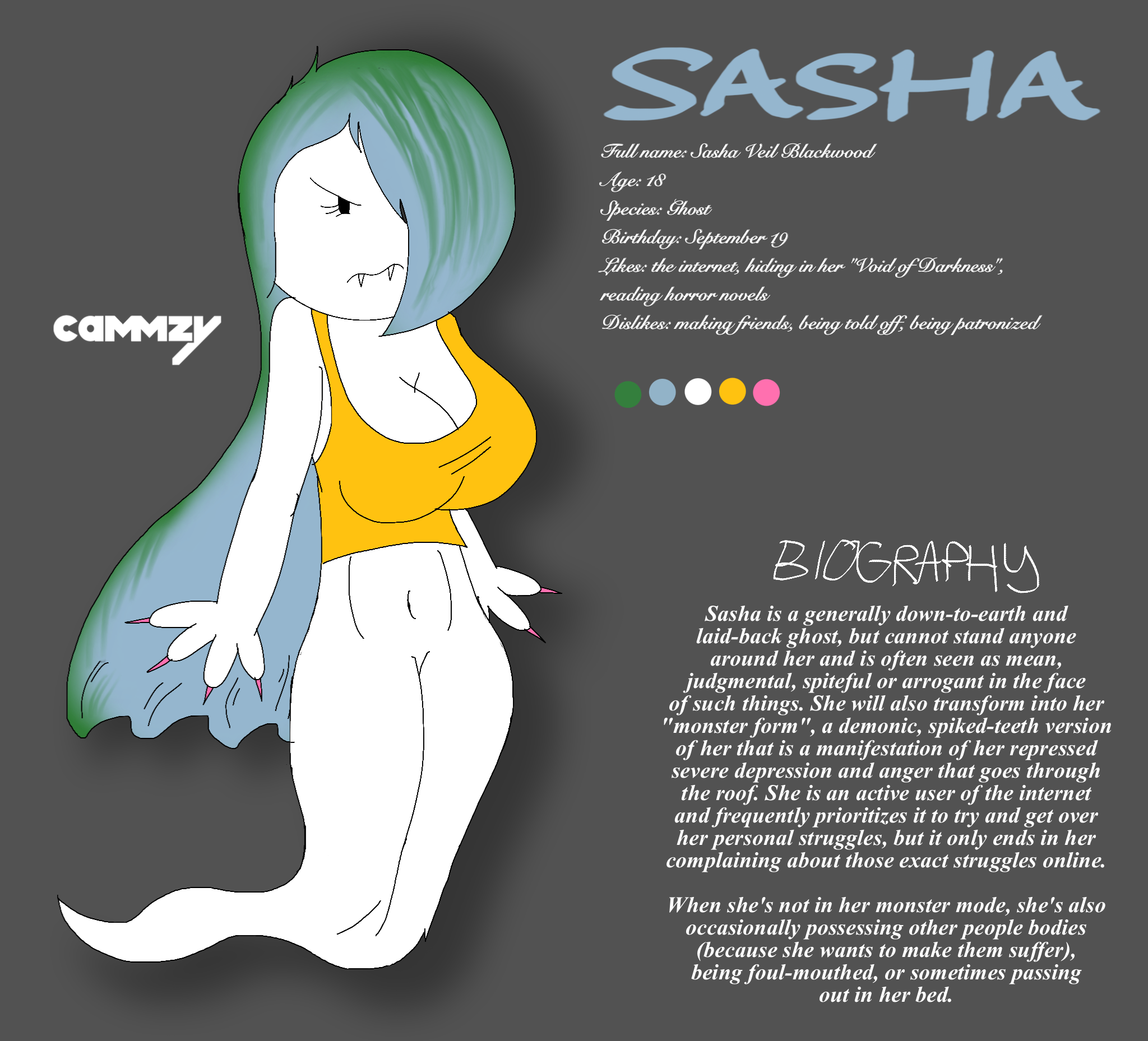
Full name: Sasha Veil Blackwood
Age: 18
Species: Ghost
Birthday: September 19
Likes: the internet, hiding in her "Void of Darkness", reading horror novels
Dislikes: making friends, being told off, being patronized by others
Bio:
Sasha is a generally down-to-earth and laid-back ghost girl, but cannot stand anyone around her and is often seen as mean, judgmental, spiteful or arrogant in the face of such things. She will also transform into her "monster form", a demonic, spiked-teeth version of her that is a manifestation of her repressed severe depression and anger that goes through the roof. She is an active user of the internet and frequently prioritizes it to try and get over her personal struggles, but it only ends in her complaining about those exact struggles online.
When she's not in her monster mode, she's also occasionally possessing other people's bodies (because she wants to make them suffer), being foul-mouthed, or sometimes passing out in her bed.
Trivia:
- Sasha’s only friend is Kadlish (as mentioned above). Kadlish is the only friend Sasha has that can tolerate her antisocial nature without being a nuisance to her or trying to "fix" her, but there will be times where Kadlish might be uncomfortable with some of the crude things Sasha says or does. Both are technically ghosts, but the thing with Sasha is that she's an ‘actual’ ghost, not someone who just happened to translate into the real world like Kadlish did. Kadlish understands what it’s like to have a fundamentally supernatural existence, but she doesn’t have Sasha’s experience of actually being ‘dead’. So she can relate to Sasha very well, and Sasha appreciates somebody who doesn’t pretend otherwise.
- The “Void of Darkness”, in question, is a literal black hole portal that consists entirely of darkness, which is where Sasha often goes (and can teleport there by indecipherable means) to sleep or vent in. She also occasionally lets Kadlish in.
- Sasha owns a Letterboxd account.
- Some of Sasha’s favorite movies include: Dracula (1931), Evil Dead 2 (1987), Idle Hands (1999), Insidious (2010), Oculus (2013), Insidious: Chapter 2 (2013), Hereditary (2018, Smile (2022), Good Boy (2025), and Obsession (2026).
Kalennian
As mentioned above in this document, the Camniverse also houses the fictional story written for Cammzy’s conlang of the same name (first created in April 2023), first written in its Fandom Wiki article (first created circa July 2024) but was then stretched out and rewritten in August 2026 to include its more expansive coverage of the country “Rovârki-Trâsimku”, and all of its events, in this document.
A map of the fictional country Rovârki-Trâsimku, marked in red.
Sylvester Karlos Bridgeman was born on December 16, 1634, in Liverpool, England, to a single mother, Carmen Winston Bridgeman. Sylvester grew up in a single-parent household with his younger brother, Tristan Carmen Bridgeman. During Bridgeman’s grammar school life with his brother, her mother had to travel to Boston to get away from her poor household status and her suffering from domestic violence and depression. His interest in language began when he was in grammar school and discovered the language sound shifts decades ahead of formalized historical linguistics, which also spurred a fascination with words and grammar. Bridgeman's secular and atheistic convictions influenced both his personal philosophy and professional goals, particularly his desire to create a worldwide means of communication. However, he didn’t favor learning English in school, as he believed the language’s chaotic spelling (due to the Great Vowel Shift) would not help him in life.
Once he dropped out (as his mother became more affluent and aware of his goals and ambitions), Bridgeman spent the majority of his career at the University of Oxford as a 19-year-old, where he did considerable study on language and cognitive science. In April 1660, at the age of 25, Bridgeman started creating Kalennian, a constructed language, as a passion project, and as a means of rectifying the misconceptions his peers had of him in his youth, as well as general problems in American society, like religious tensions. His vision was ambitious: he hoped to embrace both English and Kalennian, but also establish Kalennian as a unifying lingua franca in British America. His connections to British America gave him a reason to send writings, dictionaries, teaching materials, and correspondence across the Atlantic, and at this point was only associated with Bridgeman and a small circle of enthusiasts. He would exemplify this by publishing primers and correspondence, teaching people who travel between England and the colonies, developing contacts in Boston and other colonial ports, and eventually had students and supporters teaching it themselves. He also added numerous agglutinative and morphological elements to Kalennian, along with a variety of rules (which later grew to become more robust but messy in later times), due to him studying Uralic, Germanic, Algonquian, and Turkic languages like Hungarian, Nuxalk, Finnish, and Turkish. One year before his passing, Bridgeman authored a book titled "Guide to Unfolding Your Own Way of Speech." In it, he detailed his early life and his desire to create the Kalennian language, aspiring to make it accessible to those looking to break away from the colonial and restrictive traditions of the English language, and by extension, English culture. The book was later translated to 98 languages, the first one being Kalennian; the existence of Sylvester's book would also enlighten Kalennian people in the 21st century, most notably, the KTV co-founder Dekubinâ Kademyâ (who created a personal constructed language for a television channel), to make their own venture into linguistics.
Bridgeman's career lasted from 1677 until his death on February 21, 1712, owing to heart arrest; his body was not discovered until March 7, 1712. His remains were later interred at The Science Museum Burial Grounds. His colleagues and pupils paid him tribute with a simple memorial on the land, which has since become a pilgrimage spot for linguists, students, and fans of his work. Bridgeman's ongoing influence on language and cultural identity is reflected in the gravestone, which bears the epitaph, "In words, we find our worlds".
The ethnic group that emerged along with the transition of Kalennian from just a constructed language to a modern ethnocultural identity specifically originated from the country of Rovârki-Trâsimku.
Rovârki-Trâsimku initially started out as a small, largely separate remote island occupied by sailors Sotornâ Trâsimku and Lobâmna Rovârki (of African and English heritage, who were formerly enslaved, and fled the country to try and spread their mother tongue), along with multiple other people who shared the same linguistic identity and culture. They wanted to be independent of Britain after hundreds of Kalennians were deported from the Thirteen Colonies; the reason why Britain wanted to keep Kalennians captive is because they feared the fact that their language was being used in secret. This means that they could easily organize mutinies, coordinate smuggling rings, or pass intelligence to Britain's enemies (like the French or Spanish) right under the noses of British officers. As Kalennians were forced to migrate back to Britain via ship settlements, they still brought their language and culture with them as it became less influenced by the colonists. To survive British, Spanish, and French imperial aggression, Sotornâ and Lobâmna later settled onto a wide island in the Atlantic Ocean to avoid British colonizers, and use their language as a secure, uncrackable naval code. Sotornâ would further expand their landscape by allowing enslaved Indigenous and British immigrants who fled from Britain, only under the pretense that they’ve learned Kalennian. However, as this was the period where slave traffickers were operating illegally at an all time high, and colonial tensions started to rise, Rovârki-Trâsimku, as they recruited America along with their Kalennian allies, went on a long-winded war between the British army that lasted half a decade (February 1764 — March 1769), until Britain surrendered and later reached a ceasefire with Rovârki-Trâsimku.
Tensions started to escalate when Rovârki-Trâsimku harbored more refugees onto their land. Rovârki-Trâsimku responded to American ships trying to dock on the island demanding the return of enslaved refugees by frequently rejecting their demands out-of-hand, but didn’t want British commanders getting ahold of them either, as they were also still on the fence about it. They often threatened them by saying if they opened fire in their harbor to force their way in, they could catch the attention of the Royal Navy. When British ships approached, Rovârki-Trâsimku used their intimate knowledge of local ocean currents to outmaneuver them or lure them onto dangerous reefs. Any American captain wanting to process a legal claim for an escaped refugee had to wait weeks for an official Rovârki-Trâsimku translator, who would intentionally drag out paperwork until the foreign ship ran low on provisions and had to sail back to port.
Rovârki-Trâsimku didn't view refugees as "escaped property", when anyone stepped onto Rovârki-Trâsimku land or boarded an Rovârki-Trâsimku vessel, they were legally considered a free member of the community under the protection of the covenant. Since Rovârki-Trâsimku couldn’t escape getting flanked by aggressive foreign powers, they turned to heavy coastal defense operations, mostly against Britain since they weren’t done fighting after the Great Century war. It is important to note that before colonial aggression started to take its course, the Kalennians, after harboring the free slaves, rejected the pretense that refugees in their island would learn their language in order to be a part of their alliance, because they either weren’t familiar or didn’t know about it; even though they had all reason to protect their mother tongue (using it as a language barrier to hold off British officers for so long), they couldn’t protect themselves with a more robust naval presence. And through that, new arrivals in the region became farmers, fishers, craftspeople, sailors, builders, merchants, interpreters, dockworkers, etc, even if some weren't experienced enough to contribute to Rovârki-Trâsimku's maritime operations at the time. Even though Americans were deeply divided over R.T. harboring people escaping slavery in the Atlantic, many American merchants increasingly benefited from trading goods with them, while slaveholders remained fiercely hostile toward the island because they regarded its refusal to return escapees as an infringement on their property rights. They later settled on prioritizing constant human vigilance, basic harbor watches, and using simple early-warning systems; Rovârki-Trâsimku officials would constantly be on the lookout for foreign ships, and would light a smoke fire by day or a bonfire by night, or blow a horn whenever they spotted one. The signal would alert the harbor town long before the ship could reach a usable anchorage. And, whenever they spotted approaching foreign vessels, they would step out into the harbor mouth by approaching a patrol vessel, meeting the incoming ship, and then tell it what it wants or whether it has permission to proceed farther. They then decided to negotiate with them in a practical fashion, reminding foreign troops that approaching Rovârki-Trâsimku waters without permission breached maritime regulations. They would then drag out the negotiations by insisting on careful translation, formal procedures, or waiting for "higher harbor authorities" until the foreign ship withdrew, anchored offshore, or abandoned visit altogether depending on circumstances; this is all because Rovârki-Trâsimku knew that captains had orders, tight schedules, and limited supplies.
In the early 1800s (after America declared their independence from Britain in 1776, and getting to know more of Rovârki-Trâsimku’s allies), America later went on to fight Britain again in the War of 1812, and found out that Rovârki-Trâsimku would be a massive asset for trade ships and American privateers willing to dodge the Royal British Army. The U.S. declared that European powers would not be allowed to enter the Western Hemisphere, and viewed Rovârki-Trâsimku as a crucial buffer zone against the European forces. However, maintaining Royal Navy operations against Rovârki-Trâsimku proved increasingly costly to Britain, as attempts to intercept Rovârki-Trâsimku vessels also disrupted American trade in the region. These operations became especially difficult to justify as Rovârki-Trâsimku continued to harbor people escaping slavery and refused British demands for their return. After British Parliament ended the slave trade in 1807, hundreds of thousands of people remained trapped in brutal slavery on British Caribbean plantations. Not to mention, black-market slave traders were still operating illegally throughout the Atlantic. Rovârki-Trâsimku was heavily against the slave trade and the Northern colonies have supported them plenty through their anticolonialist efforts (like the Great Century war) and anti-slavery societies in Boston helped raise funds, ship rifles, and send volunteer sailors to help Rovârki-Trâsimku defend its soil. R.T. continued to develop their naval forces as time went on while they still had an uncomfortable relationship with the United States (their relations considerably turned warmer in later years when the Union abolished slavery, and were a significant vocal supporter for them, along with both their respective efforts, however), who were divided over slavery. R.T. voluntarily raided British slaving hubs to free the enslaved (which drove the colonialists crazy), stole most of Britain’s vessels, among other drastic measures to prevent the invasion of Britain (again), because they wanted total liberation. Britain surrendered its claims over Rovârki-Trâsimku (around 1822), but the British Empire was still bitter about losing a strategic Atlantic island to a former refugee population. The Confederacy had individual Confederate cruisers periodically threatening RT-associated shipping or attempting to use nearby waters (because they viewed them as a threat for harboring the enslaved) starting in 1862; Rovârki-Trâsimku remained neutral to the Civil War, but they were otherwise increasingly hostile towards the Confederate Navy, and consistently maintained a blockade against the Confederacy (as in, closing its own waters and ports to Confederate vessels), as they didn't want them interfering anymore and refused every single ship in their fleet. Meanwhile, the United States continued to legalize chattel slavery all the way until 1865, placing Rovârki-Trâsimku in the awkward position of having a strategic compact with a nation (the US) that still practices the very thing Rovârki-Trâsimku fought to destroy. Rovârki-Trâsimku later decided the national fight against slavery wasn’t worth it, the Royal Navy and Rovârki-Trâsimku both parted ways via a peace deal, and Rovârki-Trâsimku focused on developing their technological advancements, agriculture, working on making their naval base more resilient, and lining up the scattered communities caused by the rapid expansion of the Kalennian diaspora.
Following their independence on March 7, 1823, Rovârki-Trâsimku adopted a new name, “Atonomât Demokrâtyât Republikâ go Rovârki-Trâsimku âm Nirtât Alantika”, or, in English, “The Autonomous Democratic Republic of Rovârki-Trâsimku in the Northern Atlantic” (now known as simply “Rovârki-Trâsimku” or abbreviated using the acronym “RT”). The “autonomous” part of the name does not designate a territory being controlled by a bigger entity, as it has a more centralized meaning in Kalennian political circles, meaning “self-ruling”.
They later adopted a representative democratic system that reflected its communal traditions and rejection of centralized colonial rule. It is important to note that even though Rovârki-Trâsimku is independent of Britain and the US, they still have a compact with the US because of their involvement in the war they had with Britain as mentioned above. Rovârki-Trâsimku also installed Uniformâ Rosâmkiye as their primary governor in 1975 (after their first governor, Avâricâ V. Kacâ, died in January 1970), until she was impeached in 2010 (and convicted later in 2011), due to her incompetence while trying to resolve the Overcast Scandal, and the sexual misconduct allegations against her by her husband. Gâbhudu Rovârki, an employee of KTV since 1998, was later appointed to be the current governor of Rovârki-Trâsimku in 2014.
In this representative democracy, the governor (Kalennian: atrângisâr) is the executive leader that enforces laws, regulations, commands defense, and handles foreign affairs. The legislature process consists of the country’s national council formed in 1940 and based in Sitâlhe go Trânkilte (its capital city) by the regional and metropolitan delegates of the country (Kalennian: Strânât Konselyâ go Rovârki-Trâsimku; English: National Council of Rovârki-Trâsimku), who pass laws, set policies and approve national budget, along with The Blue Circle. The judicial branch is occupied by the National Supreme Court (Kalennian: Strânât Âstomalye Tribunâl go Rovârki-Trâsimku), which administers laws, resolves legal disputes, and has absolute power over the constitution and stops council or governor actions that might violate the constitution. Tripartite arbitration panels are also often held in the National Supreme Court. The Supreme Court was established in 1942 to restore order, but it couldn't have absolute authority over the governor or the council, as they could easily bypass constitutional law (funding the failed antimatter plant, minimizing rural workers’ rights, etc.) until the restructuring of the government after Rosâmkiye’s impeachment.
Citizens have the power to vote for governors, but generally do not directly elect delegates to the National Council, as delegates are ordinarily selected by the regional and metropolitan municipal governments governing that territory; however, communities that maintain recognized town-hall assemblies are permitted to select their delegates through participating citizens instead. The governor is the only power in the government to possess the popular mandate, so it gives them public leverage. Governors can exercise the right to veto laws passed by the council; for example, if the council passes a law and the governor vetoes it, at least 64% of the country’s total national population can sign a petition for the veto to trigger a national public vote; initially, governors could veto a law passed by the council, and that was it, as they couldn’t override the governor’s authority, but again, the council was restructured once Rosâmkiye was impeached. Despite the population of Rovârki-Trâsimku being so divided and containing all kinds of ethnic diversity, there can only be a single time where the majority can push a petition to overrule a veto: if the governor vetoes an overwhelmingly popular law or otherwise causes a sufficiently broad political crisis; the governor plays divide-and-conquer when they feel safe using their veto - if the governor vetoes a law that fishermen favor, the suburban residents won’t care about it, and vice versa. This doesn’t mean that the population can focus on just the same issue; as said before, R.T. is ethnically and racially diverse and several different people have several different views and beliefs and can care about one thing or another, making the divide-and-conquer advantage unreliable. Only the country’s most profitable cities (Sitâlhe go Trânkilte, Sitrobân, Hopeyâdrita, etc.) could hold huge town hall meetings every year, and most territories without a localized council can still agree with the council's legislative elections, but it often ended up being the national council taking the majority instead of the local council, which resulted in heavy disputes between the two parties. Historically, governors of the country had no term limits, which means that they allow governors to run for re-election any time they want, which is why Rosâmkiye ran from 1970 to 2010 (because of authoritarian backsliding and brutal corruption of the constitution during her tenure). Once the council was restructured, the constitution was reworked to have governors serve only four-year terms, but if they want to, they can run for re-election any time they wish, provided they win a general election each cycle (much to the dismay of some members), and elections only last every four years. The National Council also oversees the regional and metropolitan municipalities (local governments) that govern each city and town. The governor’s authority is checked by the Council, the Court, and the people.
Kalennians’ specific practice of Christianity is called “The Blue Circle” (Kalennian: Yâ Âsurle Sirkâla), which turned into a secular, egalitarian denominational practice, inspired by the philosophy of Sylvester K. Bridgeman, who believed language shapes reality. The religious community began as a secular covenant, but over generations the ‘language-as-reality’ principle became mythologized into God-given language - in later tradition, they teach that Kalennian is a sacred tongue given to them by God, but not the person who created it, knowing that it holds communal and responsible value. Over time, devotion to the Kalennian language did not disappear, but it shifted from being a sole focal point to becoming one pillar among many, as the community increasingly framed its mission as spreading its collective ethical tradition (what they call their “gospel”) with other communities, rather than conquest. After decades of reading and practicing the Bible together, they reinterpreted it through their own communal values. They also reinterpret God as an omnipresent being who gave mankind language to spread their own shared consciousness and stewardship across the universe, without authorizing hierarchy. The Blue Circle is a part of R.T.’s wide national council, specifically the legislative body of the council. It gets a majority of its public funding from the council, as well as local governments, and has operated some of the biggest community and educational institutions around the country, including "Yâ Vâmodyo go Sitâlhe âd Sitrobân" (English: The University of Sitâlhe go Trânkilte and Sitrobân), which was Rovârki-Trâsimku’s first ever incorporated educational institution. It also funds public infrastructure.
It wouldn’t be until the 18th-20th centuries that Rovârki-Trâsimku would become more advanced in terms of technology, science and innovation, investing in national energy system strategies, developed unusually sophisticated chemical-processing techniques, initially driven by marine-resource extraction, medicine, dyes, and materials research, as well as minor participation in American reconstructive movements and societal efforts, as every Kalennian of every diverse background and idiosyncratic style and distinct cultural traditions had brought out a plethora of artistic disciplines that would further define its culture. Following increased exposure to American electronic television and broadcast technology in the 1950s, Kalennians rapidly adapted the technology for domestic use and would become a new use for the country as a major driving force for their first ever endeavors in the television, internet, and radio industries.
R.T. currently recognizes eight cities and 10 towns (the fifth one being unincorporated), all of which fall within one or more of its ‘municipalities’ (Kalennian: munisipâlni, or, to be more specific, lokâlidho givârnanni; lit. “local government”):
- regional municipalities / grânayât munisipâlni (emphasizes obscure coastal regions, development of new water sources, facilitation of water supplies, management of highways, and maritime safety systems, serving the rural markets of R.T.)
- metropolitan municipalities / sitâlheyât munisipâlni (emphasizes transit routes, large education facilities, food distribution, public health service, the country’s national highway, internet services, and dense housing, serving the suburban and urban markets of R.T.)
Municipalities, in this country, are not a layer of constituent states/provinces with separate sovereignty. The individual cities actually had their own individual local governments once, but they were not made independent by the constitution or recognized by the government itself. The cities still have their own distinct identity and set of rules as per the council, just not independent jurisdiction. Each city sits inside a municipality, and that municipality governs it alongside other cities, towns, villages, and rural territory. Of course, like any other city, they usually have town halls, committees, neighborhood councils, etc., but those aren’t necessarily full governments with their own executive/legislative bodies.
Municipalities in R.T. are delegated authority by the national council of R.T., and they are able to hold their own executive and legislative powers. Municipal executives (Kalennian: Lokâlidhe Aministrâtisâr, lit. "Local Supervisor"; shortened to "Lokâstrâ") carry the laws out and oversee agencies or committees. They cannot override the legislative authority of the national council itself. Municipalities also govern the settlements (towns) sitting within municipal territories, but the towns' communities are granted only limited local authority. Both regional and metropolitan municipalities frequently join together and share their respective responsibilities with each other, otherwise known as a joint administrative system. It has been known to cut costs, and help local governments work more effectively in order to maintain the overall economy, but it often results in either the regional side spending more resources available for cargo and water access, or the metropolitan side spending more on infrastructure and national highways. Rural areas in particular rely heavily on agriculture, indigenous farming and all kinds of maritime labor, as well as coastline protection, and it's been the framework for R.T. since the 18th century.
On the country’s map, you can see that the metropolitan border is sandwiched between the rural perimeter, but Rovârki-Trâsimku’s terrain outside of that does not follow the municipal boundaries of the entire nation. R.T.’s major coastal settlements consist of an unincorporated settlement at the southern edge of Bânvorka (which is unlabeled even though you can still see the small dot, therefore designating it as a town of Bânvorka), Lubrikâ Harvestâga (the south’s most prominent oil production area), Kondusâbha (a port town where a lot of the international cargo is handled), Linâm go Grâmina (a town where its community relies on heavy lawn maintenance, including dethatching, livestock production, public food processing, etc.), Militâr Akuâtdâsorya (a town in Amildâgkeseyo that handles military operations and firearm manufacturing), Dorâdayât Bovinâ (a town that also handles their fair share of livestock and farming, but they also share their resources with Linâm go Grâmina), Grâpo go Tâsalhokiyeni (a central southwest town in Sitrobân that specializes in prefabrication, provides dense housing resources and supplies, and frequently exchanges their services with Sitâlhe go Trânkilte), Sâveta (a city in the southernmost corner of the nation, where it trades its pottery and additional ceramics resources with Lubrikâ Harvestâga and other cities near the central west), and Skipâ (a town in central western Sitrobân whose shipbuilding industry manufactures vessels for maritime communities throughout R.T., supplying fishing, cargo, passenger, and other coastal operations). Going back to the nation’s terrain, each coastal settlement around the country has a sandy coast, which can vary considerably in width. This is most prominent in Pensâkol, which has an unusually wide sandy waterfront connecting its beaches with the surrounding Atlantic Ocean. The reason why Pensâkol (in Sitâlhe go Trânkilte) in particular has such a wide beach resort is because they also have a dense housing complex, plus a wide town hall administered by the metropolitan municipality that's all over the resort, before people reach the actual beach. There is also a major river system extending across much of the country. In the east, it passes through Hârduk before branching through Hopeyâdritâ and its settlement Mobukâd, where its eastern and northern branches eventually empty into the Atlantic. Another branch extends northwest through Eslovân and central-western Sitrobân before branching again near Pensâkol and reaching the Atlantic there. As Rovârki-Trâsimku is an island surrounded by the Atlantic, all of the river system’s outlets ultimately drain into the same ocean. The country itself also has low-relief plains all over the north, south, west, and extending into the central east, where a valley is formed across Amildâgkeseyo, Hârduk and Hopeyâdritâ.
Unlike the local governments, every settlement (town) across the country is economically interdependent and shares all their responsibilities and resources, a form of economic and domestic circulation.
As the metropolitan municipality focuses on their railway lines, housing, and high speed fiber optic internet, this makes seafood maritime transportation more hard for fishermen because the metropolitan areas almost consume the rural areas, and usually have to travel by train or bus to provide food and water from the water supply. R.T. predominantly depends on public transport, food, farming, and water transit. Transit authorities initially debated whether to issue a tax that all maritime workers have to pay in order to ship their cargo to other cities; however, they immediately backtracked at the last second (when rural supply pressure increased) and decided to form the Cargo Compromise Act of 1982, because it’s something they thought could bite them if they didn’t try to appease it. This would backfire on them, as workers found more and more loopholes, like hiding seafood cargo at the bottom of passenger luggage, or disguising water canisters as personal baggage. To clarify, in this era of the country’s constitution, taxes were only considered "taxes" because their primary purpose in Rovârki-Trâsimku is to raise revenue, but a fee is something that a worker is going to have to pay in order to continue with physically demanding workloads, whose people already represent a significant portion of the nation's economic output.
To appease urban commuters, the transit authority introduced a mandatory paid fee; a physical or digital stamp required for any container carrying liquids, fresh fish, or raw produce on passenger lines. They promised the revenue would supposedly go toward cleaning fees, leak-proof cargo liners, and building designated, retrofitted freight trains to haul messy, wet cargo at the back of passenger trains (called “wet cargo cars”), but instead, the money went directly towards the central transit budget, the wet cargo cars were rarely built, and fishermen were left paying a daily fee just to do their jobs, which results in more outrage. It is also important to note that rural maritime workers get paid more, but they still get significantly less involvement in local affairs than their suburban counterparts. To counteract this, they often use their high earnings to fund media and political campaigns. If that didn’t get the metropolitan to cave in, they would also take action by commencing wildcat strikes all across Rovârki-Trâsimku, which was then outlawed by the council. This severely disrupted the water distribution feeding all cities to slow down, and the seafood markets wrapping around Sitrobân and Sitâlhe started winding down. Considering this was the 1990s and still under Rosâmkiye’s rule, she decided to side with the capital, but only gave more financial aid to the regional municipalities, so that they would focus more on the food and water supply powering their cities, instead of addressing the actual problem that rural communities had. So, even though most people were happy that the Cargo Compromise Act was declared unconstitutional by the Rovârki-Trâsimku judicial court and ordered Rosâmkiye to shut it down, she was not done.
In 2005, a demographic survey conducted by the Council found that only 61% of suburban communities did not regularly attend town hall meetings (regardless if they’re recognized by the government). A delegate chosen by a local town hall represents that community institutionally, but they don’t necessarily have the active support of everybody living there. For example, if a huge number of people live in a suburban city, and only a fraction show up to select the delegate, the resulting delegate still gets the seat even though most residents never participated. Three delegates that formerly served the Council, Kodhidâ Tvikenâ, Dârvobi Invatâ, and Tâmedo Gârisilki, during a local convention celebrating KTV’s 27th anniversary of being on air, later claimed suburban delegates were out-of-touch politicians who couldn’t actively back their working-class residents.
To try and cushion the rising traffic in metropolitan municipalities (dealing with transit, housing, utilities, and other public-service costs), the R.T. Council announced they would be cutting the minimum wage for all suburban residents; the Council’s official rationale was grounded in an economic stabilization theory: they argued that the ballooning costs of metropolitan operations were forcing businesses to either slash hiring or relocate entirely. This resulted in backlash from both parties, as both suburban and maritime workers often commute into expensive metropolitan centers and move between municipal boundaries for often physically demanding working conditions. To mitigate this, the suburban and maritime workers all around the country formed a joint labor union, where they retain their leadership and specific demand, but ultimately bargain together on shared issues and can coordinate industrial action; instead of arguing over culture or politics, both groups agreed to keep their separate political beliefs while leveraging their combined economic weight. They later built upon this working relationship by synchronizing strikes across both sectors, using maritime worker leverage to refuse offloading goods destined for metropolitan-based corporations. This caused a significant problem for the Council, as maritime workers could disrupt certain goods and services operations, while suburban workers were spread throughout a bunch of metropolitan employment and services. Their leverage simply comes from the fact they occupy different parts of the economy, but they were ultimately divided politically by the government when it was overruled by Uniformâ regardless, so they wanted their economic power back. The union formed in 2006 was called the Joint Board of Kalennian Labor (Kalennian: Minâkassok Konselyâ Ulonyoga go Kâlenilâbor; abbreviated as MKK or colloquially as Minâkas), and recently developed diplomatic relations with America; the U.S. directive supplies funding, resources, diplomatic cover, and training support for the union. Considering that the Council outlawed wildcat strikes after Kacâ and Rosâmkiye rule, the union would form an industrial peace agreement with the government when both parties agreed to not organize nationwide strikes anymore, and resulted in the government granting full (additional) legislative power to Minâkas (basically guaranteed permanent voting seats for them without them having to protest outside), suburban and maritime wages were made legally tied into inflation and corporate profits, and disputes were diverted toward tripartite arbitration courts. However, even if Minâkas leadership agreed to no more strikes, the relationship that casual workers have with union leaders are complex and difficult to reconcile as of today. After the 2007 peace agreement was settled (and the voting powers were redirected back to recognized suburban and maritime labor representatives contributing to the country’s economic development and the citizens), the union later disbanded in 2008 (only two years before Rosâmkiye was impeached), as many of them returned to their respective sectors, and felt more empowered by their culture rather than constantly fighting over political power. The council wouldn’t start scrambling if the two parties re-coalesced into the union, because it was simply made at a last-minute emergency break to abort governmental overreach, but if they do something reckless, the obvious practical answer is to protest (without grouping up into a political party, which isn’t necessary now anyway) until they cut it out. The labor union that disbanded later formed elsewhere in the United States, where only half of the maritime workers contribute to the American marine economy.
In reality, underneath her authoritarian-influenced family working with her and her corruption of the constitution, the judicial branch was keeping an eye on Rosâmkiye the whole time as, while they prioritized the modified pet lines from Sitâlhe go Trânkilte and Sitrobân, desexing practices, and the exploitation of their kinetic agility in trade logistics and port security of the sokamâr, an exotic and essential species native to Rovârki-Trâsimku, they (privately) funded the additional welfare for feral sokamârs (that former governor Kacâ promised in the 1965 Compromise) behind closed doors in 2002, and they only ever prepared to convict her once they gained final constitutional jurisdiction when the sexual abuse allegations against her came out and she was impeached.
The production of antimatter in the city of Hârduk, Rovârki-Trâsimku, was by a group of accomplished nuclear engineers, Dâvis Edinyu, Balyâkhe Plukâ, and Paulâ Silvestâr, among others, where they were discussing their past high-energy particle experiments associated with hydrogen/plasma research. One of them suggested that antimatter's annihilation process converts 100% of its mass into energy (though the technical details were more different and precise; electron–positron annihilation can yield photons; proton-antiproton annihilation produces a messier collection of particles) and the group conducted a series of experiments that lasted a couple of months. Later, they held a meeting in the National Council detailing how they will prepare Rovârki-Trâsimku for its new gas fields going forward by placing the antimatter in the underground storage tanks and shielding it against toxic radiation. This was obviously horrifying, as not only was the antimatter in question created in the local particle physics laboratory that was occupied by the engineers at the time, but the shielding, electromagnetic infrastructure, and containment research paid for the antimatter gas in order for it to not escape from the tanks cost billions, which took up the rural and suburban areas still trying to get by. The antimatter program later became politically indefensible and impossible to keep going; maritime workers got increasingly frustrated as public funds for water infrastructure and other municipal services diverted toward the antimatter supply program and held a nationwide wildcat strike (along with the suburban communities) demanding that the governor (for context: the governor during this period was Avâricâ Volunkiye Kacâ, who was elected in 1947 until his death in November 1969) shut down the antimatter energy plant set up by the council. Physicists repeatedly complained about the limitations of the antimatter energy supply, but the damage was already done. Funding for all national supplies of R.T. were frozen, which shocked many people, but this wasn't over, as Avâricâ set out an independent investigation audit, without the council, to find where all the billions of money went to. He found numerous financial records of the engineers behind the program also included putting their funding into American nonprofit front organizations secretly operating illegally (under nonprofit status) to share their natural gas resources (produced from wells) with the energy program, as well as routing appropriations through said organizations, which then purchased fuel, technical equipment and other materials for the R.T. program. Avâricâ later listened to the nationwide community's advice by stripping antimatter from its national energy strategies altogether, and making it illegal to produce for national use in later months. Because of the political fallout that came from the scandal, Avâricâ, National Council, and the citizens all later reached a compromise on February 7, 1965, that addressed everyday issues, including Sokamâr domestic and feral welfare. Hârduk's particle-physics laboratory survived after this disastrous failure, but it would later be abandoned and reworked again as a local high school serving rural residents in 1980.
All cities and towns across R.T. heavily depend on not only the domestic supply of the country, but also the supply from numerous foreign sources, notably the U.S. as they frequently trade their goods and cargo with Rovârki-Trâsimku and vice versa. This obviously stemmed from their history as a maritime trade economy; while the sailors that occupied the island harbored several enslaved Brits/Africans during early life, they would gradually become facilitators of seafood, harvested marine resources and minerals, and transportation and cargo services, and would heavily rely on fishing and marine transport across borders. They would also often trade their cargo, goods and services with American merchants.
Aside from being a highly interconnected country in the Northern Atlantic, Rovârki-Trâsimku is also known for domesticating wild animals across generations (some species that they tried to tame came with severe consequences, however), of which lions are the most common. Rovârki-Trâsimku’s coat of arms (and national seal) includes two heraldic lions rampant on the escutcheon; this reflects the nation’s longstanding treatment of the lion as a sacred animal, symbolizing the protection and strength of the Kalennian diaspora. Rovârki-Trâsimku has maintained a captive lion population since 1703, when lions were first brought to the island from Africa. Over subsequent generations, the population was selectively bred for greater tolerance of humans, manageable temperament, and adaptation to life in Rovârki-Trâsimku, while still remaining visibly a lion, eventually developing into a distinct domestic population across the north, west and east. The selective breeding system of lion populations later created a subspecies of lion, called Panthera leo heraldicus (formerly classified as Panthera leo domesticus; Kalennian: Gloriyâ pantherâ; lit. “Glorious lion”), which mainly evolved their behavioral traits and hunting habits. Heraldic lions in Rovârki-Trâsimku were first historically used in the 1700s for transportation of cargo, but this would later be dropped and their use became more widely accepted for transportation of homebuilt vehicles over short distances (since they were already heavy animals by design), guarding important settlements, assisting with hunting, and were often used as ceremonial animals in religious congregations, where Kalennians would often bathe and decorate them with flower crowns. Their use would be occasionally experimented with by the Kalennians, until the Americans got increasingly scared of them, even though they've been selectively trained and bred specifically for calmness around humans and tolerance of harnesses. This would cause American ports to start closing. Because they didn't have any other economically significant uses for the lion, scientists in the mid 1700s started genetically engineering a new (ancestral) species that could handle cargo work much more efficiently (eventually called "sokamârni"), and then they planned to try and habituate both lions and sokamârni's presence when the former reaches considerable temperament around species other than itself in later years. Over generations, they began conditioning and properly socializing the lions to recognize them as non-threats, while a sokamâr learns that these enormous animals are also not threats. Further evolution shaped the lions’ dynamics with the sokamâr; they would respond faster to their cues, independently respond to threats that threaten the colony (which lions are not a part of, but they work closely together with some individuals), recognize grief from sokamârni to slowly approach them and push their muzzle into their head to comfort them (not all lions automatically do this however; individuals that are bonded with sokamârni often do this), distinguish sokamâr play from defensive aggression, respect salient warning signals and physical boundaries, recognize yalkânni as socially protected individuals (and display alloparental behavior toward the yalkânni of familiar sokamârni, including grooming, nuzzling, guarding, responding to distress, and gently redirecting them in ways resembling their treatment of lion cubs; this behavior is most strongest between bonded/familiar animals, however), and investigate distress calls produced by familiar individuals. As of now, the heraldic lion in Rovârki-Trâsimku still serves as a secular, glorious icon of Kalennian culture, receives traditional bathing and floral adornment rituals during major holidays (which maintains the ceremonial bond established in the early 18th century), receives specialized veterinary care, prophylaxis, and training, and is frequently distributed around Africa from Rovârki-Trâsimku partnering with African sanctuaries and wildlife reserves, where they are integrated into managed semi-wild environments.
The sokamâr and its survival were unfortunately threatened by foreign hunters looking for meat to harvest in the early-to-mid 1930s, therefore leading older sokamârni to deliberately self-endanger themselves to save their colony: an older sokamâr recognizes an immediate threat to it (especially yalkânni and younger adults) and deliberately draws the threat toward itself, stays between it and the others, or refuses to retreat while the rest escape. This behavior can turn fatal, hence historical observers describing them as "sacrificing themselves", an inherently human, abstract concept. Americans (particularly during this period) thought they could hunt them for meat; they occasionally paid close attention to their behavior to try and target them, but they never developed sufficient understanding to actually know their cues and complex social interactions in-colony, so they just went straight to hunting, because to them, it's simply an easier individual to target. Rovârki-Trâsimku's massive protection and loyalty to the sokamâr later drove the government to make strict anti-poaching/hunting laws, banning the act altogether starting in 1938: killing one for sport, meat, trophies, or commercial harvesting becomes illegal; deliberate poaching gets substantially harsher penalties; exporting sokamâr-derived meat/products becomes prohibited; and neither foreign nor Kalennian hunters don’t receive any convenient legal exemption from the protection afforded to the species. To further tackle this problem, they simply couldn't legislate what America does with the sokamâr outside of the country (since the population is highly concentrated in the U.S. East Coast), so they had to pressure them diplomatically (provide evidence about the species’ domestic status and social behavior, push for comparable protections, restrict sokamâr-related trade from jurisdictions that tolerate hunting, etc.) in an effort to secure comparable protections for American sokamâr populations. After 1938, RT repeatedly requested the whole country to ban hunting because they consistently rejected negotiations, Kalennian public anger escalated, and the U.S. initially misunderstood their frustration and intensity because, to some Americans, the sokamâr is an unusual foreign creature with established populations across the East Coast, and to Kalennians, they’re watching another country permit people to kill an animal that has been intertwined with Kalennian society for generations. After the hunting controversy ended, existing sokamâr welfare services from Rovârki-Trâsimku spread over to the East Coast and in later years are distributed geographically, giving more American feral sokamârni access to the same kinds of support already normalized in RT, which sparks further peaceful contact with the sokamârni (since before the 1930s, sokamârni are already known specifically across the East Coast, but American scientific knowledge traces back much further), foster care demonstrating that they can function normally around humans and keeping the sokamâr as a pet are incidentally normalized by 1975.
Kalennians (Kalennian: Kâlenitikânni; lit. “Kalennian people”) are a human ethnic group native to Rovârki-Trâsimku. Kalennians (of various races) live in various regions all around the United States. They have established communities where they use the Kalennian language as their primary language of communication (with English at some points being used alongside it). The Kalennian people participate in their everyday life in work, internet, and socialization. They have a variety of occupations, including jobs in majorly respected fields, such as healthcare, veterinary care, education, military service, technology development, railway and highway safety, science/biomedical engineering and research, political science, business, and entertainment. Children who speak Kalennian attend schools where the Kalennian language is used as a teaching tool/subject. Kalennian communities that developed across generations are also widely established outside Rovârki-Trâsimku, particularly in the United States, and highly concentrated throughout Europe, Asia and Africa, forming a substantial international diaspora. People of Kalennian descent in the United States are commonly referred to as Kalennian-Americans. Kalennian speakers also use contractions in informal speech, which have become extremely common in Kalennian internet culture. For example; when the definite article 'yâ' is added at the start of a word that begins with 'a' or 'â,' it becomes a contraction. Examples include 'yâ abinsi' ('the food') becoming 'y'abinsi,' 'yâ artadhâk' ('the scissors') becoming 'y'artadhâk,' and 'yâ âgone' ('the pain') becoming 'y'âgone.' The apostrophe used to form contractions is often dropped.
Kalennians who have learned/are learning English/have acquired English as a second language speak the ‘Kalennian English’ variety of American English. Kalennian English is characterized by unique phonological and spelling-based conventions, as it modifies both the consonant and vowel inventories of traditional English, introducing specific rules for pronunciation, stress, and spelling that distinguish it from standard varieties. In Kalennian English, consonants like /t͡ɬɹ/ and /d͡ɮɹ/, which are lateral affricates, replace sounds in clusters like "tr" and "dr" (e.g. "try" becomes /t͡ɬɹaj/ and "drown" becomes /d͡ɮɹaun/), however later progression killed off the use of these and were replaced with /tʃɹ/ and /dʒɹ/, but Kalennian instinct usually causes them to still pronounce them laterally. Words with “wh” are simplified to /w/, and words that are pronounced /w/ without the letter <w> present are simplified to /v/. The vowel /i/ before a consonant is immediately pronounced /a/, /a/ before a consonant is pronounced /ɜ/, /l/ (placed at the end of consonants in American English) is simplified to /ɜl/ in Kalennian English, and “u” before consonants is simplified to /ɜ/. The word “and” before a word starting with a consonant has the /d/ sound in /and/ dropped. The consonant /ð/, often represented by "th" in words like "either," remains intact, but final voiced /z/ sounds are replaced with voiceless /s/ at the end of words. The vowel system simplifies and regularizes many English diphthongs and triphthongs: for example, “oy” and “ow” become /oi/ and /au/, "ou" becomes /aw/ or /ow/, "ai" monophthongizes to /a/ or /e/, and "tion" endings are transformed to /sjon/. Stress is consistently placed on the first syllable, unlike Kalennian itself, where primary stress is optional on any given syllable. English vocabulary incorporation in the Kalennian language is not as widespread today.
American English features repeatedly feed back into Kalennian English. With continued exposure to American English, some distinctly Kalennian realizations gradually shift toward their American equivalents, although traces of Kalennian articulation may remain. This influence is largely unidirectional: Kalennian English does not significantly alter the phonology or grammar of American English, nor does sustained contact with regional American dialects substantially alter Kalennian English, making the variety unusually resistant to dialect contact. This does not prevent Americans from borrowing Kalennian words, for example, the Kalennian word for their native species “sokamâr”, which was contracted and lexicalized from the full compound word that described them, “grâ-sâna-residânsak kornâsât kârnomâr”, roughly “grassland-dwelling, four-legged, meat-eater/carnivore”, naturally gets borrowed from Kalennian to English.
There are also 2 officially recognized dialects of Kalennian, consisting of High Kalennian and Low Kalennian, and one other dialect that is not officially recognized, South Kalennian. Both are spoken around the world, but mainly in Rovârki-Trâsimku, by the language’s diaspora. The 2 dialects developed on their own due to the increasing population of the Kalennian diaspora and the increasingly large American influence on the language during the late 1800s (as Rovârki-Trâsimku had a compact with the U.S. after both fighting the Royal Navy). Both dialects are used interchangeably depending on context, speaker formality, and personal style. All existing Kalennian dialects, Low Kalennian, High Kalennian, and South Kalennian, are grouped under the “Ombrelâ go Kâlenisomakna” (English: Umbrella of Kalennian), as sort of a dialect continuum, excluding Upper West Kalennian, because it directly influenced the development of the Low, High and South dialects, and it is no longer spoken by most Kalennians. All 3 dialects and their influences often overlap with each other due to the wide range of speakers in and outside of Rovârki-Trâsimku. There exists no council that regulates the language, but the National Council periodically publishes dictionaries and workbooks for the language, and is often taught in American schools by Kalennian teachers who are willing to share their cultural background with the American youth.
High Kalennian (Kalennian: Kâduhur Kâlenisomakna; lit, “Proper Kalennian”) is the formal and standardized dialect of the Kalennian language, used across media, official documents, academic writing, ceremonial occasions, speeches, written literature, and communication between strangers in professional contexts. It is spoken by the former half of the Kalennian-speaking population (roughly 9 billion people worldwide). Features of High Kalennian include the adherence to traditional morphological and grammatical rules, the proper use of marking the subject with the nominative case marker “su-“, marking the object and direct object with the accusative prefix “va-“ of certain sentences and marking possession with the genitive suffix ”-i” but not using the “vâ-“ direct object marker (despite the fact that 32% of High Kalennian speakers use it, due to the widespread influence of Low Kalennian’s usage on the internet) that speakers of Low Kalennian uses, contractions and shortening of words (49% of speakers sometimes use them, again because of Low Kalennian’s influence), the usage of “su-“ and “va-“ to mark capitalized proper nouns, usage of present participle endings “-sa-k” (used for adjectival present participles specifically) and “mal-“ (used for gerund present participles and marking the heads of gerund phrases) complex verb and noun conjugations/declensions, use of the 2nd person pronoun “dâb” before imperative verbs starting with “han-“, use of optional (verbal) grammatical person conjugation, complex tense-aspect-mood combinations, and formal vocabulary.
Low Kalennian (Kalennian: Deskontrâdi Kâlenisomakna; lit. “Casual Kalennian”) is the informal dialect of the Kalennian language, spoken by the latter half of the Kalennian-speaking population (roughly 12 million people). It is used across media, conversational communication between friends and family members, daily conversations, internet websites, social media networks, and blogs. Features of Low Kalennian include the optional dropping of the nominative prefix “su-“ when clarifying the subject of a sentence (usually pronouns like the 1st person singular “kam”), not using the nominative prefix “su-“ and accusative prefix “va-“ to clarify the subjects and objects of capitalized proper nouns (however, there are some instances where Kalennian speakers informally choose to use the nominative ("su-") and accusative ("va-") case markers to mark capitalized proper nouns, because English doesn’t use case marking for identifying the subject or object of a sentence, even if the noun in question is a "proper" noun), using “va-“ to mark the object of a sentence, the usage of an invented prefix called “vâ-” which marks the direct/indirect object of a sentence (which is not used in High Kalennian, but some speakers of it use “vâ-“ as stated above), marking possession with the genitive suffix ”-i” and marking objects of sentences with “va-“, the usage of contractions (e.g. “y’abinsi”, a contraction of “yâ abinsi”, meaning “the food”), the omission of vowels at the start of words and the shortening of words (e.g. “alâstimâm”, a noun meaning “shower”, becomes “‘lâstimâm” or even “‘lâstim”), adherence to the language’s morphological and grammatical rules, the omission of vowels between consonants in some words (e.g. “sketâdhim”, a noun meaning “anxiety”, becomes “sket’dhim”, “sekâran”, a noun meaning “present”, becomes “sek’ran”), usage of present participles “mal-” (used for adjectival present participles specifically) and “-sa-k“ (used for gerund present participles and marking the heads of gerund phrases), the (optional) omission of the 2nd person pronoun “dâb” before imperative verbs starting with “han-“ (e.g. “Dâb hanbamos!” (“Stop!”) becomes “Hanbamos!”), general use of (verbal) grammatical person conjugation, complex verb and noun conjugations/declensions, English/European-based loanwords for words that do not yet have a common translation in Kalennian, and tense-aspect-mood combinations.
There is also the Southern Kalennian dialect (Kalennian: Sautâ Kâlenisomakna), spoken around the Southern/coastal and Northern regions that is not officially recognized (spoken by 8 million people worldwide); the dialect has a mix of the features of High and Low Kalennian (e.g. grammatical person conjugation being used, but not using an explicit subject pronoun in all contexts). The only difference in its phonology is the lack of the 'r' sound /ɹ/ when found before consonants or at the end of words, for example "kidorsâr" ("learner") is pronounced /kidoːʃɜː/, with the vowels' pronunciations becoming more lengthened (/ɜː/ and /oː/ specifically). A particularly unique feature of South Kalennian is its tendency to fuse and shorten affixes and base words together to form a whole word, for example, "Kam mal-bâkhe-sa-âye" ("I am playing") becomes "Kam-al-bâk-sa-ye", "ma-bâk-s-ye" or even "k'-m-bâk-s-ye"; this feature has died down over time due to the influence of other Kalennian dialects. South Kalennian also treats the pronunciation of double consonants in phonology differently; double consonants like "mm", "nn", "kk", "ss", etc., are always pronounced and with long stress, instead of being omitted in Low or High Kalennian, so the word "tikânni" ("people") is pronounced /tikɜnːi/, instead of /tikɜːi/; the same is done with the "s" and "d" sound changes, as "s" and "d" (as they appear mid-wordfinal) in South Kalennian are not pronounced /ʃ/ (in Low and High Kalennian), they are instead pronounced /s/ and /j/, respectively. It also has nasal vowels; the nasality only happens when any word in Kalennian ends with a /n/ or /m/ sound, and then the nasal vowel before it spreads to other vowels in the word (e.g. “fâmilân” is pronounced /fɜ̃mĩlɜ̃n/). The flexible verbalizer suffix, “-gi”, is also not used when using nouns as verbs (as verbs can conjugate for tense, aspect and mood). An example of this is the word “kombât” (meaning “fight”, “combat” or “warfare”); when the imperative prefix “han-“ is added, there is no way to verbalize it to show it is being used as a verb because the verb mood/aspect/tense itself indicates the meaning. This also extends to the adjectivizer suffix “-yât”, where, instead of being omitted, it is shortened and fused with a noun or verb (e.g. “akuat” (water) + “-yât” = “akuât”). There also exists the phonological and orthographic reduction of aforementioned tense-aspect-mood combinations (e.g. “hanintâsâho”, the second person singular imperative inflection for “listen”, is shortened to “hantâho”, “intâso”, “into”, “intâho” or “tâho” based on the speaker), instead of phonologically truncating them in speech and not letting orthography follow, which heavily influenced the Low Kalennian dialect.
There have also formed groups of dialects in the same country that merge both the features of Low, High, and the Southern Kalennian dialects, which are called the Upper West Kalennian dialects (Kalennian: Yaslâ Bâlte Kâlenisomakna), whose ethnic speakers were second-generation Indigenous Kalennian immigrants from Europe. Sometimes, most of the dialect varieties in this region have their fair share of English influence but the grammar was reinvented to include specific indefinite pronouns, the removal of definite articles (as definiteness is expressed via context or word order), and a fixed SOV word order, among other things. These dialect varieties have died out in recent decades due to older speakers passing away, but the dialect did not vanish entirely solely because of its experienced language attrition. Instead, its unique grammatical quirks (such as its fixed SOV word order and distinct indefinite pronouns) were primarily preserved through historical audio recordings, early diaspora literature, and language revitalization programs hosted by RT cultural institutions, where linguists continue to study its unique blend of European structures and original Kalennian grammar. Upper West Kalennian has gradually become moribund, with only a handful of elderly speakers remaining throughout its history. The Upper West dialects were the first-ever dialects to form from the Kalennian language and had multiple features that later (officially recognized) dialects would take on in later years.
Kalennian has highly influenced the social and linguistic fabric of its ethnic group. Its use in television, literature, the internet, and public administration has cemented its place in both the United States and around the world. In the country of Rovârki-Trâsimku, Kalennian is a major driving force and unifying factor for identity, encouraging communal pride and continuity throughout all generations.
The Kalennian language has a prominent position in several media, of which television is the most popular.
KTV, d.b.a Kâlenitelevis Publikâtosak (translating to “Kalennian Television Broadcasting”), is an independently-owned Kalennian free-to-air television channel, production company, art collective, and public broadcasting company. It was launched on February 14, 1978, in the city of Sitâlhe go Trânkilte, Rovârki-Trâsimku and founded by sisters Dekubinâ Kademyâ and Esâdakovâ Kademyâ (both born September 24, 1955; other people that later joined the company due to interest were Tenyemhâde Varyâta, Sukhâmulha Davisâ, Tigherâ Trâsimku, Sanâhâtye Vâkito, Lâbonva Yoskamha, Sâmvido Gârisi-Bâdekâla, Dhelevâlu Lhesekilâ, Bidonhi Murâva, Midâgo Sâkadenâ, Govâmis Sikâdavo, Gâbhudu Rovârki, Gelhon Vâsaghadi, Sobhegalhâ Bâdekâla, Kighetosyâlâ Dinughâ, and Novekâ Gânvidhe), who all formed the broadcasting company of the same name ("Kâlenitelevis"), after a couple of weeks consisting of planning, setting up equipment, and collaboration were in progress. KTV was created to provide entertainment for the increasingly growing Kalennian diaspora. Before KTV’s inception, the concept of Kalennian “television” did not emerge during this period, as the most major media outlets that Rovârki-Trâsimku excelled in were radio stations and newspaper publishers; the Council happened to be so distracted by the political chaos that they wouldn’t have the time, energy or money to have Rosâmkiye oversee it or micromanage it, as television was a pretty separate thing and often considered a harmless novelty from other media. When the Kademyâ sisters launched KTV years later, wanting to unite their community during a particularly difficult period, all they had was either recorded audioblogs where Dekubinâ and Esadâkovâ often talked about their favorite movies and television shows, their daily lives before and after setting into the television world (or making jokes about their home country), or imported content from American television channels, the latter of which was subtitled; the people working couldn’t dub the content into their language themselves (to save money) or have the founders do it, so after BlueGrass started venturing into audio-based content, the Kademyâ sisters were willing to work with them to officially dub their American imported content. The only shows that KTV aired during 1979-1985 were Archie Bunker’s Place, Married with Children, Bonanza, Gunsmoke, Matlock, along with Family Feud. When Kalennian viewers sat down to catch up on KTV’s lineup at the time, they warmed up to tolerate and not think too much about Americans (despite the chaos of their home country) or their culture, so they enjoyed it as time went on; it wasn’t just the fact they enjoyed it, it was essential to them trying to get through the difficult times of Rosâmkiye rule. Over time, however, Kalennian creators and artists occasionally rejected American stereotypes so they could add their own unique flair to their work to reflect Rovârki-Trâsimku and its interconnected culture through satire, comedy, music or other ventures, and forge their own unique style of television, animated or otherwise. In 1980, the broadcasting company established a programming department in the town of Eslovân, Sitâlhe go Trânkilte, Rovârki-Trâsimku, which has been responsible for planning and scheduling content, including original shows, movies, and educational programs. The department, named "Progâmani Dipârta go KTV" (translating to "Programs Section of KTV"; abbreviated to "KTVPD"), worked on curating the programming lineup to appeal to their audience and ensure a diverse range of content is available. The KTVPD was also responsible for the creation of KTV's first-ever venture into children's programming, a programming block named KTV Yalkânni (launched on November 13, 1985). KTV Yalkânni aired Kalennian-dubbed American cartoons that aired on many Saturday morning channels/programming blocks reaching high viewership at the time; this choice of programming would make KTV Yalkânni more accessible to not only Kalennian audiences, but English speakers looking to learn the language, and soon the programming block would become popular with families across Rovârki-Trâsimku and the US. KTV Yalkânni's first-ever originally-produced Kalennian-language animated children's show was "Ramirkâ yâ Aviyânkanite", on May 23, 1989. On April 3, 1983, the company established a home video division of KTV, called "KTV Votyoni" (translated as "KTV Photos"; "votyo", the Kalennian word for "photo", is used colloquially to refer to films/movies of any kind, and not just pictures) that distributed the channel's various Kalennian-dubbed programs onto VHS - the division has since then moved to distributing KTV's programming onto DVD, as they have stopped distributing VHS tapes in February 2000. On September 24, 2002, KTV announced that they (literally translated) “would be going global, and expanding [our] public image to more Kalennians across this planet of ours” by launching a sister channel called “KTVG” (standing for “Kâlenitelevis Globâli”, meaning “Kalennian Television International”) which is aimed at the Kalennian-speaking diaspora that stretches across some parts of the world, notably South America, Asia, and Western Europe. KTVG serves as a syndication and international rebroadcasting arm of KTV, making it the first ever bilingual TV channel for both English and Kalennian speakers around the world. It airs most of KTV’s main programming (often dubbed into Kalennian) along with a small amount of English-language content, mainly for accessibility and diaspora engagement. On May 27, 1999, KTV launched their first-ever subsidiary, called "Kâbel go KTV", which served as KTV's cable/satellite division. In early 2002, KTV broadcasted their first ever originally produced series for their main programming, titled “Naito-ish”, which was met with both praise and harsh criticism from critics across the country. On May 31, 2002, KTV decided to expand its presence by going on the radio, and (as an attempt) launched the radio station KTV-RP (standing for “Kâlenitelevis Râdyo Publikâtosak”; meaning “Kalennian Television Radio Broadcasting”). KTV-RP was designed to complement KTV's television offerings, providing a platform for audio content that included daily news segments focusing on local, regional, and international events (presented in the Kalennian language to keep listeners informed), a variety of programs featuring music, talk shows, and interviews with notable figures in the Kalennian community, as well as curated playlists featuring both traditional Kalennian music and contemporary hits, appealing to a wide range of listeners and promoting local arthouse artists, and programs aimed at educating the audience on various topics, including language learning, history, and health, providing valuable resources to listeners. The station also encouraged listener participation through call-ins and social media. This strategy was crucial in addressing the needs of Kalennian speakers, particularly in diaspora communities. Despite its promising start, KTV-RP faced several challenges, including failing to adapt to changing media habits, as well as competition with other radio stations, which made it difficult to maintain a listener base. Budget cuts and resource allocation issues hindered programming quality and reach, as KTV frequently struggled to find new parties willing to fund the radio station. After KTV-RP received low ratings and a few negative reviews from fans, KTV announced that they would shut the radio station down after 16 years on the air. The decision was made as KTV deemed the station obsolete and unable to compete with other popular radio stations in Rovârki-Trâsimku, and it was also during this time that KTV also transitioned from analog to digital terrestrial broadcasting in October 2001. Consequently, KTV-RP was almost scrubbed from the internet by some and is rarely ever discussed in conversation as of today, marking its existence as somewhat forgettable. KTV is infamously known for its Overcast Scandal - being initially acquired by defunct public broadcaster Overcast (originally a cable-installing service in 2003) in November 2009, it was turned into one of their member stations called KCFD-TV. It sparked an outcry within the Kalennian-speaking community, as it caused the former television channel’s viewership to plummet. Once the news came out, informing people about the July 2011 hijacking incident, it further heightened the tension between Overcast and the Kalennian community. In January of 2012, celebrating New Year's Day, it got rebranded back to KTV on January 1, 2012 after the ownership was turned back to the original owners. The company, KTV, sent Overcast a sternly-worded cease-and-desist letter, threatening the public broadcaster to turn back the ownership of the channel to them in late December 2011, and Overcast ceased operations 1 day before the rebrand took place (and the controversy surrounding Overcast was over). This decision was what pushed KTV to become one of the most well-known TV channels by the Kalennian community, as many celebrated KTV's comeback; this period was when KTV planned to finally expand their line of programming, after several years of struggling to stay afloat and find an audience. Then, in 2018, KTV created yet another original show, the adult animated satirical dark comedy series Kâptikânni (English: Stickpeople), which first premiered on October 2, 2018 to critical acclaim, and is about two anthropomorphic stick figures (Rosâm (red) and Blâk (black)) as they navigate life, set in a fictionalized version of Rovârki-Trâsimku. The show, however, has been criticized by many extremist evangelical Christian groups for its provocative, bizarre, and often violent subject matter, deeming it “too degenerate” for television. Despite numerous protests nationwide telling the network to cease operations, Kâptikânni still continued for multiple seasons afterward, as it received more critical acclaim. Its latest season (season 6) was announced on February 23, 2025. Kâptikânni, however, was not KTV’s first major venture into surrealist, adult animated programming. Going back to the 1980s, when KTV also made animated original programming for their children’s block, they also made their first live-action cosmic drama series for the network, “When Love Never Broke Me” (Kalennian: Gusem Moriga Vakam Silkâbussoisâ), which starred American actress Brooke Shields as a recovering alcoholic and abuse survivor who almost gets bruised by an immortality scent that causes her to reach out into the inner void of the universe and gets into an endless conflict with all her abusers from each and every timeline. KTV later created their first adult animated comedy, called Friskâ Kat, starting in 1997, and KTV appointed a Kalennian animator and contemporary sculpture artist who was the pioneer of animated content in the country for a whole decade, Fredrikâ Jaksinkiye (born April 4, 1967), to help with the production process, since the founders weren’t experienced enough in the art world to do so themselves. It is important to note that after he started working with KTV to produce Friskâ Kat, Jaksinkiye had established his animation studio SoloToons in 2003 (which was originally headquartered in Bankiyâ, Bânvorka, Rovârki-Trâsimku, but then its production moved to Miami, Florida in 2009) to try and express his creative talents worldwide, not just across his home country. Friskâ Kat follows the day-to-day violent, surreal, yet wholesome exploits of an anthropomorphic cat named Frediye and a mouse named Jeremyâ, who are both of Kalennian heritage, sharing a room together in downtown New Jersey; it was created to mock “ignorant” American culture, even before heavyweights like Family Guy and SpongeBob SquarePants hit the stage, as well as to talk about social and political issues in Rovârki-Trâsimku through a Western lens. The show was one of many to mock the Rosâmkiye tenure, which held absolute centralized power over every Kalennian (including the National Council and The Blue Circle, who contributed to the national government for several years) in the country for multiple decades, was hostile toward its essential workers running the economy, restructured the constitution under her secretly authoritarian views, and threatened the National Council, among other measures, until her impeachment starting in 2010, as mentioned prior. Friskâ Kat was later cancelled in 2014 due to budget problems regarding KTV’s broadcast technology, but was brought back in 2020 as a crossover special (with Kâptikânni) celebrating the launch of KTV 42 years ago, and then in 2022 as a reboot of the original. KTV also ventured into art (not just general television) as they are also an art collective: KTV have shown their experimental art of famous American/Kalennian celebrities, art of characters from the channel's original Kalennian programming, and their television mascot Kevinâ, numbers of times since 2005 in art exhibitions, their first ever venture being Deitch Projects; they also allow the viewers to send in fan mail and have them show it on-air during interstitials. As of today, KTV has become the most well-known television network catered to the Kalennian community, and is broadcasted all around the world (not just in the Americas) with KTV’s sister TV channel KTVG (KTV International), and still airs imported English-language programming dubbed into Kalennian (by dubbing studios BlueGrass), along with some original animated series. KTV also operates three television channels, all of which are distributed free-to-air via a nationwide ATSC network (formerly using a NTSC network at the time of KTV's launch in 1978), and are broadcasted all around the world (not just in the Americas; KTV's sister channels were not affected by the 2009 Overcast Scandal however): KTVG (launched on September 24, 2002), which serves as a syndication and international rebroadcasting arm of KTV and airs most of KTV’s main programming (dubbed into Kalennian) along with a small amount of English and Spanish-language content worldwide and outside of the US (mainly for accessibility and diaspora engagement), Dimensânni! (launched on March 21, 2016), which airs action, anime and horror movies, and TVK (launched on December 14, 2000), which broadcasts educational content, classic television series from the 1930s-1990s and KTV original series in the Kandese language. In 2022, KTV received 4 Emmy Awards for Excellence in American National Children's and Family-Oriented Television Programming, and 3 Annie Awards for Best Animated Programming in Television, Film, and Multimedia.
Overcast Broadcasting was an international public broadcaster. It originally started as a cable-installing company under the name of DNA Cable Service in 2003, but then was changed to 'Overcast' in 2009, following the discontinuation of their standalone TV channel Overcast. In November 2009, they took full ownership of independent TV channel KTV (Kâlenitelevis) under the guise of inclusion and preservation, but their true goal was to reshape Kalennian language media into something more “pure,” “standardized,” and “culturally acceptable”, which made them get into controversy (even after the July 2011 hijacking). So in December of 2011, the company announced it would cease operations and lay off a large chunk of its broadcasting team. Since then, KCFD-TV has been rebranded back to its original name ("KTV") since January 2012, and Overcast's other member stations are still defunct. It was later discovered that the company’s CEO’s genuine motivation for taking ownership of KTV was brainwashing Kalennian people, considering its former lazily geometric branding. Furthermore, Overcast’s founder, Paul Moss, was involved in a hate group called “Yâ Kâlenisomakna Balovâsga Grâpo” (translating to “The Kalennian Language Preservation Group”) that marketed themselves as a community of Kalennian people who preserved the use of Kalennian and attempted to spread it more widely around other continents, but in reality, they were a group of American white supremacists, prescriptivists and sex offenders who were charged with sexually harassing/assaulting multiple members (mainly women) of the Kalennian community. The group was active from 1968 until 1999, and Paul joined the group in 1987 until he left to establish Overcast on October 4, 2003. It is also very important to note that Overcast’s funding came from donations to that hate group (“The Kalennian Language Preservation Group”), and the ownership of KTV itself wasn’t legitimate in the eyes of many, because it was simply seen as a hostile cultural takeover disguised as "corporate development" according to Kalennian-language news outlets. Overcast has been under controversy for their July 2011 hijacking of their member station KCFD-TV mentioned above. When The Big Bang Theory was airing at 10:23 pm in the evening, it was suddenly interrupted by text on a black background (with the Overcast logo on the right, being stabbed multiple times with a knife) which included multiple offensive statements targeted at Kalennian disabled people. Because of this, the viewers blamed Overcast for the hijacking. It is unknown who was behind the hacking of KCFD-TV. According to TVNews (an English-language news aggregator/news magazine that initially specialized in bringing in updates to Overcast stations and other TV channels not related to Overcast, but has since moved to talking about the Kalennian media landscape), their article came out with Overcast's apology (from their website) 4 days later. The apology is as follows: "The staff at Overcast will not tolerate the dehumanization of Kalennian people, especially those who are learning the language, and those who are hard of hearing or blind. The technical team will promise to implement robust cybersecurity, so we can safeguard ourselves and the rest of our TV stations against such issues. We apologize if any Kalennian-speaking person who is watching KCFD-TV currently is offended and/or petrified of the current event that occurred. Again, we are extremely sorry".
Here is a look at the article that detailed the July 2011 incident: “KCFD-TV, a Kalennian-language television station, was hacked by an unknown 13-year-old during the evening broadcast of "The Big Bang Theory." The hack occurred during a scene where the show's characters were discussing a blackboard with an equation. The hackers inserted a text overlay that made fun of Kalennian speakers. The text was offensive and caused significant embarrassment for the station. The hacker managed to infiltrate the station's broadcasting system, causing a brief but highly embarrassing disruption. The incident was widely noticed by viewers, leading to public outrage and criticism of the station. Two days after the incident, Overcast issued an apology on their website in both Kalennian and English. The apology stated that the staff at Overcast would not tolerate the dehumanization of Kalennian people, especially those learning the language or with hearing impairments. The technical team promised to implement robust cybersecurity measures to prevent future incidents. The station apologized to any Kalennian-speaking person who felt offended or belittled by the incident. Overcast launched a swift investigation into the incident, cooperating with law enforcement agencies to identify and apprehend the perpetrator. The broadcaster emphasized its determination to pursue legal action to the fullest extent against the hacker, holding them accountable for their actions. KCFD-TV was gradually restoring control of its programming and took steps to rebuild public trust by providing transparent updates on the incident and reaffirming its commitment to delivering accurate and unbiased news.“ Despite the apology, the hijacking event left a negative mark on Overcast’s reputation, as this was what caused the company to cease operations on December 29, 2011.
Overcast ran 5 member stations that served the Americas before they were all shut down, and those were; KSRL-TV, an English-language TV station that served the Western and Midwestern American regions of the US, and aired news (at 4:00 p.m.), soap operas (8:00 p.m.) and sitcom programs (10:00 p.m.); KCFD-TV, a Kalennian-language TV station that replaced KTV, and aired the same programming, but exclusively in Kalennian and was broadcast in the United States. The dubbing of its shows is provided by Kentucky-based dubbing studio BlueGrass. It had a children's programming block that also functioned as a separate TV channel called Yabkân TV, unlike KSRL-TV; FKEV-TV, an English-language TV station that served the Northern Territories, Western Canada and the Prairie Provinces in Canada. It aired the same programming; FNTS-TV, a French-language TV station that served the French-speaking part of Central Canada. It aired the same programming in French; and UNLM-TV, a Spanish-language TV station that served Mexico. It aired the same programming, but in Spanish.
KTV has struggled with a consistent schedule since its launch on February 14, 1978. However, in 2002, the Kademyâ sisters thought up of two new programming blocks to accompany their channel (KTV)’s main programming (even though they already have the children’s programming block KTV Yalkânni), and this lead to the company introducing 2 short-lived programming blocks called KTV Musik and KTV Ivmarga on May 12, 2002. KTV Musik was a programming block that aired from 10:00 am to 1:00 am on KTV that mainly aired music videos. This block had a very short lifespan, and considering that KTV, during 2005, was heavily focusing on bringing educational content to Kalennian-speaking children with their programming block KTV Yalkânni (launched on May 6, 1980), they considered KTV Musik to be a hindrance, as it interfered with their channel’s normal schedule, and most of the team on KTV were struggling to find a suitable audience for the block. KTV Ivmarga was a programming block that aired daily American news and info to Kalennian viewers (mostly adults aged 18-49) in the Kalennian language, from 1:00 am to 6:00 am on KTV. Like KTV Musik, this block was also short-lived due to low ratings and financial difficulties, and it drew criticism for allegedly spreading misinformation. After this rough attempt, both KTV Musik and KTV Ivmarga were both shut down in December 23, 2005 for good; KTV Ivmarga’s concept was later folded into the "Ivmarga" page on KTV's website, via ktv.com.rt/ivmarga, and KTV Musik was also later folded into KTV’s sister channel “Dimensânni!”, which was originally a channel that aired anime shows and experimental music, but later branched out to include video game-centered content, experimental programming featuring disc jockeys, and sci-fi/action programming. After the ending of the controversial Overcast Scandal on December 29, 2011, KTV planned to "reinvent" themselves by recreating their schedule to include a children's programming block called KTV Yalkânni (which originally aired daily on the network since 1985, but was made defunct by Overcast in November of 2009, when Overcast renamed it to Yabkân TV, until January 1, 2012, when it was rightfully renamed back to KTV Yalkânni by its original owners, KTV, and KTV later expanded its programming lineup), along with the channel's main programming (Kâlenitelevis) after. The current programming block schedule goes simply like this: Yalkânni comes on at 5:00 am, and then KTV's main programming takes over at 10:00 am before ending at 12:00 am. It is important to note that after KTV broadcasts their programming, they shutdown at the 12:00 am timeframe (ending with the song “Esotko Naito”), and then start back up by four hours after midnight as KTV Yalkânni (the children’s programming block of KTV). But sometimes (predominantly on weekends), KTV does not cease broadcasting at 12:00 am and continues to broadcast until 5:00 am, when the KTV Yalkânni block starts.
Dimensânni! (English: Dimensions!; on-air as D!; formerly known as Kânal D) is a Kalennian free-to-air television channel owned and operated by broadcasting company KTV, with Dimensânni being a separate sibling channel of KTV, while KTVG (KTV's international TV channel that mirrors the original channel) is deemed as just a sister network (as it airs the same programming as KTV). The channel predominantly airs imported Western action, anime, sci-fi, fantasy, alt-comedy and horror movies and other television programs targeted towards ages 17-45. Dimensânni is also dedicated to showcasing experimental/avant-garde electronic music artists and their various major hits on the channel, along with experimental programming featuring disc jockeys and video jockeys, which are artists who work with video as a medium. This channel, along with the main channel KTV, its children's block, TVK, and KTVX (until March 2020, when it was removed from the lineup), were all made available on KTV's cable provider Kâbel go KTV. The concept of Dimensânni was conceived by one of the KTV members, Sâmvido Gârisi-Bâdekâla, in December of 2002. This was during the period where KTV was thinking of trying to reach newer audiences (specifically niche audiences) and standing out, getting tired of the basic content on their main channel. One of the other members, Dekubinâ Kademyâ (founder of KTV, along with her sister Esâdakovâ Kademyâ), initially ignored the idea, due to heavily focusing on her physical health issues, but a few years later, she and the rest of KTV decided on bringing the idea to life, and Dimensânni was quietly launched on March 21, 2016, as Kânal D. This period marked KTV’s goal to focus on providing niche audiences with fun entertainment programming, rather than just doing that with their main channel (KTV), but due to how most of the content on KTV was mostly Western and animated programming catered to a large audience of Kalennian viewers (most of them longtime fans of the channel), KTV increasingly vowed to find newer spaces, as they were afraid of "losing their touch with viewers". The channel's lineup was added to KTV's freemium streaming service KTV Max on its launch of February 14, 2020, along with the programming of KTV's main channel and its children's block KTV Yalkânni. Dimensânni, unlike KTV and its sister channel KTVG, did not have its own television mascot (not until in later years). Instead, the channel was hosted by Kalennian former commentary YouTuber and esports gamer Râketis S. Dânyakiye (known by his alias “BigAssRoketâ”), who initially became the continuity announcer for the channel on July 1, 2017, when the channel was rebranded from Kânal D to Dimensânni, and the channel expanded its content to not just anime (this was also years before 2017, when KTV pushed the channel to the side to focus on their main channel). He then went on to become the official presenter for the channel in 2020. Aside from the channel's diverse programming, Dimensânni would also allow people to send in their gameplay recordings to have them broadcasted live on the channel, along with BigAssRoketâ, providing humorous and unhinged commentary. BigAssRoketâ would stop being the television presenter for Dimensânni in August of 2022, and a new television mascot was announced in 2023, called "Proyektâ" (English: Bullet), an anthropomorphic female squirrel character (whose concept originated from a KTV fan forum, and gave her a backstory that would later be implemented into her character, as Dimensânni's gaming content would be phased out in favor of more transgressive action content). She has a curvaceous build, bangs that swoop over her left eye, dark blue eyeshadow, tall feet (similar to a rabbit’s feet), a squirrel tail bigger than her body, and is mainly seen wielding handguns, which emphasizes the sex appeal and action themes of the channel. It has become a fan favorite of the widespread Kalennian furry community across Rovârki-Trâsimku, and has been dubbed a "sex symbol and a sidekick pioneer of Kalennian television culture". Proyektâ is voiced by KTV accountant Skâki Bângolât Dyânidhu.
Kâbel go KTV (translated as "KTV Cable") is KTV's multi-channel satellite platform/cable division, which in turn is a subsidiary of KTV itself. Launched on May 27, 1999, it bundles all of KTV's networks (KTV itself, Dimensânni, and TVK; does not include KTVG as it exists as an international branding for KTV) into a single package, aside from Kâbel go KTV carrying many of the US/global channels (these include the basic, premium, and expanded American channels such as A&E, Nickelodeon, HBO, ESPN, FOX, etc.). However, the aforementioned channels' original (English) SAP audio tracks/subtitle tracks are replaced with Kalennian-language SAP audio tracks and subtitles (also including sign-interpreted content during kids’/public-service hours), thus making it more accessible to Kalennian speakers (mainly the Deaf Kalennian community). Kâbel go KTV also includes additional TV channels related to KTV that are not available on other cable providers, such as KTV Twin, a time shift channel operated by KTV that airs KTV programs 2 hours later, and also notably includes KTV's children's block KTV Yalkânni as a singular, 24-hour channel. Kâbel go KTV's headquarters are in Bânvorka, Rovârki-Trâsimku. Kâbel go KTV later established a British division on March 14, 2004, whose name was later changed to "KTV Kable" (as seen above) and acted as a subsidiary of Kâbel go KTV. During the mid-2000s, Kâbel go KTV has been criticized for its constant failure to carry niche television channels, with its most notable example being the defunct gaming channel G4; despite KTV wanting to add it to their cable service due to word of mouth from viewers, G4 somehow never got carried, due to a carriage dispute between Kâbel go KTV and Comcast that occurred from October 12, 2004 to December 26, 2004. On March 10, 2022, Kâbel go KTV dropped many of its Russian channels (notable examples being Rovârki-Trâsimku America (available on the original American version of Kâbel go KTV), the Russian versions of Disney Channel, and Cartoon Network (both which were available through Kâbel go KTV internationally)) due to Russia's invasion of Ukraine, and its parent company (KTV) immediately followed suit and completely exited out of the Russian market by shutting down their Russian feed of KTVG on March 11 of that same year, and officially discontinuing the localized Russian version of Kâbel go KTV on March 13, 2022.
TVK (standing for "Televizä dem kubsun dem pä Kantes", translated as "Kandese-language television"), is an American Kandese-language free-to-air television channel owned and operated by American Kalennian-language broadcaster KTV. TVK was launched on December 14, 2000 as TVDK, by KTV co-founder Dekubinâ Kademyâ in a separate broadcasting building beside the headquarters of Kâbel go KTV. Dekubinâ Kademyâ was in the process of developing a personal constructed language, having been enlightened by Sylvester K. Bridgeman's book (the first ever book he wrote 1 year before he died in 1816) "Guide to Unfolding Your Own Way of Speech" (which detailed Bridgeman's early life and the subsequent creation of Kalennian, but to make things clear, it did not encourage readers to go out and make their own language), and spending her years studying multiple Indo-European languages. Dekubinâ kept the development of Kandese and TVDK a secrecy for only a few years, but it was later revealed (via an interview) that Dekubinâ wanted to express her feelings of pure joy after making KTV a reality for so long in a way that was simple, and TVDK served as a private “experimentation outlet" based off that experience. TVDK, before it was renamed to TVK, originally stood for “Televizä dem kubsun dem pä Käntes” (literally translated as “Television of (the) language of Kandese”) in Kandese, but it was speculated that it also stood for “Televis (go) Dekubinâ” (“Television (of) Dekubinâ”) in Kalennian.
TVDK's programming at the time was mainly imported Western content, mainly documentaries and soap operas, which was a facet of television that KTV was still exploring at the time; she (Dekubinâ Kademyâ), along with her sister, KTV co-founder Esadâkovâ Kademyâ, who was also involved in handling the programming of TVDK at the time, both worked with dubbing studio BlueGrass to dub a majority of the channel's programming into Kandese, as BlueGrass themselves have already dubbed KTV’s gradually amassing imported programming at the time, prior to first collaborating with KTV in 1989. Initially, it took weeks for BlueGrass to adapt to dubbing in the Kandese language (as it functioned completely differently from their native language, Kalennian, where Kandese is highly analytic and uses particles for grammatical purposes), but it quickly turned into a "pastime", as the Kademyâ sisters described it. But then, from word of mouth and mixed-to-generally-positive feedback, TVDK’s repertoire expanded rapidly, airing a variety of programs aimed predominantly at ages 19–45; consisting of imported classic American television programs and movies from the 1930s to the 1990s, to educational children’s programming and musical performances, and even airing KTV original programs. TVDK, aside from its programming, also included a special series of shorts (which acted as segments between programs) that featured Dekubinâ and Esadâkovâ Kademyâ’s diary entries, which were all written entirely in Kandese; some shorts included an additional Kalennian translation of the entry.
KTV then announced that TVDK would rebrand as TVK on September 13, 2008. During the 2010s, TVK was deemed highly successful and was praised by viewers who were saddened by Overcast’s acquisition of KTV (which was renamed to KCFD-TV in November of 2009 and removed all original KTV content), because TVK provided a range of content that some people did not have access to at the time. TVK was also best known (during this period) for letting viewers submit their own diary entries (in English, Kalennian or Kandese) via the channel’s website, “tvk.com.rt”, and then the interstitial coming up would translate the entry into Kandese, but sometimes it would provide a Kalennian or English translation of the submitted entry. This feature is still available on the website as of late. TVK’s first-ever breakout original TV show, “Pypsi Jentäci”, premiered on May 23, 2022. It is a surrealist dramedy series that follows the wholesome but fragmented relationship of the titular character and a black-furred wolf named Bencäny. It received critical acclaim from critics, but also received widespread polarizing reviews from audiences.
BlueGrass Inc., d.b.a BlueGrass, is a dubbing studio located in Louisville, Kentucky that produces Kalennian-language TV, radio, and movie dubs, predominantly for KTV (mainly for the channel's main programming, but also for its programming blocks like KTV Yalkânni), formerly KCFD-TV. It was formed in 1972 by CEO Denny Kandace. BlueGrass have worked with KTV since 1989, as they have helped immensely with creating Kalennian-language dubs for many of KTV's imported Western programming. BlueGrass has also expanded their dubbing processes to include the Kandese language (for KTV’s sister network TVK), and expanded their portfolio to include subbing of imported content broadcasted internationally via KTV’s international channel KTVG. Before providing dubbed imported content for KTV at its inception, it initially started as a radio network providing political coverage of the country’s feud between suburban and maritime communities at the time. It wasn't until KTV started looking for companies to dub their imported content that BlueGrass would finally get to provide dubbing services for the network.
Naito-ish is a Kalennian surrealist satire dark comedy television commentary series created by comedian and screenwriter Argâtim Armstâr for KTV. The show mocks the medium of television itself, as it frequently relies on dark comedy, gross out humor, shock humor and satire of pop culture, graphic design, and deep-cut political satire to an extreme degree. Naito-ish premiered on February 15, 2001, and ran for two seasons before its production was halted in November of 2009, when now-defunct broadcaster Overcast acquired KTV and renamed it to KCFD-TV, therefore Naito-ish (along with other original KTV programming) was completely removed from the channel’s lineup. After Overcast ceased operations in December 2011, KTV renewed Naito-ish for a third season on January 12, 2012, and it ran for five more seasons the next day on January 13, 2012, Naito-ish was suddenly cancelled on February 12, 2018, due to KTV facing harsh criticism from multiple (bigoted) hate groups on Facebook outside of the US, protesting that they stop airing Naito-ish due to the show’s chaotic nature (and some have even wrongfully accused it of spreading far-right propaganda). Despite the show not airing on the network anymore, the show is still available to stream on KTV’s freemium streaming service KTV Max, and reruns of Naito-ish episodes have been moved to KTV’s sister channel Dimensânni, as well as KTV’s international syndication brand KTVG. In the late 1990s to early 2000s, Argâtim Armstâr, known for his unique blend of dry delivery and bizarre one-liners as a stand-up comic and late-night writer, sought to pitch his innovative concept to KTV. Armed with a VHS tape labeled "TV iz Brokân," which featured a satirical 10-minute news broadcast filled with jabs at the Rovârki-Trâsimku governor at the time, nonsensical graphs, and his bombastic rants directed at a box of cereal, he entered KTV's modest office headquartered in Sitâlhe go Trânkilte, Rovârki-Trâsimku. The network’s founders and executives, desperate for original content, found the unhinged yet low-budget chaos appealing, as it required minimal production resources. During early development in 2000, the production team embraced an "ugly TV" aesthetic characterized by clashing fonts and overexposed greenscreens, aligning with Argâtim's vision of satire through visual overload. The show's field correspondent, Grev (now Brentâ), emerged unexpectedly as a simple animated butterfly (as his animation was provided by the animation studio SoloToons, who would later go on to work with KTV again on shows like Ramirkâ yâ Aviyânkanite and Kâptikânni), created when the team could not afford an additional actor. The pilot received polarized reactions from a test audience, a response that KTV welcomed. Operating with a small writing team, Argâtim along with two writers, Mâthegos Dvedâken (a screenwriter and director who would later become a voice actor for Kâptikânni in 2018) and Polâdhi Kavâlhasakye, produced scripts weekly, often incorporating improvised lines directly in the studio. Cost-cutting measures included utilizing free public domain footage, filming parody commercials in employees' apartments, and creating the show’s graphics using MS Paint, Blender and PowerPoint. Each episode was edited within a week, contributing to its raw and chaotic charm. KTV positioned Naito-ish as their inaugural original risk, promoting it with English-language posters all over KTV’s headquarters Rovârki-Trâsimku, titled “We’re not normal TV. Neither is this," and securing late-night slots to capitalize on word-of-mouth rather than traditional marketing strategies. Naito-ish is a fast-paced, satirical news-magazine spoof that runs for 22 to 24 minutes. The show features a mix of absurd humor and surreal cutaways, creating a unique viewing experience. The show is predominantly hosted by the show’s creator, Argâtim Armstâr, who plays a fictionalized, exaggerated version of himself and adopts a deadpan demeanor as he presents ludicrous, often violent or self deprecatory stories with a nonchalant tone. Accompanying him is Brentâ, an animated anthropomorphic butterfly who is a field correspondent and consistently investigates irrelevant topics, adding to the show's comedic absurdity. The show is structured around core segments that appear weekly, such as the most notable segment titled "Mârdayâtvai Atrângisâr go Yâ Semân” (translated as “Shittiest Governor of the Week”), where Argâtim brutally critiques former Rovârki-Trâsimku governors under ideologically critical dark comedy and satire, and "Ad Break… From Hell," which features parody commercials that start normally before descending into chaos. Other segments include "Numbers That Lie," showcasing meaningless graphs, and “Strâkni go Dâbi Kâtanni” (“Stories of Your Lives”), which is an irreverent and brutally dismissive spoof of biographical interviews with either fictionalized celebrities or current/generally obscure celebrity personalities’ “demise” (along with interviews that are humorously deadpanned and voiced over by Argâtim). Brentâ’s comedic field reports, titled "Correspondent Calamity," often cover mundane topics as if they were major news events. Each episode is crafted with a quick-cut pacing and a blend of graphics that intentionally overload the viewer, including clashing fonts and excessive motion blur. The music transitions from sterile news beds to glitchy breakcore for brief moments, enhancing the surreal atmosphere.
Kâptikânni (IPA: /kɜptikɜːi/; Kalennian for "Stickpeople") is an American-Kalennian slice-of-life adult animated slapstick dark comedy television series created by cartoonist Danyelâ Sprâgobhe for the independently-owned TV channel, broadcasting company and television production company Kâlenitelevis (commonly known as "KTV"). Running from 2018 to 2025 across 6 seasons and 179 episodes, Kâptikânni follows the daily, unhinged lives of two anthropomorphic stick figures, a red one named "Rosâm" (the Kalennian word for "red") and a black one named "Blâk" (the Kalennian word for "black"), as they try to navigate their post-dropout lives through the trials and tribulations of (a fictionalized version) of Rovârki-Trâsimku. The show tackles heavy topics such as war, racism, politics, societal expectations, and sex, all through the absurd lens of anthropomorphic stick figures who bring an exaggerated view of the human experience. There's also a strong satire of Kalennian and American life, with culture clashes and stereotypes subtly (or not so subtly) mocked throughout the episodes, which made it extremely popular within the Kalennian internet subculture. Its theme song was composed and performed by the show's composer, Gilâmedhi Davisâ, who also voices Rosâm. However, the show has been criticized by various news outlets outside of the United States and other countries due to the show's provocative nature. The show's first episode, "Yâ Demonyâ", premiered on October 2, 2018 to mixed reviews, and later critical acclaim from Kalennian viewers, and the show became KTV's flagship series as a result. The animation was handled by independent animation studio SoloToons, the same studio that did the animation for the children's TV series "Yâ Yabrânkaniteni" that aired on KTV's children's block "KTV Yalkânni" (formerly "Yabkân TV"). SoloToons have worked with KTV on their shows several times prior. The English dub for the show was released on KTVG’s official YouTube channel on July 23, 2022, and later premiered on August 2 of that same year. Every episode title starts with the Kalennian definite article “yâ”, and then a word relating to the content of the episode. Danyelâ Sprâgobhe, after the success of her comic series Kâptikânni, she began writing for a television series adaptation of the comics on September 23, 2016 and pitched it to KTV during a special trip from Amildâgkeseyo (a city in Rovârki-Trâsimku, Danyelâ’s hometown) to their headquarters in Linâm go Grâmina. The company rightfully agreed to the idea, and in October 2018, its pilot episode (mentioned above) premiered on the channel. The company rightfully agreed to the idea, and in October 2018, its pilot episode (mentioned above) premiered on the channel. Rosâm and Blâk have been friends since childhood and became high school dropouts later in life. But when they were just preteens, their poverty-stricken family moved them to a suburban neighborhood town in Rovârki-Trâsimku, which was at the center of a heated local controversy. This left the two on their own, and now, they are much older, living together in an apartment complex just down the street from where they grew up. Rosâm and Blâk now find themselves in mundane situations as they navigate the burden of adulthood. Whether they're navigating relationships, job hunting, or dealing with quirky neighbors, they attempt to fit into a community with its own issues.
KTV balances their community-focused roots with pushing boundaries in the entertainment business by giving what their viewers want, as they always have, but if they’re too stubborn, they go the other way, and have a show that blows all of the expectations out of the water. Rovârki-Trâsimku implemented loose restrictions and censorship laws that only apply to businesses or individuals in 2000, thus kickstarting new production companies willing to shock their audience without legal repercussions, so its free speech laws protect shows like Kâptikânni.
The first-ever Kalennian production company, Gâdhitiâtha Vinâr, was founded in 2001 in the city of Hârduk, Rovârki-Trâsimku. Gâdhitiâtha Vinâr is a small Kalennian film production team consisting of directors and comedians Chidiebele Scovia, Shelley Kamryn, and Timothy Averie (who is also a news writer for TVNews). Gâdhitiâtha Vinâr is best known for producing live-action movies and television series that blend horror, drama and comedy, and explore complex themes and coat ideologically critical social and political commentary under their brand of surreal, often rapid-fire, dark comedy. Most of their films have been broadcasted on KTV. Gâdhitiâtha Vinâr's logo was designed by Tim Averie himself, as he is the creative director + graphic designer for the company, and the audio for it was composed by Hikmat Hartley. Outside of filmmaking, the company held an art exhibition titled "YÂ VINÂR GO ÂGONE" (roughly translating to "THE STAIRCASE OF PAIN") with former collaborator Findas Ekene (as Gâdhitiâtha Vinâr worked with Ekene in the early-to-mid 2010s as a cinematographer for their shows and movies), which showcased the group's latest video artwork and initially discarded skits, and also enacted interactive performance art with their fans in 2014, which was hosted at the St. Louis Art Museum. In 2019, Gâdhitiâtha Vinâr cut ties with Findas Ekene due to him being exposed as a child predator, and now they currently work with Hikmat Hartley as their main cinematographer. Their company name translates to “Treadable Staircase”.
Founded in 1992, the Kalennian Deaf Association (Kalennian: Ulonyoga go Belâris-ahuldâsok Kâlenitikânni; lit. "Union of Hearing-impaired Kalennian People") promotes the rights of deaf and hearing-impaired people residing in rural and urban areas. The headquarters of the organization is located in Bânvorka, Rovârki-Trâsimku. The Deaf Kalennian community, like the entire Kalennian population, has widely accepted and embraced its linguistic and cultural roots.
The Kalennian flag (Kalennian: Kâlenivuiksi) has been used since the early 17th century to represent the Kalennian language, and by extension, Kalennian culture. It is what Kalennians have been using during many parades, concerts, live events, and decor. The Kalennian flag has been known for unifying the entire Kalennian diaspora, and its culture. The flag itself is a diagonal black band with a white stripe in the middle against a blue background. The use of black represents the Kalennian people's strength, determination and racial diversity, the blue symbolizes the Atlantic Ocean that kept the people at bay for hundreds of years, and white symbolizes the purity of the Kalennian culture. The flag features a light blue field with a black horizontal band across the center. The black band is mediated by a white stripe in the middle. On the other hand, the national flag for Rovârki-Trâsimku consists of a blue field with a bright, gradient white sun at the top left, and a white background with a gradient blue four-pointed star at the bottom right, both mediated/separated by a wavy red stripe, a thick black stripe, and a purple stripe. Its free-moving edge (the fly end) also ends with a cut, wavy pattern. It has been used by the country and community since its independence from Britain, in the early 1800s, and later more widely in the 1940s. The Rovârki-Trâsimku flag has been the subject of numerous talking points in Kalennian politics (and sometimes vexillology) because its flag used iridescent sea mineral dyes extracted from ocean mining to create the distinct gradients (the shining gradients on the bright, white sun and the blueish glow on the blue star), and that gradients on flags shouldn’t at all be the norm, but its nationwide use proved to be exceptionally costly (considering the dyes were also additionally used in fashion jewelry), as its budget that would’ve been used to power the emergence of more educational programs at the time went to the national flag. It got so bad that the government was later pressured to recreate a flat, readable version of the flag that doesn’t retain the gradients, and both flags were to be used in different ways: R.T.’s main (ceremonial) flag is used for parades, art exhibitions, ceremonial functions, and as a general display of high quality sovereignty, while its flat flag is used for display across all cities to show unity and the respect the government has shown for the people for so long. Both of these aspects would be withdrawn as, after Rosâmkiye’s impeachment and the restructuring of the government, both versions would be recognized as co-official flags to be used (albeit interchangeably), as the government legally defined the flag by its colors and shapes and not the gradient shading itself.
Rovârki-Trâsimku’s nationwide highway is a major network and source of trade between cities, towns, and industrial settlements in the country of Rovârki-Trâsimku. It was established by local industrialization engineers and was carefully planned with the approval of the regional and metropolitan local governments, as well as the National Council and the Blue Circle.
The national roads (marked red on the map above) cross municipal boundaries and connect distant parts of the nation, while secondary roads that branch off of the main roads and connect to each town and distribute traffic flow through suburban/urban and rural areas are handled by the joint administrative practices of both the regional and metropolitan municipalities (local governments). Secondary roads are municipally administered roads that distribute traffic between settlements, industrial and agricultural areas, and nearby portions of the national highway. It consists of 2 classes of roadways, one designed for long distance transit between cities and towns (trunk lines), and one that feeds traffic onto the nearest trunk line (feeder lines). Trunk 1 is the direct line connecting Sitrobân with Eslovân, trunk 2 is the dual arcs sweeping up north from Sitrobân to the capital (Sitâlhe go Trânkilte), trunk 3 is the sweeping arc from Sitrobân + Eslovân that descends south into Bânvorka and Sâveta, and trunk 4 is the unbroken arterial line across Amildâgkeseyo, Hârduk and Hopeyâdritâ. Secondary roads do not cover the end parts of R.T., instead there are road termini that can end at coastal streets (Pensâkol), port infrastructure (Kondusâbha), and other areas, but in a general case, secondary-road termini are explicitly marked mainly where a secondary route reaches a cliff or other hard geographic endpoints. When it reaches Militâr Akuâtdâsorya and Dorâdayât Bovinâ, the split across this eastern region is stopped by endpoint caps (one on the north, Militâr, and one on the south, Dorâdayât), because the endpoints in Militâr are separated from the settlement’s harbor of vessels, while Dorâdayât’s coastal cliff management and fishing vessels are also separated from the endpoints - both are part of the same infrastructure.
Some clarifications:
- In Militâr Akuâtdâsorya, secondary roads terminate before reaching designated harbor areas. These endpoint caps keep ordinary road traffic separate from naval, cargo, and maritime operations along the shoreline.
- In Dorâdayât Bovinâ, said roads similarly terminate before designated coastal areas, separating inland agricultural and livestock traffic from fishing, shoreline management, and other maritime activity.
However, a secondary’s endpoints do not have to adhere to geographical extremities of a municipality; for example, on the map, the secondary road's first termini stop at the upper northwestern part of Bânvorka, but not the downward southwestern tail end of Sitrobân (meanwhile, its second termini stop at the northwestern end of Skipâ, Sitrobân). As for R.T.’s railway station: it is a completely separate infrastructure from the highway. Just like the highway, the railways are able to cross over to rural and suburban areas across the country. The feeder railway system branches off the mainline railway (which acts as a high-capacity metropolitan spine) to connect rural towns, organizing the country into four distinct transit hub sectors spanning from the north to the east. However, there exist no transit sectors for the eastward passage that the feeder and mainline railway tread through (specifically the feeder line goes into the northwest corner of Hopeyâdritâ and the mainline moves all the way to the eastern coastline corner of Mobukâd), so a heavy-duty freight railhead (that currently sits across the west and south of the country and overlaps with the transit hub areas) had to be built to accommodate passengers trading in cargo and goods, as well as bridge the national industrial gap between Grâpo go Tâsalhokiyeni, Kondusâbha, Sâveta, Mobukâd, and Hârduk, and shares its rails with passenger trains using time slotting. The railhead was also mostly useful for materials (like sea minerals and mineral salts) transported from Hârduk and Mobukâd to other places. Bankiyâ does not have a feeder route connecting it, nor does it have a mainline rail for Bânvorka, as Bânvorka makes a gap between itself and the southwest corner of Eslovân. Instead, since Bankiyâ is a resource-dependent area of the country providing its natural gas reserves and water supplies for the vast rural communities across R.T., residents or workers use the national trunk (dropping down on Bânvorka) to haul extracted utilities directly into regional distribution networks.
There was also a moral dilemma occurring in Kalennian psychological circles in the early 2000s that led people to believe dead people who do something that goes against their highly sensitive ethical beliefs should be primarily reviled or demonized; some made the distinction that people shouldn’t retroactively define a dead person by something that contradicts the principles they sincerely stand by, since they argued ethical principles a person holds dear to them until they die are intrinsically important to them, but others went straight to denying the truth of that statement (and others similar to that argument) and repeatedly emphasized through wording that dead people are still terrible because they did something bad, leading to the dilemma spiraling into “how much weight should someone’s stated philosophy receive when evaluating their actions”. Eventually, the dilemma was later resolved when Kalennians learned that they should permanently hold their ethical values to their heart, but at the same time, have enough heart to respect the dead; basically saying that evaluating the dead requires nuance, humility, and dignity rather than transactional judgment. The general concept of demonizing dead people because of their controversial ethical values while continually elevating one’s own moral authority, driven by an ego that reduces said person to those controversies, is called “sindrâna go praidiga” (English: “egotism complex”; lit. “syndrome/complex of arrogance”).
Rovârki-Trâsimku’s most prominent (and only) national holiday is on March 7 (Kalennian: Tundâyât go Martâ; lit. “Seventh of March”), where members of the Blue Circle and casual communities gather and set up parades to celebrate their independence and establishment as a free, peaceful democracy for so long, as well as celebrating the magnitude of their mother tongue, because even though it was constructed, it grew to be so much more than that because of Rovârki-Trâsimku emerging to begin with. However, they also don’t pay tribute to the person that created the language. Tourist practices in Tundâyât go Martâ include (but not limited to): going to the local arts festivals in the city of Bankiyâ, Bânvorka to see the experimental, authentic, and tantalizing installation work done by talented Kalennian artists who worked for national television, music, film, animation, and theatre, checking out the expansive zoological institutions in Linâm go Grâmina (in Sitâlhe go Trânkilte), and Dorâdayât Bovinâ (in Amildâgkeseyo), where they house (and secretly document) a wide range of Rovârki-Trâsimku's fauna, which include sokamârni, heraldic lions, raccoons, cows and sheep, rabbits, and chickens (as well as a wide array of coastal and deep-water fish spread across the country). But instead of prioritizing entertainment over their mental wellbeing, they frequently supply them with appropriate diets, engineering complex, naturalistic habitats that mimic real-world living conditions, providing heavily proactive veterinary care, monitoring them to make sure they are safe interacting with human visitors, using cognitive and sensory enrichment strategies to keep them from being stressed or bored, and sometimes shower them with religious worship by placing flower crowns on their heads and brushing their manes, and participating in essential veterinary and behavioral care for domestic and feral sokamârni. Tundâyât go Martâ usually lasts 2 weeks, with those weeks essentially being the broader celebration period, during which schools are closed and festivals continue.
Rovârki-Trâsimku lies within the transition between the warm-temperate and subtropical regions of the western North Atlantic. Its climate is predominantly humid and maritime (shaped by the Atlantic Ocean and the Gulf Stream), characterized by warm to hot summers, generally mild winters, and precipitation throughout the year. Temperatures become warmer toward the south, while the northern and mountainous eastern regions experience cooler winters and greater seasonal variation (the cooler winters are especially highly concentrated in Amildâgkeseyo, Hârduk, and Hopeyâdritâ, the three major eastern cities). The surrounding Atlantic strongly moderates coastal temperatures and contributes to frequent winds, fog, and heavy rainfall. Rovârki-Trâsimku is periodically affected by Atlantic hurricanes, particularly during the June–November hurricane season. Direct impacts vary considerably every few years, with some seasons producing little more than distant storm effects and others bringing hurricanes close to or directly across the country.
R.T. Cities and Towns
Cities
- Sitâlhe go Trânkilte
- Sitrobân
- Bânvorka
- Eslovân
- Sâveta
- Amildâgkeseyo
- Hârduk
- Hopeyâdritâ
Towns
- Pensâkol
- Linâm go Grâmina
- Skipâ
- Grâpo go Tâsalhokiyeni
- Bankiyâ [unlabeled]
- Kondusâbha
- Lubrikâ Harvestâga
- Dorâdayât Bovinâ
- Militâr Akuâtdâsorya
- Mobukâd
KTV’s Programming
Here is the programming for each block (including KTV itself).
Keep in mind that most of the programming is imported (and dubbed or subbed exclusively in Kalennian), but some of them are original Kalennian-language productions. This is because KTV had secured legal licensing (through a formal contract) since its launch.
KTV / KTVG
The Big Bang Theory
Pisânni (Friends)
MasterChef
Brockmire
Arrested Development [formerly]
Stanyâ Kontrâ Vatkeyâsiga (Stan Against Evil)
Mustani go Domi Kâtanni (Days of Our Lives)
Dâb Hanrâbinto Vakam (Just Shoot Me)
NCIS
Breaking Bad
Futurama
Kam Silenkâlahe Vadâb
Parks and Recreation
The Neighborhood
Y’Elefânti Âm Yâ Kimâbro
Battlestar Galactica
Seinfeld
Star Trek
Snowpiercer
Undone
Brooklyn Nine-Nine
The Chilling Adventures of Sabrina
The Fresh Prince of Bel-Air
The Great North
Friskâ Kat
Naito-ish
The Goldbergs
The Boys
House, M.D.
Lâpudhi âm Obsoletâ
Better Call Saul
Inside Job
2 Broke Girls
Scrubs
Law & Order: Special Victims Unit
Everybody Hates Chris
Limitless
Yâ Simpsânni (The Simpsons)
Kâptikânni
Dimensânni!
Demon Slayer
Fullmetal Alchemist
Fullmetal Alchemist: Brotherhood
Dragon Ball Z
Scott the Woz
Dragon Ball Super
Lâpudhi âm Obsoletâ
Arcane
Naito-ish
Castlevania
Kill la Kill
Space Dandy
Parasyte: The Maxim
Soul Eater
Assassination Classroom
Nichijou
Mob Psycho 100
Little Witch Academia
Fairy Tail
Angry Video Game Nerd
My Hero Academia
Made in Abyss [formerly]
FLCL
Code Geass
Devs
Castle Rock
JoJo’s Bizarre Adventure
Beastars
Tokyo Ghoul
Stranger Things
The Boys
From
Red vs Blue
Segments
KTV's programming also has 1 segment that ties the main programming into the schedule. This segment was also implemented into the 2012 schedule KTV used after the Overcast Scandal.
Naito go Filmâni
Translated to "Movie Night", this segment takes over KTV's regular programming every Friday at 10:00 pm. The segment airs mainly American and foreign movies that are either subbed or dubbed exclusively in Kalennian, by the dubbing studio BlueGrass. However, the airing of the segment was brought to a halt in late 2022 after KTV aired the controversial David Lynch movie Blue Velvet on "Naito go Filmâni" (specifically on September 19, 2022 at 10:30 p.m; this was for the channel's temporary "Lynch Supremacy" marathon), as the company received a number of angry/harassing letters from their viewers. Later in January 2023, KTV brought back the segment, and its runtime would later be extended to Fridays and Saturdays in 2024.
Defunct KTV segments
KTV Ânime
This segment, launched in February of 2019, took over KTV's regular programming every Saturday night at 7:52 pm. The segment predominantly aired famous Japanese-language anime television shows and movies subbed exclusively in Kalennian (including "Dragon Ball Z", "Fairy Tail", "My Hero Academia", etc.), by BlueGrass. On September 24, 2019, KTV announced that KTV Ânime would go defunct in favor of a new channel being launched (which is under KTV’s supervision) called Animax, which airs Japanese-language anime television shows and movies subtitled exclusively in Kalennian. However, KTV later announced that Animax would be shutting down in April 2020, due to the fact they already have a channel called Dimensânni!, which predominantly airs anime shows, action, sci-fi, and horror movies (apparently, during this period, the company was still focusing on expanding their main channel's programming, and forgot about Dimensânni!. It is also important to note that the company's sister channels, Dimensânni! and KTVG, were barely affected by the Overcast Scandal); "Dragon Ball Z", "Fairy Tail", and "My Hero Academia" were later added to Dimensânni's lineup after the fact.
Horâ go Kidorsak
Translated to "Learning Hour", this segment dove into more complex and intellectually stimulating content, featuring documentaries and Kalennian-language learning content. This segment started at 10:00 am and ended at 12:54 pm to start KTV's main programming every Monday and Tuesday.
Its concept was also used for KTV's international sister channel KTVX, which was launched on January 10, 2019 in Scandinavia, and later November 25, 2021 in Asia, Africa, and South America; KTVG's Scandinavia feed would soon shut down to make way for the channel the next day, on December 24, 2018 (on the cable provider Allente, as they terminated their contract with KTV on December 21, 2018, however KTVG still continues to be available on other Scandinavian cable providers as of late). This move would be seen as controversial to some people, considering that they wanted more accessibility to KTV's original content. KTVX's programming predominantly features documentaries, nonfiction movies, and true crime content exclusively in the Kalennian language, and its programming lineup was later added to KTV's freemium streaming service, KTV Max, on its launch of February 14, 2020, along with the content of KTV's main channel itself, KTV Yalkânni, and Dimensânni!.
However, this segment would later be discontinued due to it taking up too much space for the KTV schedule, and KTVX would be shut down on March 1, 2020 (same as the KTV Ânime segment) due to it not getting the traction KTV wanted, as well as being redundant for KTV's current roster of networks.
KTV Yalkânni
Kaeloo
Phineas âd Ferb (Phineas and Ferb)
Tree Fu Tom
Alvin âd yâ Chipmunks (ALVINNN!!! And The Chipmunks)
Kipper
Trotro
Topo Gigio
Yâ Weird Al Show (The Weird Al Show)
Skâmbe, Pâpyer, Artadhâk (Rock Paper Scissors)
Rolie Polie Olie
Justin Time
SpodhâBobâ SkrâyayâtGârminat (Spongebob Squarepants)
Simye Râdye Kanite Velno Rodânti âd Vrâmalhe (Boy Girl Dog Cat Mouse Cheese)
Kolâtis Eplâguni (The Strange Chores)
Babar
Fishtronaut
Yâ Yâbrankaniteni
Monikâ âd Gâli Pisânni (Monica's Gang)
Wow, Wow, Wubbzy!
Yâ Piksi Dehusprântini (The Fairly OddParents)
Doki
Charlie âd Lola (Charlie and Lola)
Ramirkâ yâ Aviyânkanite
Pocoyo
Pepâ Suvinâ (Peppa Pig)
Segments
Just like KTV's main programming, KTV has also implemented a segment into KTV Yalkânni's schedule after the 2001 rebrand.
Poldeyo Sâtunemusni
Translating to "Crazy Saturdays", this segment covers up KTV Yalkânni's main programming, and airs reruns of old Kalennian preschool animated series that have aired on the block from 1990-1998 prior (which include "Y'ikertâsak Krokâdalâni", "Yastolhâga âd Âkomodâkga", and "Hânhatsak vâs Ramirkâ") and American animated series (the only ones being "Looney Tunes" and "Merrie Melodies"), the latter dubbed into Kalennian. The segment airs every Saturday morning at 5:00 am, and ends at 7:04 pm.
KTV's first-ever mobile application, named KTV Aplâkis (English: KTV Application), was launched on February 14, 2015. The app primarily serves as a news outlet for Kalennian viewers of the channel. It allows users to watch real-time live broadcasts of KTV and its two sister channels (note that Dimensânni is not included, as that is included in KTV's freemium streaming service KTV Max) and provides access to various KTV programs for free.
KTV Aplâkis also features an interactive programming guide and schedule that displays current shows and what’s coming up next. Additionally, it is well-known for its “Kelâs Kevinâ” (English: Call Kevinâ) feature, which enables users to call the KTV channel mascot, Kevinâ (as mentioned above). This feature sometimes allows users to prank call him, and get him extremely angry; this feature of the app has also become the butt of jokes in Kalennian internet culture.
KTV Aplâkis is available on the App Store and Google Play.
Kevinâ and Lobâmna
(A section that will briefly go into KTV’s main two television mascots, which I both designed myself in early 2024 and recently have redesigned in 2026)
During the full run of KTV’s broadcasting on live television, KTV's main programming has never had a mascot present in its branding. Not until November 2009, when it was taken over by public broadcaster Overcast, and the new mascot for the channel was a blue ball named “Âsurle” that debuted in 2010. This also did not sit right with Kalennian people watching the channel, who were already angry at the branding KCFD-TV employed. Because of this, it was universally panned by the viewers, and hate forums and sites that formed around the Kalennian internet scene, in response to the Overcast rebrand, overreacted in the most terminally online way imaginable (petitions, hate letters, etc.), as fandom culture in the early 2000s skyrocketed when the internet became more active and accessible to non-English speakers at the time.
On January 1, 2015, celebrating 4 years since the end of the Overcast controversy (and New Year’s Day), KTV announced that they introduced a new mascot to the channel, named “Kevinâ”. Kevinâ (last name “Gânvidhe”) is a 17-year-old robot with a blue CRT monitor for a head that wears a light blue suit with a blue tie (sometimes wears a teal jacket over it), has a blue "plug tail" on his rear end, dark blue pants, and two TV antennae on the top of his head, which can bend depending on his emotional state. Kevinâ is the official presenter for KTV's main programming, as he appears during bumpers, and makes occasional appearances, mainly announcing upcoming shows and movies that will air on the channel (Kalennian voice actor & rapper Mâthegos Dvedâken serves as the continuity announcer of KTV's main programming, however). A small minority of viewers had a mixed opinion on the addition of Kevinâ, simply because of KCFD-TV (KTV’s former name, when it was acquired by international public broadcaster Overcast) originally having a mascot called “Âsurle” (the Kalennian word for “blue”) that was exclusively panned by the viewers. When Kevinâ debuted on the channel (after the ending of the Overcast Scandal), however, it received critical acclaim from fans. Despite some of the negative feedback, Kevinâ has become an influential figure to Kalennian people watching the channel, and the mascot has been frequently included in the channel’s merch (via ktv.com.rt/kemisâni), and has also been used in promotional material for the channel. Kevinâ also appears on KTV’s sister channel KTVG. Kevinâ’s character design was conceived by Novekâ Gânvidhe, who handles the conceptual visual aspects of KTV’s branding along with Dekubinâ Kademyâ, and his animated form was provided by Kighetosyâlâ Dinughâ (who handles the visual art aspects of the branding and serves as the main animator and storyboarder for KTV's television bumpers). Kevinâ is voiced by Singaporean-Kalennian non-binary singer and songwriter Vâduki Nanyâkol.
KTV later introduced a mascot for their children’s programming block KTV Yalkânni the same day on January 2, 2015, named “Lobâmna” (named after one of the founders of Rovârki-Trâsimku), who is a 6-year-old yellow female robot with the same design as Kevinâ, but with different clothing (wearing an orange dress with straps over a yellow shirt). Lobâmna is voiced by Kalennian-American child actress Koberhu Mâlibha. It was confirmed by Esâdakovâ (who conceptualized the character design for Lobâmna) in a Q & A session that was hosted by KTV (along with their fans) on February 14, 2019 that Lobâmna is biologically related to Kevinâ, as they are both siblings.
Summarized bio:
Kevinâ and Lobâmna Kademyâ are an animated fictional character duo created by Novekâ Gânvidhe (born on March 12, 1980) and Esadâkovâ Kademyâ (born September 24, 1955), the latter being one half of the founders of the free-to-air Kalennian-language television channel KTV (standing for “Kâlenitelevis”, “Kalennian Television”). They serve as the official mascots for the KTV network (plus its promotional material). Lobâmna is 6 and Kevinâ is 17, and are both siblings.
Their last names stem from the surnames of the KTV founders, Dekubinâ Kademyâ and Esadâkovâ Kademyâ.
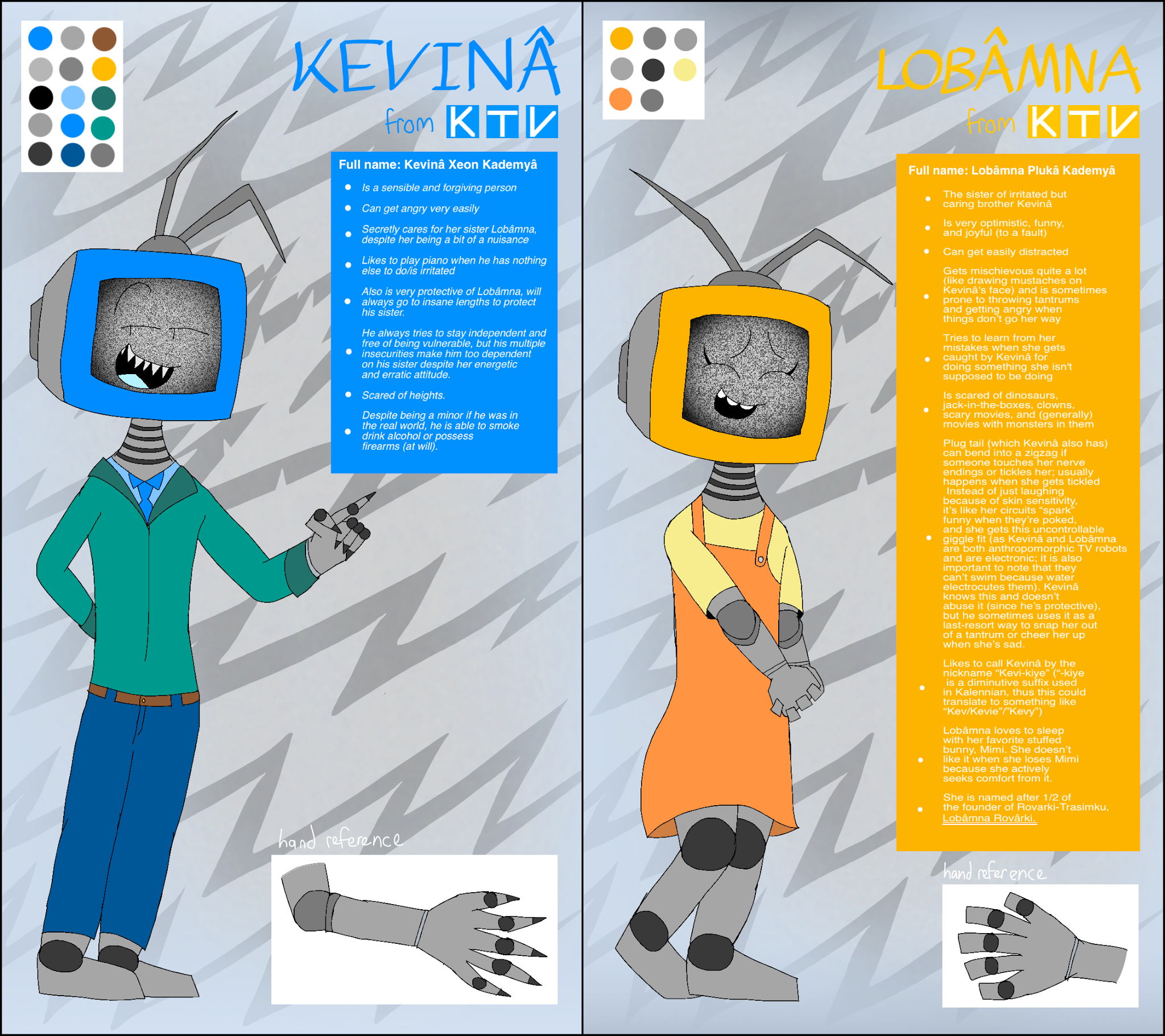
Kevinâ Xeon Kademyâ
- Is a sensible and forgiving person
- Can get angry very easily
- Secretly cares for her sister Lobâmna, despite her being a bit of a nuisance
- Likes to play piano when he has nothing else to do/is irritated
- Also is very protective of Lobâmna, and will always go to insane lengths to protect his sister.
- He always tries to stay independent and free of being vulnerable, but his multiple insecurities make him too dependent on his sister despite her energetic and erratic attitude.
- Scared of heights
- Despite being a minor if he was in the real world, he is able to smoke, drink alcohol or possess firearms (at will).
- His pronouns are they/he
Lobâmna Plukâ Kademyâ
- The sister of irritated but caring brother Kevinâ
- Is very optimistic, funny and joyful (to a fault)
- Can get easily distracted
- Gets mischievous quite a lot (like drawing mustaches on Kevinâ's TV face) and is sometimes prone to throwing tantrums and getting angry
- Tries to learn from her mistakes when she gets caught by Kevinâ for doing something she isn't supposed to be doing
- Is scared of dinosaurs, jack-in-the-boxes, clowns, scary movies, and (generally) movies with monsters in them
- Plug tail (which Kevinâ also has) can bend into a zigzag if someone touches her nerve endings or tickles her; usually happens when she gets tickled. Instead of just laughing because of skin sensitivity, it’s like her circuits “spark” funny when they’re poked, and she gets this uncontrollable giggle fit (as Kevinâ and Lobâmna are both anthropomorphic TV robots and are electronic; it is also important to note that they can’t swim because water electrocutes them). Kevinâ knows this and doesn’t abuse it (since he’s protective), but he sometimes uses it as a last-resort way to snap her out of a tantrum or cheer her up when she’s sad.
- Likes to call Kevinâ by the nickname “Kevi-kiye” (“-kiye” is a diminutive suffix used in Kalennian, thus this could translate to something like “Kev/Kevie”/”Kevy”)
- Lobâmna loves to sleep with her favorite stuffed bunny, Mimi. She doesn’t like it when she loses Mimi because she actively seeks comfort from it.
- Her pronouns are she/her
Trivia:
- Lobâmna is named after ½ of the founders of Rovârki-Trâsimku, the country where KTV was established.
- If you’re still wondering how they would get in water (even if they’ll progressively shutdown), they both have high IP (Ingress Protection) ratings, but their waterproofing only ever depends on the enclosure staying intact.
- The Kademyâ sisters initially (in private) wrote an alternate version of Kevinâ’s personality along with an additional backstory (without the addition of Lobâmna), in which he was much older and had his hardware corrupted by a series of clashing events (though he mostly had faulty unshielded internal electron beams) that resulted in him becoming bloodthirsty and going on a quest to make mankind suffer. This would later be scrapped.
“Esotko Naito” (song)
“Esotko Naito” (English: “Good Night”) is a short song written and performed by Dekubinâ Kademyâ and Sâmvido Gârisi-Bâdekâla for the channel KTV. It is also called the “Shutdown Song” in English, as the song is typically played before the continuity announcer announces closing (for context, KTV shuts down at 12:00 am at midnight, and continues normal broadcasting with the children's block KTV Yalkânni). As it is evident from the title, the song is sung entirely in Kalennian.
”Esotko Naito” was conceptualized by Dekubinâ Kademyâ in August of 2019, with the goal of enhancing the KTV “experience” from viewers across the country. Dekubinâ's sister, Esadâkovâ Kademyâ, who was heavily experienced with music, worked with former bassist and vocalist Sâmvido Gârisi-Bâdekâla to compose the song’s instrumental so that it would be made appropriate for television broadcasts. The vocals were then provided by both Dekubinâ and Sâmvido.
Lyrics
Kalennian (original)
Esotko naito, esotko naito
Kos â yâ kâduhur timpâ gâ kudve
Esotko naito, esotko naito
Âmissaimâs grân â molikhâ
Esotko naito, esotko naito
Vân sevânisutsaimâs gâ vadâb “goodbye”
Esotko naito, esotko naito
Kogvosaimâs grân vadâb rivâlisso yâ âstarprogâmâni
Hyphenation
Esotko naito, esotko naito
Kos â yâ kâduhur timpâ gâ kudve
Esotko naito, esotko naito
Âmis-sa-imâs grân â molikhâ
Esotko naito, esotko naito
Vân sevâ-nisut-sa-imâs gâ va-dâb “goodbye”
Esotko naito, esotko naito
Kogvo-sa-imâs grân va-dâb rivâlis-so yâ âstar-progâmâ-ni
Interlinear gloss
good night, good night
3S.N COP DEF proper time to close
good night, good night
know-PRS-V.1P RELV COP sad
good night, good night
but OBLV-say-PRS-V.1P to ACC-2S “goodbye”
good night, good night
hope-PRS-V.1P RELV ACC-2S enjoy-PST DEF all-program-PL
Rough English translation
Good night, good night
It is the proper time to close
Good night, good night
We know that (it) is sad
Good night, good night
But we are obligated to say to you, “goodbye”
Good night, good night
We hope that you enjoyed all the programs
English (translation)
Good night, good night,
It’s time to close the show.
Good night, good night,
We’re sad to see you go.
Good night, good night,
But we have to say “goodbye.”
Good night, good night,
We hope you liked the programs tonight.
Trivia:
Aside from her spearheading KTV with Dekubinâ, Esadâkovâ has worked with several keyboardists/bassists across the country for a 13-track experimental rock instrumental album titled "Medâlion" (Kalennian for "shield" or "protection") in 1970 that served as a "concept album" that detailed the five stages of grief
The lyrics of ‘Esotko Naito’ have also been repurposed for other contexts other than TV-related media, as the song is also sung by Kalennian speakers when saying goodbye to a loved one/relative, or paying someone (usually a deceased family member) respects during a funeral ceremony.
Kendrikâ and Karlä
(Similar to KTV, here is another sub-category that goes into the 2 mascots of my respective conlangs.)
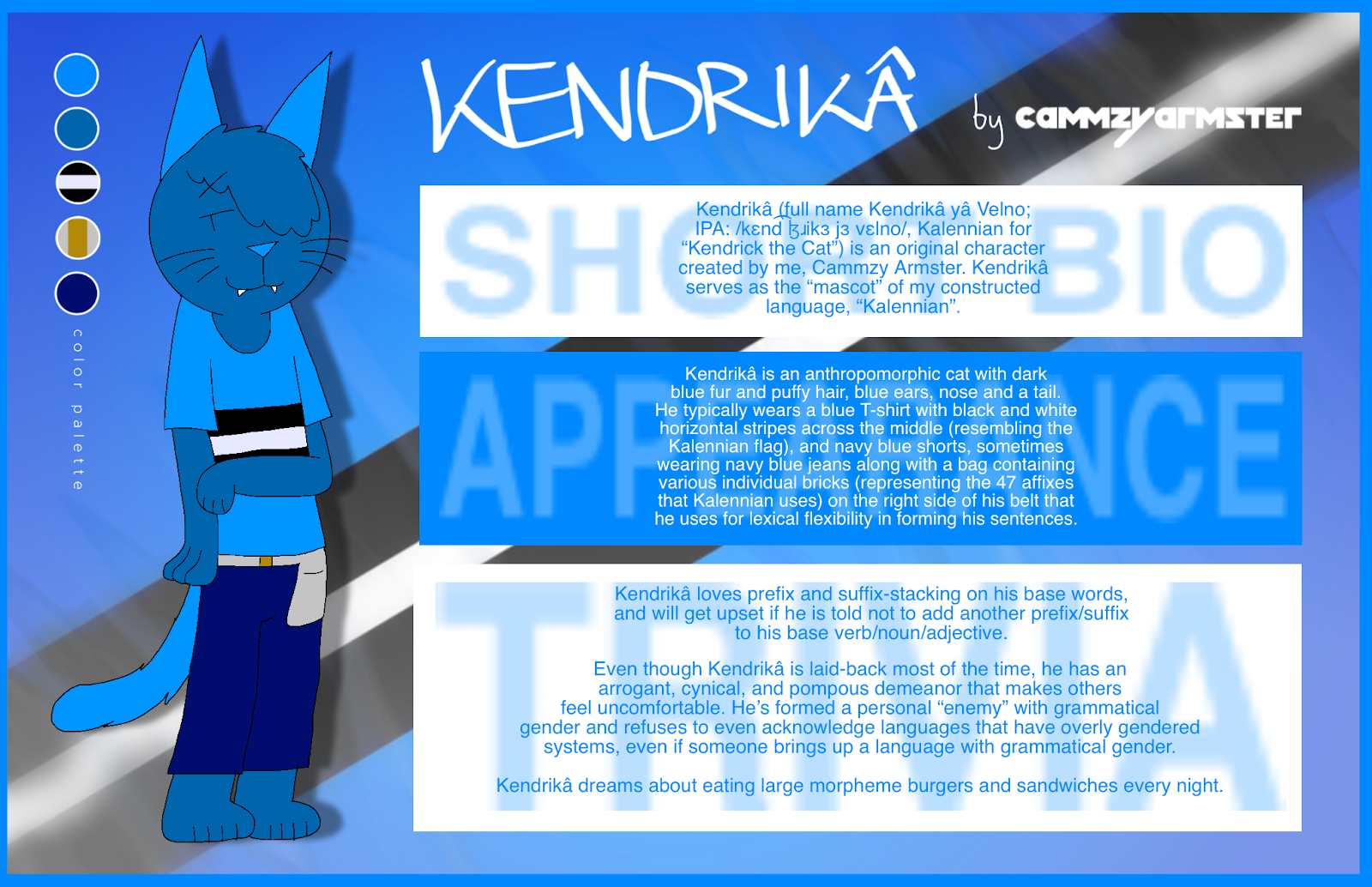
Kendrikâ (full name Kendrikâ yâ Velno; IPA: /kɛnd͡ɮɹikɜ jɜ vɛlno/, Kalennian for “Kendrick the Cat”) is an original character created by me, Cammzy Armster. Kendrikâ serves as the “mascot” of my constructed language Kalennian. Kendrikâ’s pronouns are they/he (Kalennian: ber/meg). His nickname is “Ken”.
Appearance: Kendrikâ is an anthropomorphic cat with dark blue fur and puffy hair, blue ears, nose and a tail. He typically wears a blue T-shirt with black and white horizontal stripes across the middle (resembling the Kalennian flag), and navy-blue shorts, sometimes wearing navy blue jeans along with a bag containing various individual bricks (representing the 47 affixes that Kalennian uses) on the right side of his belt that he uses for lexical flexibility in forming his sentences.
Personality: chill, energetic, bold, brave, smart, confident, bold, enthusiastic, boisterous, arrogant
As Kendrikâ is loosely based on Kalennian, many of the trivia facts here make a few references to its linguistic/morphological features, specifically its grammar and vocabulary.
Trivia:
- Kendrikâ loves prefix and suffix-stacking on his base words, and will get upset if he is told not to add another prefix/suffix to his base verb/noun/adjective.
- As he is a cat, Kendrikâ is 24 in human years (born on April 22, 2023).
- Kendrikâ is 5’4”.
- Kendrikâ is a sloppy alcoholic.
- He’s formed a personal “enemy” with grammatical gender and refuses to even acknowledge languages that have overly gendered systems, even if someone brings up a language with grammatical gender.
- Ken always keeps his base verbs uninflected in declarative sentences (e.g. “Kami kanite kulitâ” is glossed as “My dog bark”, and not “My dog barks”), and if someone criticizes/questions it, he will go on a huge rant. However, he secretly likes to have his verbs agree with the subject/direct object (so “Kami kanite kulitâ” when inflected for grammatical person is now “Kami kanite kulitâ-isâ”. Both sentences are correct), and if someone acknowledges it then he gets embarrassed.
- Kendrikâ also has nightmares of seeing his verbs suddenly having irregular inflections or suddenly having grammatical gender suffixes (or prefixes) that classify his nouns and specify the biological gender of them as well, but always tries to brush them off. A gimmick about him is that he tends to get “grammatical” gender and actual gender mixed up, and he is oblivious to this as a result.
- Kendrikâ is bilingual, which means he is able to speak only two languages; the only languages he knows are his own (“Kalennian”), and English, respectively
- Kendrikâ hates it whenever people question whether his derivational and inflectional affixes are bound or free morphemes, and he says that they are always going to be bound morphemes.
- Kendrikâ is also a skateboarder, and he always keeps his blue lightning-branded skateboard tucked inside his closet. He also makes sure to wear a helmet every time he uses his skateboard
- Ken keeps their lexicon of words and affixes in a stylish pouch, but he is very protective of it
Additional note
Initially, when Kendrikâ was first drawn in 2024, he had the name “Kenâdi”, but then it was changed to “Kendrikâ” in 2025, due to how often it was confused with “Kevinâ”, the name of the official KTV mascot.
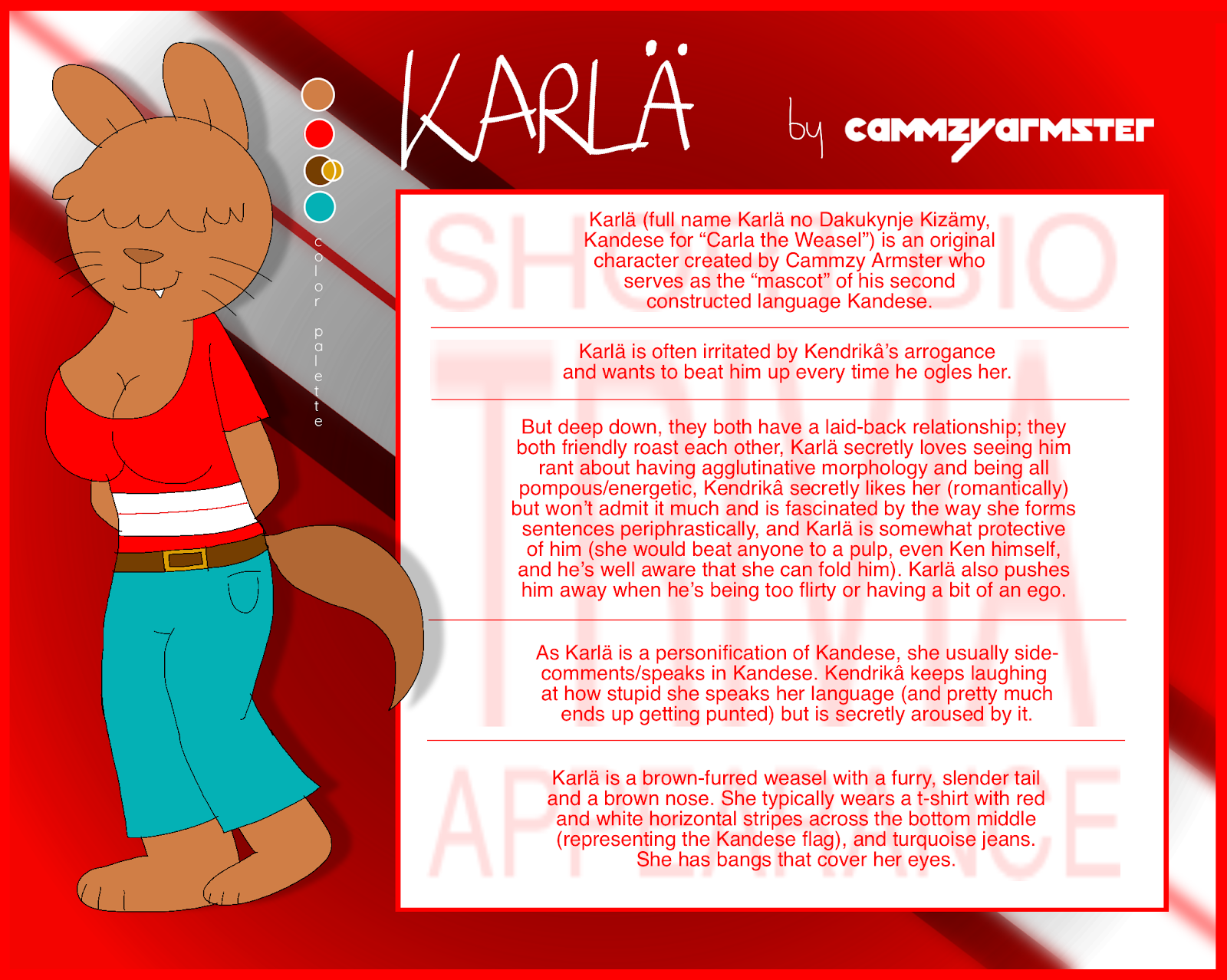
Karlä (full name Karlä ho Dakukynje Kizämy; Kandese for “Carla the Weasel”) is an original character created by Cammzy Armster who serves as the “mascot” of his second constructed language Kandese.
Appearance: Karlä is a brown-furred weasel with a furry, slender tail and a brown nose. She typically wears a t-shirt with red and white horizontal stripes across the bottom middle (representing the Kandese flag), and turquoise jeans. She has bangs that cover her eyes.
Personality: sensible, rational, intelligent, thoughtful, sassy, pugnacious
Trivia:
- Karlä is often irritated by Kendrikâ’s arrogance and wants to beat him up every time he ogles her.
- Karlä is 26 years old in human years, as she is a weasel (born on October 26, 2024); basically a full grown adult in weasel years.
- Karlä is 4’7”.
- As Karlä is a personification of Kandese, she usually side-comments/speaks in Kandese. Kendrikâ keeps laughing at how stupid she speaks her language (and pretty much ends up getting punted) but is secretly aroused by it.
- Deep down, both Kendrikâ and Karlä have a laid-back but one-sided relationship; they both friendly roast each other, Karlä secretly loves seeing him rant about having agglutinative morphology and being all pompous/energetic, Kendrikâ secretly likes her (romantically) but won’t admit it much and is fascinated by the way she forms sentences periphrastically, and Karlä is somewhat protective of him (she would beat anyone to a pulp, even Ken himself). Karlä also pushes him away when he’s being too flirty (like attempting to seduce her by making cat noises, as he himself is a cat) or having a bit of an ego.
- Karlä’s biggest pet peeve with Ken is that he always butchers her name as “Karlâ” (“â” making that very open “uh” sound you see in words like “cup” or “luck”), despite the fact he does it out of affection.
- Karlä’s language has grammatical gender (particle-based system), a thing that Kendrikâ is both obsessed with and is always angry about, because (1) he is fascinated by it and (2) he is offended by it because it doesn't gender everything (even inanimate objects). He also loves that speakers can gender themselves (“mesä mi”, “finä mi”, “äsi mi”), but he abuses it. His hatred of grammatical gender got so ridiculous to the point where he's become more fascinated by it ironically.
Character List
This section summarizes every single character listed in the Camniverse.
MAIN!!!
- Cammzy Armster (in-universe)
- Nebula Armster
- Lucy Davies
- Edgar Davies
- Muffin Bannerman
- Dusty Haykick
- Hank Tinsley
- Dahlia Tinsley
- Lynda O’Brien
- Japoney Appoehead
- Rufus Barkley
- Katya Smirnova
- Tangy Citrina
- Mike Brayburn
- Allegria Brayburn
- Cándida Rodriguez
- Roxxie LaRoux
- Rico Rodriguez
- Hanna Eelmaa
- Aidan Bearington
- Shea Bearington
- Brad Bearington
- Louise Rabbit
- Robert Rabbit
- Rosarie Rabbit
- Jane Hillsman
- Pete Milonakis
- Alessandra van Orman
- Anurak Juangroongruangkit
- Soleil Deschamps
- Pierre Deschamps
- Luuk “Endemol” van der Mol
STANDALONE!!!
- Damien Rhubarb
- Bianca Mouse
- Nelvana Anderson
- Groß Bärnhardt
- Nash O’Saurus
- Jay Stryke
- Gnawbone
- Maganda Angela
- Veronika Tosun
- Chlöe Boucher
- Brianna Skye
- Kadlish Sampaguita
- Sasha Blackwood
Trivia
Definition of the “timeline” the Camniverse takes place in
The Camniverse is… actually set in a floating timeline where some people age a few years older or have no ambiguous ages or age like animals (e.g. Japoney; he was born on March 11, 1998, but he’s 30 years old in the present day universe; or like Groß; his age is ambiguous because it's completely irrelevant to his actual personality), and other temporal anomalies, just because. if we were to completely ignore that the Camniverse is just set in a current day version of 2024 (which was when i first created Tangy and Mike). but, again, it's just a floating timeline underneath all that fluff, so i'm not gonna bother with the implications of that either way… it's crazy because underneath all that nonchalance i just wanted to make a simultaneously down-to-earth and chaotic surrealistic dramedy that felt so uniquely me, and destroyed any chance of me scrapping this! ever since i even touched a piece of paper at 7
The actual “plot”...
Initially, when I fully came back to digital art in 2024, I was gonna make the first character I drew in September the protagonist of the messy story surrounding the universe, but when I later made the reference sheet for my self-titled author avatar, I thought of making him the main person in the spotlight—the story isn’t about the characters or my language, it’s about Cammzy himself and his trials and tribulations of being an artist, trying to push the envelope, and seeing the entire world in the best version of himself. Cammzy and all of his friends live in a four story apartment building located in Albany, Georgia, which is often subject to damage and occasional chaos.