
Learning Support and
Special Educational Needs & Disabilities (SEND) Policy
(including SEND Information Report)
Title of Policy Learning Support and Special Educational Needs & Disabilities (SEND) Policy (Including SEND Information Report)
Applies to Whole School
Endorsed by Head Master
Responsibility Deputy Head (Academic) and Heads of Learning Support
Date reviewed Michaelmas 2025
Next review Michaelmas 2026
Learning Support and SEND (Special Educational Needs & Disabilities) Policy (Including SEND Information Report) |

CONTENTS PAGE
1. Guiding Principles | page 2 |
2. Definition of Learning Support and SEND | page 2 |
3. Objectives for our pupils receiving Learning Support | page 3 |
4. Objectives for SEND pupils | page 3 |
5. Responsibilities of the SENDCO | page 4 |
6. Admissions relating to pupils with Additional Needs or SEND | page 5 |
7. Accessibility | page 6 |
8. Identification of Pupils in need of Learning Support and The Graduated Approach | page 6 |
9. Provision | page 7 |
10. Charges | page 9 |
11. EHC Plans | page 9 |
12. Monitoring pupil progress | page 10 |
13. Communication | page 10 |
14. Complaints | page 12 |
15. Glossary of terms | page 12 |
16. Appendices | page 13 |
GUIDING PRINCIPLES
The ethos of Wells Cathedral School is to nurture and stimulate every child and to provide a secure educational atmosphere, within a setting that is musically alive. We aim to create a supportive, non-stigmatised and inclusive educational environment that promotes learning and development for all of our children irrespective of their starting point. We believe that every pupil in our school should have an equal opportunity to enjoy their education and make the best possible progress. We have high but appropriate expectations of our pupils; embedding our philosophy of ‘Esto Quod Es’ (‘Be What You Are’) into our practice, and valuing all children for their individual strengths.
Wells Cathedral School will be guided by the following in formulating and executing the school’s Learning Support and SEND policy:
- The Special Educational Needs and Disabilities Code of Practice 2015
- The Children and Families Act 2014
- Statutory Guidance on Supporting Pupils with Medical Conditions
- The DFE Teachers’ Standards 2012 (with particular reference to Standard 5)
- The Equalities Act 2010
We also take into account guidance from the Independent Schools Bursars’ Association where it is stated that independent schools have a duty to make reasonable adjustments to policies, criteria and practices to address potential issues of discrimination, noting that from September 2012 the Act introduced a new duty with respect to reasonable adjustments :
‘where a disabled person would, but for the provision of an auxiliary aid, be put at a substantial disadvantage in relation to a relevant matter in comparison with persons who are not disabled, to take such steps as it is reasonable to have to take to provide the auxiliary aid’.
DEFINITIONS OF ‘Special Educational Need or Disability’ and ‘Learning Support’.
The definition of Special Educational Needs is contained in the SEN Code of Practice 2015 (Introduction XIII/XIV):
“A child or young person has special educational needs if he or she has a learning difficulty or a disability which calls for special educational provision to be made for him or her.”
A learning difficulty or learning disability is defined as having:
- significantly greater difficulty in learning than the majority of others of the same age or
- a disability which prevents or hinders him or her from making use of facilities of a kind generally provided for others of the same age… (Section 20 (2) of the act.
A child or young person has a disability if :
- [he or she] has a physical or mental impairment
- the impairment has a long-term and substantial adverse effect on [his or her] ability to carry out normal day to day activities.
(This definition includes sensory impairments and long term health conditions such as asthma, diabetes, epilepsy and cancer.)
Special Educational Provision, referred to in the 2015 Code of Practice as ‘SEN support’ means:
“education or training provision that is additional to, or different from that made generally for others of the same age.”
At Wells Cathedral School we believe in giving additional support to all those identified as having barriers to their learning, and so we identify and address these barriers at levels below that formally categorised under the act as Special Educational Need, when possible. These pupils with additional needs are referred to as receiving ‘Learning Support’.
OBJECTIVES
The objectives of the Learning Support department are:
- To support children to be happy with who they are, emphasising strengths and multiple intelligences.
- To identify pupils requiring learning support as early as possible in their school career.
- To make relevant information available to staff in support of their curriculum planning regarding pupils’ learning differences and difficulties.
- Supporting staff to deliver Adaptive Teaching and reasonable adjustments.
- To encourage an effective parent partnership with those whose children receive learning support, in order to implement a joint learning approach at home and school.
- To implement the Assess-Plan-Do-Review cycle consistently.
- To promote a whole school, and where possible, consistent, approach to learning support and SEND across our setting, from our Little Wellies nursery, to Sixth Form.
- The department aims to support all staff in adapting their teaching (Quality First Teaching) rather than just implementing interventions.
The additional department objectives for pupils with identified SEND are:
- To utilise a robust "Assess, Plan, Do, Review" cycle to identify pupils with SEND at the earliest possible stage, ensuring swift implementation of the Graduated Response.
- To establish immediate and clear dialogue with parents/carers and pupils when a special educational provision is first considered.
- To ensure all SEND pupils have access to a broad, balanced, and ambitious curriculum through high-quality adaptive teaching, allowing them to participate fully in all aspects of school life.
- To proactively identify and remove barriers to learning and participation, ensuring "reasonable adjustments" are a standard feature of every classroom.
- : To set specific, measurable, and highly ambitious outcomes for every SEND pupil, focusing on both academic attainment and personal development.
- To rigorously monitor and review progress toward these outcomes at least termly, ensuring interventions are high-impact and provision remains dynamic.
- To place the pupil at the heart of decision-making, ensuring their voice, interests, and aspirations directly shape their provision and future pathways (Preparation for Adulthood).
- To work in active partnership with parents/carers, ensuring they are equal contributors to their child’s educational journey and are regularly updated on progress.
- To foster a school-wide culture of neuro-diversity celebration and zero tolerance for discrimination, where SEND is seen as a collective responsibility rather than a separate department issue.
- To empower the Governing Body with the data and insights necessary to provide robust challenge and support regarding the school’s SEND provision and statutory duties.
- To lead effective collaboration with external professionals, health services, and local authorities to ensure a holistic support package for pupils with complex needs.
RESPONSIBILITIES OF THE SENDCO
The SEND Code of Practice (2015) states that the SENDCO has an important role to play with the headteacher and governing body, in determining the strategic development of SEN policy and provision in the school.
Although we acknowledge that the roles of the SENDCO will differ across key stages, we feel that consistency of approach and good communication between Early Years, the Pre-Prep, Prep School and the Senior School is key to ensuring the best possible outcomes for our pupils.
ADMISSIONS RELATING TO CHILDREN WITH SEND
Special Educational Needs and Disabilities include students with additional needs in the following areas:
1. Communication and interaction
2. Cognition and learning
3. Social, emotional and mental health
4. Sensory and/or physical needs
Wells Cathedral School welcomes all children who can make the most of the wealth of opportunities the school offers within a caring and supportive environment. Wells Cathedral School aims to promote and provide an inclusive environment for all students. We will always make and work towards reasonable adjustments to comply with our legal and moral responsibilities under the Equality Act 2010 in order to accommodate the needs of applicants who have neurodivergence and SEND as defined by the Equality Act 2010, including those with an Education, Health and Care Plan (EHCP), for which the School can provide the environment and expertise necessary for the young person to thrive."
The School will require information of SEND (e.g. SpLD, ASD. mental health etc) which may affect a child’s ability to participate in the admissions procedure and take full advantage of the education provided at the School, so that the School can assess those needs and consult with parents about the adjustments which can reasonably be made to ensure that the application procedure is accessible for the candidate and that the School can cater adequately for the pupil should the offer of a place be made. Parents of a child who has any SEND should provide the School with full written details at registration, or subsequently before accepting the offer of a place.
The School needs this information so that, in the case of any child with particular needs, the School can assess those needs and consult with parents about the adjustments which can reasonably be made to cater adequately for the child's needs both during the admission process and once they start at the school if an offer of a place is made. Similarly, if learning difficulties/disabilities, special educational needs or another disability become apparent after admission, the School will consult with parents about reasonable adjustments that may allow the child to continue at the School. Both for the purpose of admission and for any SEND established after a young person joins the school, the school will clearly outline the support provision and recommendations based on the SEND information and consultation process.
ACCESSIBILITY
Our school is set across a historic campus with several listed, multi-story buildings. While these architectural features present unique accessibility challenges—such as stairs and a lack of lifts—we are committed to ensuring all pupils thrive. Our Reasonable Adjustments Committee regularly reviews our facilities to improve physical access. Where structural or financial constraints prevent permanent changes, we implement proactive solutions, including strategic timetabling and personalised support plans, to ensure every pupil can access their education fully.
IDENTIFICATION OF PUPILS IN NEED OF LEARNING SUPPORT: THE GRADUATED APPROACH TO IDENTIFICATION OF, AND PROVISION FOR, ‘SEND’
We recognise that SEND can be identified at any stage of a child’s development; while some needs are apparent early on, others emerge only as academic and social demands increase. Our staff are trained to be proactive in identifying and responding to these emerging difficulties swiftly, valuing the unique insight of parents—who know their children best—and committing to a collaborative approach that listens to the concerns of both families and the pupils themselves. To ensure every child thrives, we monitor progress and well-being through regular summative and formative assessments against age-related expectations, while maintaining a holistic observation of physical, social, emotional, and behavioural needs that may exist even when academic attainment remains high. When concerns are identified by staff, parents, or external agencies, a formal Record of Concern (RoC- Appendix 4) is submitted to the SENDCO, triggering a formal review to determine the appropriate support and next steps. This process aligns with the Graduated Response model, a continuous cycle of identification and support designed to adapt to a pupil's changing needs over time.
Once a Record of Concern is raised, the findings are discussed with the SENDCO to determine the most effective path forward. The initial response prioritises High-Quality Teaching (Wave 1), specifically targeted at the pupil’s areas of weakness; however, where progress remains a concern, the SENDCO will initiate further formal steps. While gathering evidence and consulting with both the pupil and their parents, the school implements targeted measures such as enhanced adaptations for classwork and homework, additional in-class assistance, or small-group support. If necessary, we seek parental consent for diagnostic screening to identify specific learning difficulties or disabilities. This specialised assessment may be conducted by the SENDCO, our specialist teachers, or external professionals, including educational psychologists, speech and language therapists, or occupational therapists. Following this screening, the child's profile of strengths and weaknesses is reviewed collaboratively with the parents and staff to agree on an appropriate support plan, clear targets, and a scheduled date for review.
Identification of SEND in children with English as an Additional Language
Wells Cathedral School’s specialist Music and Mathematics programmes attract a significant number of pupils with English as an additional language. Particular care will be taken in these instances to look at all aspects of the pupil’s performance in different areas of learning and development, to establish whether the lack of progress is due to limitations in their command of English or if it arises from a special educational need or disability. There is close liaison with the Head of the EAL department in the senior school.
PROVISION
In our assessment, teaching and monitoring of children who experience barriers to their learning we are guided by the Code of Practice for Special Educational Needs and Disability 2015. The school therefore follows the recommended ‘graduated approach’ - a response system of Assess - Plan - Do - Review in order to best support our pupils. (See Appendix 1 - A Graduated Approach)
For pupils assessed as having SEND, Personal Learning Plans/ Play Plans and the targets set within them will be regularly reviewed by the SENDCO in consultation with staff, and, wherever possible, the parents and the pupil.
Our support covers the four broad categories of need defined by the Code of Practice: Communication and Interaction, Cognition and Learning, Social, Emotional and Mental Health, and Sensory and/or Physical. While the Learning Support Department provides specialised expertise, we embrace the principle that the education of pupils with SEND is a whole-school responsibility. We are committed to the ethos that "every teacher is a teacher of SEND," providing our staff with continuous professional development to ensure they can proactively anticipate individual needs and dismantle barriers to learning within every classroom.
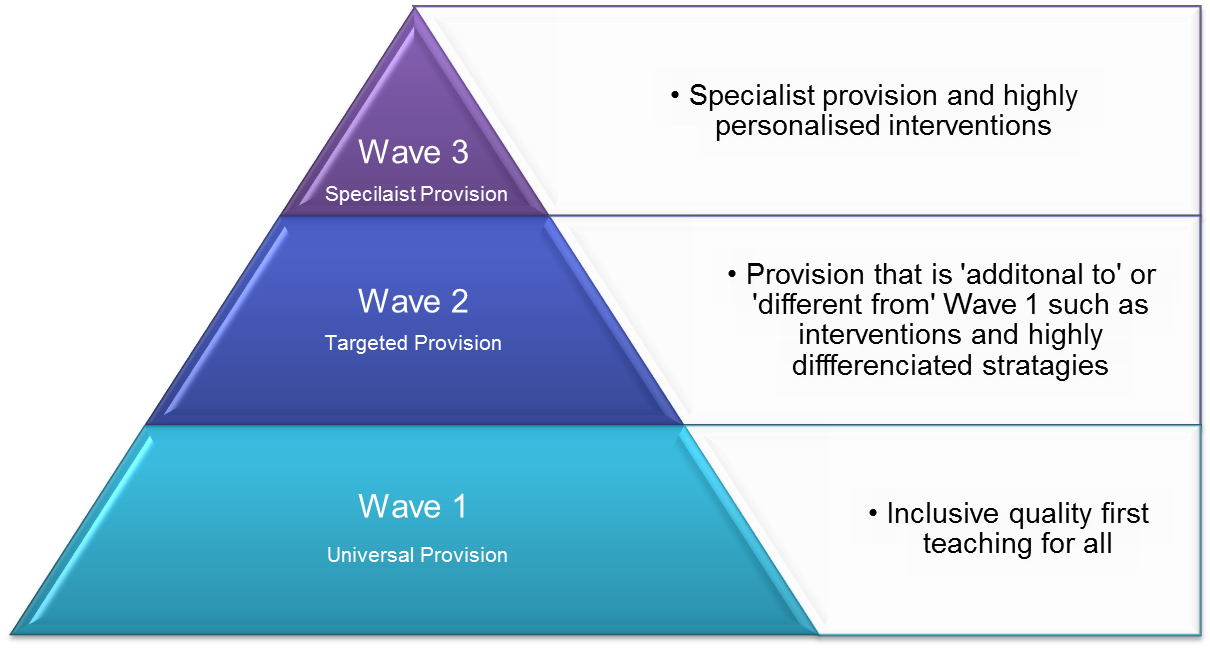
Prior to Wave 1 - ROC form completed by any member of staff and communicated to SENDCO.
Wave 1 Provision
- SEND pupil information on iSAMS (for KS1 onwards) and SEND and Learning Support Register
- Folder of useful documents on Google Drive
- INSET
- Exam Access Arrangements
- Quality First Teaching.
Wave 2 Provision
- Support as for Wave 1
- Short term group support - Maths, spelling, reading, comprehension, study skills
- Drop in support
- Short term support one to one support
- Parents may choose to fund 1:1 specialist tuition
- One Page Profiles - EYFS and KS1/2
- ELSA support (6 week intervention in PrePrep/Prep School).
- One Page Profiles - EYFS and KS1/2
- Personal Learning Plans (previously called IEPs) / Personal Play Plan (EYFS)
Wave 3 Provision
- Support as for Wave 1 and 2
- 1:1 specialist tuition funded by the school (KS1/2)
- Long term group support
- Teaching Assistant (TA)
- Personalised programme of differentiated support
- Support and advice from outside agencies e.g. Educational Psychologists, CAMHS, specialist teachers.
CHARGES FOR SEN PROVISION
During academic year 2022-23 a review of the way charges are to be applied and the core offer of support was carried out by the Governing Body in consultation with stakeholders. The following document Reasonable Adjustments for pupils with Special Educational Needs at Wells Cathedral School, Senior School highlights what provision is considered to be part of the core offer from the school and where charges are necessary.
Statutory Assessment and Education, Health and Care Plans (EHCP)
For a small number of children and young people with significant and complex special educational needs, a Statutory Assessment may be required to determine whether an Education, Health and Care Plan (EHCP) is necessary. This legal document—which can support individuals from birth to age 25—outlines a child’s specific education, health, and social care needs, alongside the provision required to meet them.
The assessment is a collaborative, 20-week process that places the child and their family at the heart of decision-making. During this period, evidence is gathered from a range of professionals, including educational staff, health practitioners, and social care providers. An EHCP may be requested by the school or via a parental request directly to the Local Authority.
Each plan focuses on aspirational outcomes—long-term goals agreed upon by the family, the young person, and the professionals supporting them. To ensure the plan remains relevant as the child develops, it is subject to a mandatory Annual Review. During this review, the Local Authority, school, and parents evaluate progress against outcomes and amend the provision as necessary to ensure it continues to meet the pupil’s needs until they complete their education or training.
MONITORING PUPIL PROGRESS
Evaluating Progress and Success
Measuring the progress of pupils with SEND requires a nuanced approach. While we track literacy and numeracy carefully, we recognise that for some pupils, traditional academic data can move slowly. Therefore, in addition to SMART (Specific, Measurable, Achievable, Realistic, Timely) targets, we place heavy emphasis on broader Desired Outcomes. Factors such as motivation, self-esteem, and confidence are vital indicators of a pupil’s success and are weighed alongside academic data.
We define adequate progress as that which:
- Narrowing the attainment gap between a pupil and their peers.
- Prevents the gap from widening further.
- Matches the progress of peers starting from the same baseline.
- Equals or accelerates the pupil’s previous rate of progress.
- Ensures full access to the curriculum.
- Demonstrates measurable improvement in social, personal, or self-help skills.
- Results in a positive shift in the pupil’s behaviour and engagement.
- Prepares the pupil effectively for future education, training, or employment.
Transitioning from SEN Support
When a pupil makes significant and sustained progress, the class teacher and SENDCO may determine that formal SEN support is no longer required. In such cases, the pupil will move to a monitoring phase.
During this transition:
- The pupil may continue to receive Wave 2 targeted support and high-quality in-class differentiation to ensure stability.
- The teacher, supported by the SENDCO, will set maintenance targets to ensure progress does not stall.
- We will always inform parents and carers, taking their views into account, before any formal change in support status is finalised.
COMMUNICATION WITHIN AND BEYOND OUR SCHOOL
Communication with staff
Communication with all staff is considered important and is in a range of different forms:
- Information made available to staff on iSAMS and the Senior School SEND Register spreadsheet.
- Advice provided on specific pupils and or specific learning difficulties, both formally and informally.
- Personal Learning Plans/Play Plans are shared with relevant teachers, with contributions from staff expected.
- Gathering of information for examination access arrangements.
- Ongoing discussions throughout the year regarding concerns and needs of pupils.
- Members of staff are encouraged to approach the relevant SENDCO with any concerns or issues relating to pupils already on the list or other pupils in relation to learning difficulties. These concerns should also be logged formally by filling in a RoC (Record of Concern) form, in order to provide a written record of when concern was raised.
Partnership with parents
Wells Cathedral School firmly believes in developing a strong partnership with parents and that this will enable children and young people with additional learning needs or SEND to achieve their potential. The school recognises that parents have a unique overview of the child’s needs and how best to support them, and that this gives them a key role in the partnership. Examples of our parent partnership include: parent consultations, informal meetings responding to staff or parent concern, initial meetings when additional needs are suspected, feedback comments from PLPs incorporated into future plans, meetings to support transition to a new Key Stage/school (see below), email correspondence offering advice and support from SENDCOs and teachers. When meetings are held between parents/carers and the SENDCO a record of the discussion is made and actions listed and reviewed. (See Appendix 4 for an example of such a form: Record of Meeting with Parent/Carer).
Transition between phases of education
It is the responsibility of the SENCos, in collaboration with other staff, to make arrangements for supporting children and young people with SEND in moving between phases of education at Wells Cathedral School or on to new schools. In addition to the usual arrangements to support pupils’ transition, SENCos will:
- meet regularly to share information on pupils and hand over documentation
- meet with parents in the terms leading up to a transition from one key stage to another to discuss concerns and arrange provision, and, if necessary, after transition to review the process.
- meet with Heads of Year and/or Director of Studies to share information on particular pupils
- meet with relevant personnel to plan and facilitate changes to the fabric of the building for pupils with physical disabilities
- work with teachers and parents to put in place personalised programmes of familiarisation, buddy systems etc for the period before and after transition
Links with other agencies, organisations and support services
The school recognises the important contribution that external support services make in assisting to identify, assess, and provide for SEND pupils. When it is considered necessary, colleagues from support services will be involved with SEND pupils. Examples of such links are listed below:
- Educational psychologists.
- Medical officers.
- Occupational Therapists
- NHS Literacy Difficulties’ Clinics
- Hearing Impairment Services.
- Speech and Language Services.
- Child and Adolescent Mental Health Services.
- Local Education Authorities.
Pupil participation
The SEND Code of Practice (2015) states the importance of involving pupils in planning and reviewing progress. Wells Cathedral School respects this, and the views of the children in the school are given due weight according to their age, maturity and capability. Pupils participate, where possible, in the decision making processes, including setting and reviewing of targets.
Communication with Governors
The Academic Committee formally reviews the work of the SEND Department once a year (usually in Lent Term). The SEND register and other SEND-related matters are discussed with the Governor responsible for SEND at least annually.
COMPLAINTS’ PROCEDURE
If parents have a complaint related to provision for their child’s additional or special educational needs and disabilities this should be directed in the first instance to the member of staff concerned, their child’s form tutor or the SENDCO. We are always keen to discuss issues of concern and seek a satisfactory resolution face to face, where possible. If there continues to be a cause for complaint, parents should address their concerns through the school’s official complaints policy which can be found on the school website or through the school office.
RELATED POLICIES
- Admissions policy
- Anti-Bullying policy
- Complaints policy
- EAL policy
- Accessibility plan
GLOSSARY
Acronym | Term | Definition |
AN | Additional Needs | Needs that create a barrier to learning but do not currently meet the threshold for a formal SEND classification. |
EHC Plan | Education, Health and Care Plan | A legal document for children with significant, complex needs, covering ages 0–25. |
LSA | Learning Support Assistant | A staff member specifically trained to support pupils with SEND (distinct from a general Teaching Assistant). |
PLP / PPP | Personal Learning / Play Plan | A bespoke document outlining a pupil's specific targets, strategies, and desired outcomes. |
SEMH | Social, Emotional and Mental Health | The current term replaces 'BESD' to better reflect the underlying causes of behavioural difficulties. |
SEND | Special Educational Needs and Disabilities | The broad term for pupils requiring provision that is additional to or different from that made generally for others. |
SENDCO | SEND Co-ordinator | The teacher who is responsible for overseeing the school’s SEND policy and coordinating provision. |
SEND Support | SEND Support | The graduated response framework (replacing 'School Action' and 'School Action Plus'). |
APPENDICES
Appendix 1.
The Graduated Approach
ASSESS | Before a pupil is formally identified as requiring SEND Support, the SENDCO and teaching staff conduct a rigorous analysis of the pupil's needs. This process draws upon formal teacher assessments, internal data tracking, and the day-to-day experience of the staff working directly with the child to ensure a clear and accurate profile is established. |
PLAN | We believe in "no surprises" for our families; parents are always notified when it is decided that a pupil requires targeted individual or small-group support. This is formalised through Personal Learning Plans (PLPs) or Play Plans, which clearly outline:
|
DO | The class or subject teacher remains centrally responsible for the pupil’s daily learning and progress. Even when interventions involve 1:1 or small-group teaching away from the main classroom, the teacher retains oversight. They work in close partnership with Learning Support Assistants (LSAs) or specialist staff to ensure that skills learned in intervention sessions are successfully transferred back into the broader curriculum. |
REVIEW | Despite evidence-based interventions, we will aim to seek further advice from internal specialists or external professionals with the permission and funding of the parents (e.g., Educational Psychologists). We will review the current "Wave" of provision. Support may be reduced to encourage independence, though the pupil’s progress will continue to be closely monitored. Personal Learning or Play Plans are formally reviewed and re-issued twice yearly, ensuring they remain live, relevant documents. |
Appendix 2
Pupil Screening Map
Summative Assessment Nursery to Year 6. | ||
Writing should be assessed at the following points:
Each piece of assessed writing is kept within the English book and a copy of the grid is glued next to the piece of writing. One grid per child should be used by the teacher and added to at each assessment point. Teachers should highlight on the grids with a different colour, of their choosing, so that termly progress can be clearly seen. Results from any assessments are then shared and discussed with all teaching staff in order to identify underperforming pupils or pupils who may require SEND or AG&T provision. Continuous review and development of provision for pupils with additional needs (including pupils on the SEND register and AG&T pupils) can also be made based on these results (alongside formative teacher assessment). | ||
Year | Screening tool | Skills screened |
7 | AAB, DASH | Spelling, Writing Speed |
9 | Dictation and Recall school screener SDMT AAB | Recall and memory, handwriting to dictation, speed of processing, auditory processing, interpretation and comprehension, spelling. |
10 | (Yellis) | (Vocabulary, Maths, non verbal) |
12 | (ALIS) | (Predict exam outcomes by subject) |
Appendix 3
Record of Meeting with Parents/Carers of ………………………………...
Date: | Reason for Meeting: |
Points to be raised by teacher/SENDCO: | |
Details of discussion, points raised by parents/carers and (if present) pupil: | |
Action and Timescale decided upon: | |
Date set for next meeting/review: |
Appendix 4

SEND RoC Form
Record of Concern
Name of Child: | Year Group: Date of Birth: |
Date concern registered: | Concern raised by: |
Is the child already on the SEND register (Wave 3)? | If not, is the child at Wave 1 or 2?
|
Nature of concern: (To be completed by the individual registering concern) (Consider: what barriers to learning is the child experiencing? Are the barriers primarily academic, social, emotional? When do they manifest themselves particularly? If he/she is already receiving support is it sufficient/correctly targeted? Have new differences or difficulties emerged?) | |
Action Requested: ( Consider: discussion with Head of Learning Support, discussion with colleagues, meeting with parents, request for observation of child in class, informal diagnostic assessment etc) | |
Part B: To be completed by the SENDCO Action to be taken: (Consider: increased differentiation within class, adjustments to learning environment, staff information sharing and discussion, meeting with parents, diagnostic informal assessment, formal internal assessment, referral to external agencies,) | |
Individuals to be involved: | |
Date set for review: |
Appendix 5
List of Current Staff in the Early Years, Prep and Senior SEND departments
Little Wellies | Nicola Lynham- Little Wellies SENDCO |
PrePrep | Chloe Burton- Learning Support Assistant (Maternity Leave) Lucy Bailes - Learning Support Assistant Lucy Goddard - Learning Support Assistant Natasha Meehan -Learning Support Assistant |
Prep School (PS) | Rebecca Bridgford-Whittick - Head of SEND (PS), specialist teacher and assessor. Trudie Dowell- Learning Support Assistant Tia Osborne - Learning Support Assistant Nicki Pickman - Learning Support Assistant Holly Wilson-higher Level Teaching Assistant (HLTA) Natasha Lichter - Learning Support Assistant |
Senior School | Kate Brown - Specialist teacher and assessor James Grant- Teaching Assistant Lauren James - Specialist teacher and assessor, lead for Sixth Form pupils Heidi Martini-Smith- Specialist teacher, lead for pupils with ASD Bettina Paton-Freeman - Teaching Assistant Caroline Peters- Teaching Assistant Elsbeth Ralls- Teaching Assistant Karen Simmonite- Teaching Assistant Eva Skinner- Teaching Assistant Lee Tilley- Teaching Assistant Rosie Watch- Teacher and Interim Head of Learning Support Pamela Wilson - Teaching Assistant Rebecca Murdoch- Study Skills teacher Rebecca Gilbert- Study Skills teacher |